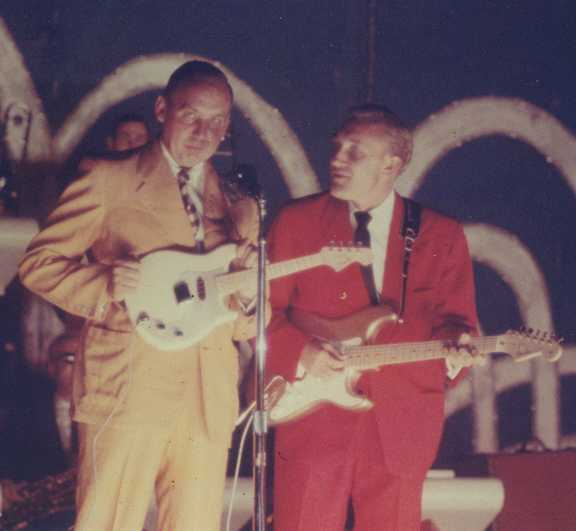
Henry D. Haynes aka Homer (of Homer and Jethro) was one of THE best rhythm guitarists ever. At least that is what Chet Atkins had to say about him. Chet should know, because he frequently called him as a session player.
Haynes started his career at age 16 when he and Kenneth (Jethro) Burns won an audition on Knoxville radio station, WNOX. At the time, the host could not remember their names, so he christened them
Homer and Jethro.
The duo played live on the great Country Music shows of the mid 1930’s, such as the
Renfro Valley Barn Dance, the
Midwestern Hayride, the Ozark Jubilee, and the National Barn Dance. These all not only had a live audience, but were broadcast on the radio. So millions of listeners became aware of the comedy duo. The guys hit it big when they discovered their niche of doing parodies of popular songs. And though Homer and Jethro were funny, both were
serious musicians.
Haynes played guitar in a style known as
comping (accompianing), which was popular with most big band guitarists of the era. Instead of playing a single chord, the player would play variations of the chord or related chords, which made the song more interesting and made great use of the guitar as a rhythm instrument. One of the few guys that has mastered this technique is Doug Green aka
Ranger Doug of Riders in the Sky and the
Time Jumpers.
Homer Haynes favored a beautiful red-burst
Gibson L-5C throughout his career. He occasionally was seen with a natural finish and a sunburst L-5C.
Early in Haynes career, he played an
Epiphone Triumph. He can be seen in videos with a Gibson J-200. The main instrument was always the L-5C.
 |
| Homer with #001 |
In the mid 1950’s, Leo Fender bestowed Haynes with a
Stratocaster that bore the registration 001. The instruments body was painted gold. The pickups were white. The knobs were white and the scratchplate was tinted gold and all the hardware was gold plated. It was a beautiful instrument. But you never saw Homer playing it. Perhaps he realized its value and left it at home under the bed.
In 1988, Fender made a decision to reissue a
Homer Haynes Limited Edition Stratocaster that was limited to 500 units (Though some authorities say 200 units.)
This was an exact replica of the original intrument that utilized the same machine bent bridge saddles and five spring tremolo. The neck was maple. The pickguard was attached to the body by eight wood screws. The pickup switch was the older 3-position model that is found on all 1956 Strats.
The
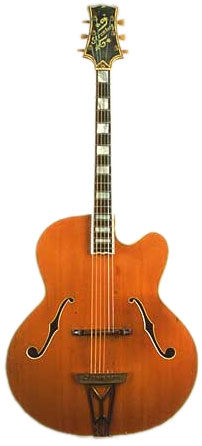
Gibson L-5C is the cutaway model of the L-5. This beautiful instrument was carved by Gibson's craftsmen out of solid spruce. The
body is 17” wide at the lower bout. The
bound neck is fitted with an ebony fretboard, with pearloid, block inlays. The neck and binding features a point at the distal end of the neck. The
headstock is bound and capped in black maple with a flower-pot inlay.
The binding around the body features six plies, while the binding on the neck and headstock are made of two plies.
Homers guitar came with a beautiful, black,
bound, celluloid pickguard. The adjustable, movable bridge is made of rosewood and the deluxe tailpiece is gold plated. The tuning pegs are also gold plated. The neck has a 25.4” scale. It is a beautiful instrument and the very guitar that
John D’Angelico and
Elmer Stromberg looked at as a model for their instruments.
Homer and Jethro’s humor may seem a little dated by todays standards, but it was always good clean fun. Both men’s instrumental musical ability was overshadowed by their fame as comedians.






5 comments:
Hey great post about a fantastic guitar player. Homer really had great taste in guitars. Just thought I'd point out that the Epiphone in the picture is an Emperor, not a Triumph. Also the guitar in the last video is a Super 400.
Great post! One of the first songs that I remember ever making an impression on me was Homer and Jethro's hilarious "Cigareetes Whusky 'n Wild Women"---and I must have been about 7! They're not appreciated enough today (Homer and Jethro, that is!).
H and J were twelve when they auditioned and were hired at WNOX.
The guitar Homer recorded with during the 40s and early 50s was a blonde Epiphone Emperor. Later he had a Stromberg, and after that a variety of Gibsons and the Fender.
Ranger Doug would be the 1st to say that he does not play rhythm the same way that Homer did. Ranger plays more in the Freddie Green one or two-note style, while Homer invented his own brilliant way of sustaining modern chords while keeping a swinging pulse going. No one has replicated Homer's style. It fit Jethro's mandolin style like the right jigsaw puzzle piece.
Homer was one of a kind. JTP
Yep, Homer was indeed one of a kind.
Leo gave Eldon Shamblin a strat as well. Seems like that's what Eldon played from that day forward. I suspect Homer didn't play his as it didn't suit him, not because he "realized it's value". Always archtops.....
Post a Comment