Sunday, March 9, 2014

Pete Seeger - America's Tuning Fork

The man that poet Carl Sandberg called America's Tuning Fork, Pete Seeger was born in 1919 to a family of devoted Christian Calvinists. His father was a musician and in 1912 he established the music department at UCLA Berkley. 

A year later he established the schools first musicology department. Unfortunately Charles Seeger was fired from his teaching position in 1918 for being an outspoken pacifist. The World was at war during this era. 
The next year Pete was born and his family had moved back to a town just east of New York City. When Pete was 18 months old, his family built a trailer and journeyed throughout the southern United States. Their mission was to bring music to the hardworking people of the South.
I mention all these facts because Pete Seeger followed this same pathway throughout his life. 
Seeger was a traveling musician, songwriter, activist and environmentalist. He traveled the world with his banjo and guitar. He advocated peace and human rights. He was concerned about pollution and was active in cleaning up the Hudson Bay near his home.  

Wherever he went a concert may erupt. It may have taken place in a classroom, a park or on the banks of the Hudson. 

Seeger was well known to put on impromptu concerts when he was in the midst of a crowd. He was not worried about risers and sound systems. 

His job was to bring the joy ofmusic and his message to the world.
Pete Seeger was one of the songwriters of Where Have All the Flowers Gone and If I Had a Hammer and the sole writer of Turn, Turn, Turn.
Pete also turned to songs of other writers and he made hits of their songs. 


Good Night Irene was written by Lead Belly and Pete made it a classic. Pete recorded Solomon Linda’s The Lion Sleepstonight/ Wimoweh long before the Tokens made it into a number one record. 


Seeger made some time changes to the Gospel song, We Shall Overcome and the song became and still stands as the anthem of The Civil Rights Movement. Seeger was the first to record the hit songs, Tzena, Tzena, Tenza, a Hebrew folk song and Kisses Sweeterthan Wine.
In 1948 Seeger wrote the instruction book, How to Play the Five-String Banjo. The book became a long time best seller and an inspiration for many, many banjo players. Who knows, perhaps his book was a impetus in the development of the five string banjo as a Bluegrass mainstay.
Pete played in a called Frailing or Clawhammer. This was an old version of playing in use by many 5 string banjo players prior to Earl Scruggs finger picking style.
Seeger also invented the long neck banjo. He tuned his banjo to “C”, but found it to be too high of a key for his baritone vocal range.  His idea was to add two frets to the neck, which enabled him to tune to “B minor” which better suited his vocal range. 

The original scale length on his banjo was nearly 28”, Pete stretched it to 32”.
The way Pete Seeger accomplished creating the longer neck was to take his Vega Whyte Laydie to luthier John D’Angelico’s shop in near by New York Cities east end. (By the way, the Vega Whyte Laydie originally cost $10.)  There the luthier D’Angelico sawed off the neck near the second fret and inserted a new piece of wood to accommodate the lower two frets. To secure it, D’Angelico glued it together and added a couple pegs to strengthen the bond.

Unfortunately, a dozen years later this banjo was stolen from the backseat of Seeger’s car. Not being deterred, Pete built a new banjo.
It is said the banjo that Pete used through his lifetime is quite heavy. It is beat and worn from use. It’s calf-skin head is inscribed with the words, “This Machine Surrounds Hate and Forces it to Surrender.” He added this as a motto and a tribute to his mentor Woody Guthrie.

It is also said that his banjo sounds wonderful. From my perspective, the sound an instrument makes when played is due to the player.

Throughout his long career, Seeger played different banjos in a couple of notable groups. The first was called the Almanac Singers, however his best known group was a quartet known as the Weavers. In the Weavers, Pete generally played a standard Orpheum banjo. 

Pete Seeger briefly hosted a television show in the middle of the 1960’s. It was called Rainbow Quest. Black and White videos from the show are still viewable on YouTube. Seeger interviewed and played with some wonderful folk artists of that era. 

He also wrote articles for Sing Out magazine.

In his earlier life, when he was traveling around the country by hopping railroad freight cars with Guthrie, Pete would occasionally drop and break his banjo. 


He would go to pawn dealers and music stores and get the cheapest banjo he could afford. I am told that Pete’s very first banjo was a used Stewart brand that he purchased at a Manhattan pawn store.


Pete's most well known banjo is the one that he and a friend cobbled together. It is probably the most pictured instrument. This has a 25 fret neck, a 32" scale and is two inches wide at the 15th fret.

The neck is made out of a very solid wood that can be found in North Africa and in the Caribbean, called lignum vitae. This wood is stronger that ebony and is so dense that it sinks in water. It is sometimes called Ironwood. This instrument was built around 1955.

The body or pot was made by Vega, from a model called the Tubaphone. This model has 28 brackets and a metal dowel stick.  But the neck was done by Seeger. 


He states that he purchased a 40” 3 x 4 piece of lignum vitae from the J.H. Monteath Company of New York. Though Seeger was an amateur carpenter; he built his own house, he took the wood to a friend to rough cut it, since he did not have the proper tools to accomplish the job.

He describes the process in his popular instruction book.  Once the neck was completed and joined to the pot, Seeger took it back to D’Angelico’s store, to be fretted. 

By this time, John D’Angelico had hired an assistant name James D’Ambrosio and it was D’Ambrosio that went to work on Seeger’s banjo.

Seeger was not at all happy with the job, stating the frets were put in the wrong place and it caused the banjo to have a brilliant tone, but not the plunky tone that Pete desired. 


So he returned it and had the frets adjusted and the bridge placed closer to the instrument’s center. 

When Pete got the banjo back he once again was not happy, since the luthier had used a piece of ebony over Seeger’s Ironwood to cover the misplaced frets. This also caused the neck heel to be lower than the pot. D’Ambrosio explained he was doing a favor, but Pete liked his lignum vitae. The scale length was once again 32”.

A very young Pete Seeger once expressed interest in being a sign painter. 

For those of you that are unaware, in the middle of the 20th Century, groups of men would earn a living by hand painting advertisements on barns and buildings and they would do a wonderful job.


Pete had studied this art enough that did the lettering that encircles his banjos calf-skin head. He does not recall when it was done. It was based on the saying Woody Guthrie wrote on his guitar; “This Machine Kills Fascists.”

I was very curious about the strings that Seeger used and based on what I have learned Seeger was not particular about the gauge and carried loose envelopes with him containing replacement strings. Seeger his played banjo mainly with metal fingerpicks. He did not use a thumb pick. 


This would make sense as frailing is mostly accomplish by use of the front fingernails of ones first and second finger hitting the strings on the down stroke and the fleshy part of the thumb plucking the lower strings.

Interestingly Seeger makes use of a Shubb 12 string guitar capo on his banjo. For his fifth string capo, Seeger drilled a screw into the banjo necks thirteenth fret to move the string.  


Additionally Seeger favored a variant of Dropped-D tuning on his banjo. (DADGBE)  From pictures you can see the banjo’s strap is attached to an eye-hook that has been screwed into the neck. I assume this offsets the instruments top heavy nature.
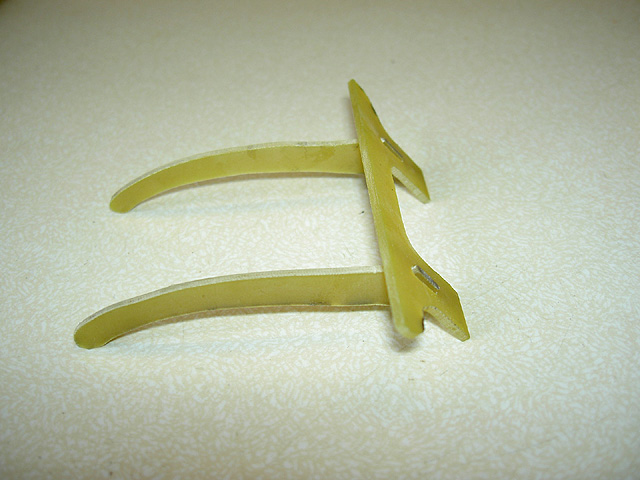
One of Pete’s friends, Stu Jamieson created an extremely unique bridge saddle for this banjo. The saddle has four feet instead of the usual two and it is constructed of fiberglass.  This allows Pete to whack the banjo as hard as he can. To compensate for the thicker gauged strings, the bridge is slanted at a severe angle.

For decades Seeger made use of a 12 string guitar for accompaniment.  He first acquired this instrument in 1959.  Seeger had a fond appreciation of blues legend, Huey Ledbetter aka Lead Belly and other blues players made that great use of Stella 12 string guitars. 

These players tuned their guitars to a key lower than normal, due to the intense strain on the instruments neck.

Once he was on tour in the U.K. with Ramblin’ Jack Elliot. During his off days Seeger tracked down an English gentleman named Stanley Francis. It was Francis that had built guitars for Skiffle artist, Lonnie Donegan and BBC Folk artists, Robin Hall and Jimmie MacGregor.

Pete desired to have a special 12 string guitar with a longer than usual neck. So he had one made that had a long 27.75” scale. This guitar was tuned two whole steps down.  Pete made heavy use of the capo. He played the guitar with thumb and finger picks.

Francis 12 string
Seeger states that he was fascinated by Stanley Francis’ ideas about guitar construction, especially bracing the body.

Pete’s guitar has a triangular sound hole. 


To the casual observer may be mistaken the guitar as an acoustic Gretsch of that era.

The longer scale, the special bracing and heavy strings made this guitar sound like a cannon.  Alas this guitar did not last and a second guitar was commissioned. This time it was made by Connecticut luthier Bruce A. Taylor in 1973. 

Seeger met Bruce Taylor at a festival that year and the two struck up a conversation about the Francis 12 string. Taylor offered to build Pete a similar one. Without hesitation Seeger handed the 12 string with Taylor, a total stranger, then went about to play the concert using only his banjo.

By the way, Bruce A. Taylor is not related to Bob Taylor, who makes the well known brand. 

Bruce Taylor has also built 12 strings for folk artists Tom Chapin and John McCutcheon.

Bruce Taylor made some changes to the original Francis bracing to strengthen the instrument. He also installed rosewood bridge plates instead of the original laminated ones. Taylor also changed the 12 strings bridge holes and built a more streamlined and ergonomic headstock.

note the aux saddle
Because of the huge strings that Seeger uses; .070 for the lowest, Taylor put in an auxiliary saddle. The guitar also has a zero fret. Interestingly the Taylor 12 string does not have an adjustable truss rod. Mr. Taylor states the guitar is already under too much pressure and a hole bored through the neck would just make it more unstable. When it was built Taylor put a composite graphite rod in a grove under the finger board to stabilize the neck.

As a tribute to Pete Seeger, the Martin Guitar Company issued a six (JSO model) and twelve string Pete Seeger 60th anniversary  (J-120SO model.) Vega banjos are now being built by the wonderful folks at the Deering Banjo company. They offer three models of long neck banjos. However you will have to make your own four post saddle.


Pete states that he had a lot of “left leaning” stickers on his guitar case. This unfortunately caused damage to his 12 string when someone of the opposite mindset in an airport luggage department, opened up the guitars case and put his foot through Pete’s guitar. Another incident happened when Pete left the guitar in case leaning against his car. The guitar fell over when he pulled forward and was crushed when he backed up. Each time he would have Taylor build him another guitar.

I recall a newspaper article that came out four or five years ago that stated Pete had lost his banjo. At the time he was approaching his 90th year.

It was found by a neighbor a couple of days later.


It seems Pete had placed it on top of his car and drove off.

Pete Seeger tuned his 12 string down 4 half steps below concert pitch to a “C”. (Noel Stookey also tuneshis Apolonnio 12 string Cittern in this manner) Seeger plays with thumb and finger picks. This gave Taylor the idea to install an upper and lower scratch plate. However since Pete liked Dropped D tuning, he often tuned the lower course of strings to “Bb.”  For any key changes, Seeger makes good use of a Shubb capo.

He always carried his guitar and banjo in Blue Heron bag.


After 94 years of providing the world with music, admonishment, environmental action and hope, Pete left the world, a much better place than he found it on January 27th of 2014


*Footnote - As I add the pictures I must admit Pete Seeger's banjo cannot be pinned down. In some pictures the neck appears to be ebony and in some newer pictures it does not. 


I have also noted the peg heads on Seegers banjos are different. Apparently Pete had a couple of banjos that he commonly put to use.


I've written that he was fond of Shubb capos, but there are plenty of photographs showing a Hamilton capo or an elastic capo on the banjos neck. Additionally there are plenty of photos of Pete's banjo with a two foot bridge saddle and with the four foot Jamieson saddle. Note also that the script font is slightly different.


Monday, March 3, 2014

The Capo -Milton Kyser's Passing

Milton Kyser was raised in a poor farming family in East Texas. He grew up during the Great Depression.

As a boy he promised himself that if he ever started a business of his own, he would have all the work done by local people so they could provide for their families. After years of hard work as a metal machinist, he created his own company;  Kyser Capos.

He was 46 years old at the time. His company built unique guitar capos and other products. And as he promised, all of the work is done in the United States. Mr. Kyser passed away on January 23, 2014.

His passing reminded me of what an important device the capo has become in the world of guitars.

When I was learning to play guitar some players referred to them as “cheaters”, since they easily enabled you to play chord shapes in different key. This was much easier than barring with your pointer finger and using the other three for the chord. The great Blues man Gatemouth Brown called them a “Choker”, because you were choking the guitars neck.

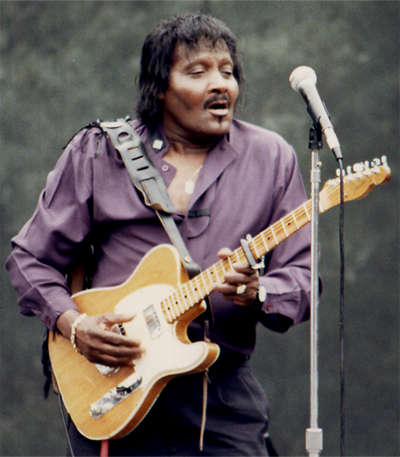
Acoustic players have made great use of capos for years. There are some Blues players that used them on many of their songs. I am thinking of Albert Collins and Lonnie Mack. Both men made use of an old fashion capo that is no longer produced.

Lately there are a series of performers that use sets of capos up the neck that enables them to play in unusual tunings.

The word Capo comes from the Italian words “capo tasto” or head fret. The capo can be thought of as a movable nut that alters the length of a guitar’s strings. (Keep in mind capos are not just for the guitar.)

The first mention of a capo was in the mid 1600’s when composer Giovanni Battista Doni uses the term Capo in his work “Annotazioni soprail compendio.”

There are some pictures of antique gut string guitars which have a small round hole in differing sections of the fretboard. This hole enabled the player to insert a wooden capo onto the neck. The capo came with a piece of wood jutting out on its bottom. A short piece of gut held it in place.

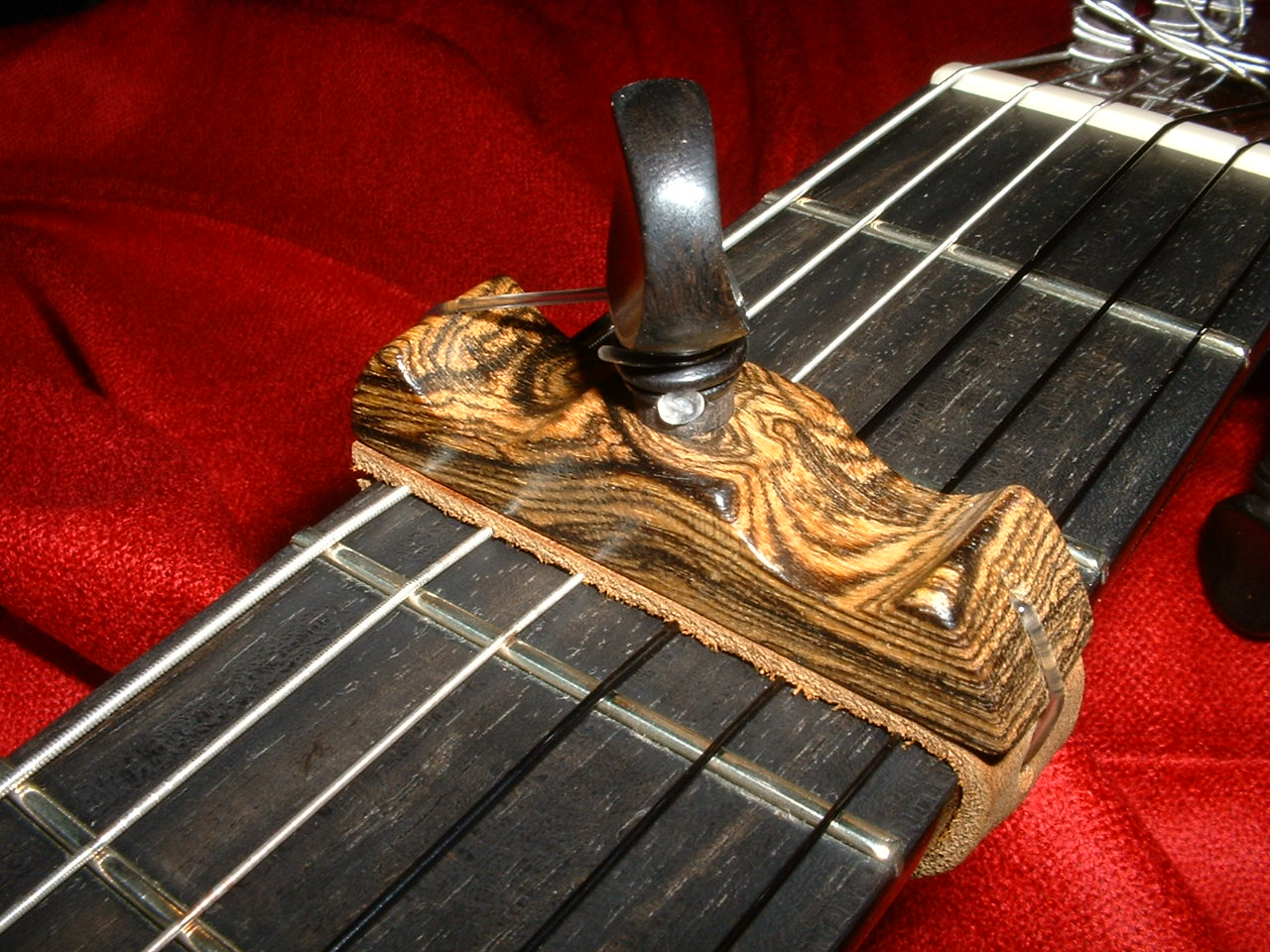
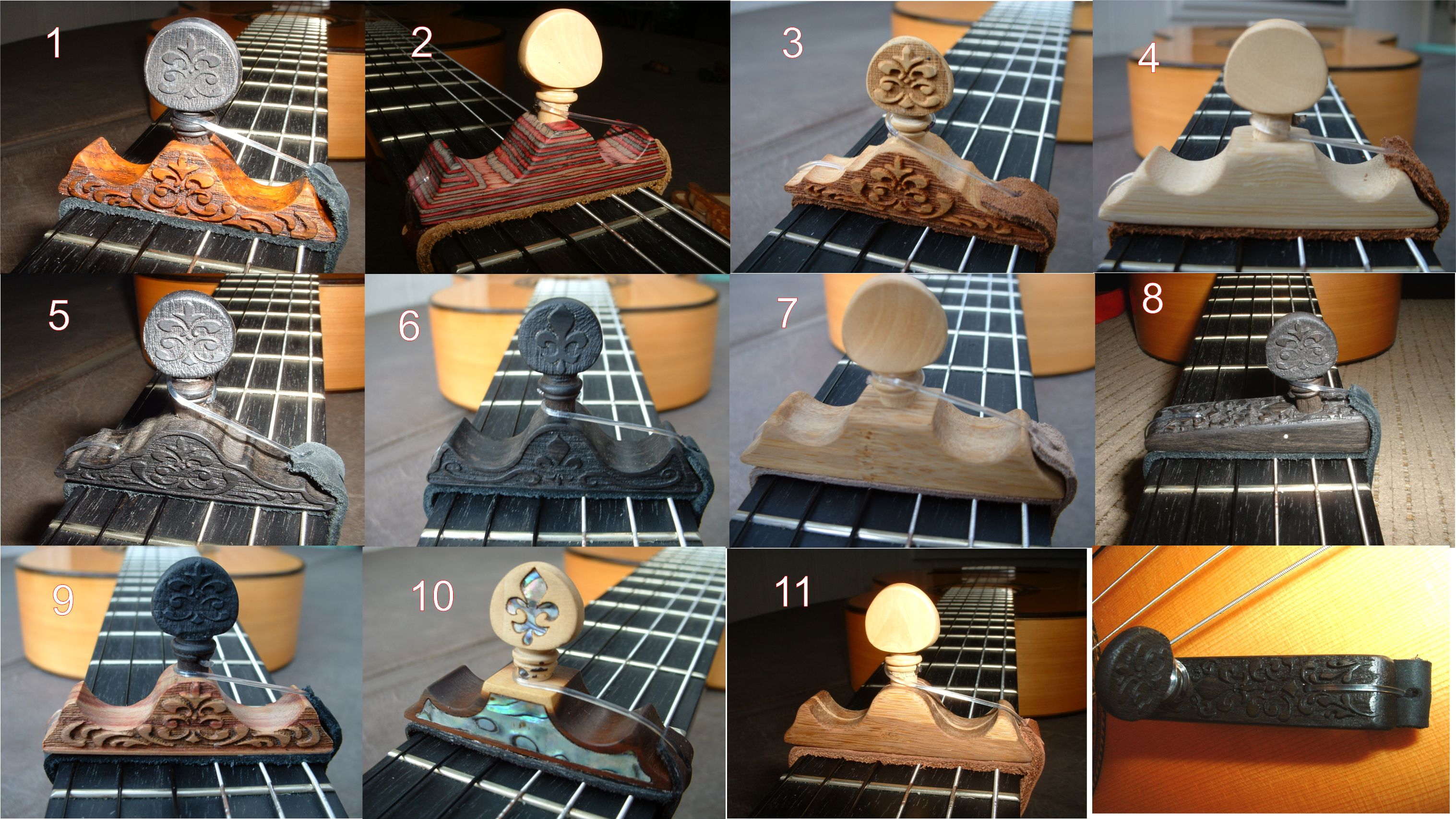
Capos are still being produced for classic and flamenco players. These devices, known as cejillas, are made of an ornate piece of wood or ivoroid that usually has a strip of felt on the bottom.

A short leather strap holds the capo on the guitars neck. There is a short bit of nylon guitar string that attaches to a peg on the top of the capo. This peg or screw allows the player to tighten the capo onto the neck.

The first capo patent appeared in 1850 and was licensed to a fellow named James Ashborn of Wallcotville, Connecticut. Since then there are at least 130 United States patents for capos.

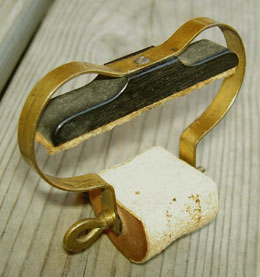
Albert Collins and Lonnie Mack both favored an old capo that is no long made, called  the Filstrup Capo. It was sort of a three sided piece of steel. The transverse portion had a thin piece of cork to prevent scratching the fret board.

A spring arrangement attached to on side and locked onto the other. Within the spring mechanism was another bit of metal with cork backing to prevent scratching the neck.

A similar capo is now being made called the Slider Capo. There is a bar that fits over the finger board. The attachment at the bottom of the capo consists of a plastic (or rubber-like) device that can easily slide up the neck.

When I was learning to play guitar in the mid 1960’s, the one stocked by most music stores was the Hamilton Capo.  Hamilton made a couple of different models. Both came with a flat metal bar covered in a clear plastic shield that would fit into a stirrup like clamp. The tension on one model was adjusted by a thumb screw with a curved metal end that was covered in felt.

The more popular spring loaded Hamilton Capo had a similar shape, but came with a spring loaded mechanism that replaced the thumb screw.  This made sliding the capo up and down the neck a breeze. These capos are still offered.

The most popular capo of the 1970’s was invented by (Bill) W.H. Russell and manufactured by the Jim Dunlop Company.  This simple device was a short metal bar that was covered in just enough plastic material to cover the fret board.


The metal ends of the bar stood out just enough for riveted woven polyester elastic band enclosed the capo. One end had enough material to go around the guitars neck. The player could attach the metal rivet to the metal bar.  Dunlop sold thousands and thousands of these capos.

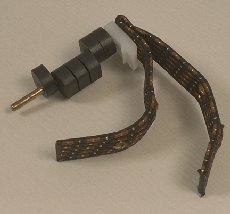
The next capo that emerged was known as the Toggle Capo. This was also manufactured by the Dunlop Company. This capo was an elastic band. One end of the band was anchored to a metal strip.


The bottom of the metal strip was covered with a flat piece of polyester rubber, which prevented damage to the finger board.  On the opposite end of the capo was a metal bar that had edges which jutted up at a 90 degree angle. Each of these edges contained 5 cut out section.

At the end of this capo was a plastic bar which had two points. The player would wrap the elastic part of the capo around the guitar, and then place the twin points of the bar into the serrated edge of the capo. Once this was accomplished the plastic bar was bent vertical which locked the capo into place.

I’ve seen players with this sort of capo, but I must say from that era the original Russell capo was more popular.

Original Shubb Capo
Sometime during the latter portion of the 1970’s a new type of mechanical capo emerged.


The first version was an invention of R. Shubb. It is still in use and known as The Shubb Capo.

Shortly afterward, Trigger Capos came into being. Initially invented by a group of three men, the capo were licensed and marketed by Jim Dunlop.

The inventor(s) claim it was influenced by spring held clothespins.

The Trigger Capo is based on two bits of metal that are hinged together with a spring.  The Dunlop Trigger Capo has two handles on its backside which the player grasps. These open up the sections thus allowing the device to fit on the guitar.

The Kyser Capo design has the handles on the side of the guitars neck.

The Kyser Company offers a partial capo for those of you that like unusual tunings. I have seen players using two and three Kyser partial capos for songs.


If you don’t want to spend money on a partial capo and own a Kyser model, you can put the regular capo on your guitar backwards so it will cover three strings.

The “Third Hand” capo is a variation of the Dunlop elastic capo. Instead of the top bar being solid, this capo has six adjustable pieces. The player can choose which strings to capo and which to leave open. It is an interesting concept.

There is a variation on this type of capo called The Spider Capo.  This device is placed on the guitars neck and tightened by using the thumbscrew.  The top bar contains dampers to capo the desired strings.


The Capo is not just for guitars. Banjo, ukulele and mandolin players make use of them too. Kyser offers capos for all of these instruments. One interesting banjo capo is made by Shubb. It covers just the fifth string of the banjo.

I have seen banjo players that use the top of a BiC pen as a capo by placing it under the banjo’s fifth string. I have also seen nylon string guitarists use a wooden pencil and some rubber bands for a capo.

One of the newer capos that is available is the G7 Capo. The G7th Capo was invented by mechanical engineer Nick Campling. He left his previous company to devote all his time to the G7th Capo development and sales.


He was soon joined by Noel Sheehan, who is a specialist in retail sales and is based in Leicester, England.

Chris Samewell is on G7th board and has been involved in the design and ergonomics of the products that are produced by G7th.

Unlike the trigger capos, the G7th Capo works be just applying it to the desired space on your instruments neck and squeezing the capo. G7th offers a variety of capos, including a trigger model.

If you have a desire leaning toward the fancy G7th offers a gold plated model and a model with Celtic designs on the capos metallic parts.  For those wealthy patriotic Americans, G7th offersa model with Red, White and Blue crystals, but make certain you have enough on your credit card as this one will sells for 539.00 UK pounds.

Most of the others run around 20 to 39 UK pounds.  G7th also offers banjo capos and classical guitar capos.

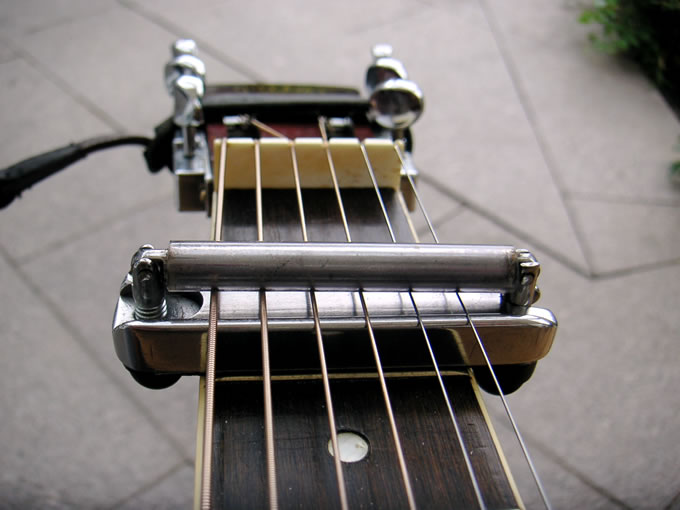
The last capo I’ll talk about is for the lap steel guitar. Because the strings are set high above the fret board and the fret board is only used for the position markers, a capo for a lap steel guitar presents a unique situation.


Instead of the capo being strapped or held behind the neck, the lapsteel capo fits under the strings. The bottom of the capo rests on the fret board and acts as a sort of stilt.

Lap steel capos are generally made of brass and have some sort of locking mechanism to block the strings.

I would like to remind you of a previous post that discussed Joshua Gomes hand built capos. He calls these Sawmill Capos. They are beautiful capos made of wood and once again they are worth looking into my friends.
©UniqueGuitar Publications (text only)