I wish all of you that have taken the time to read The Unique Guitar Blog a Happy and Prosperous New Year. May 2026 be Your year to be healthy, and shine.
2025 was certainly an eventful year in the guitar industry. Here are some trends that I have noticed in 2025.
In the UK, music distributor John Hornby Skewes, better known as JHS is taking steps to close, or to find a buyer. This is Britain's largest music distributorship company. The founder, Mr. Skewes, passed away this past September. According to his wishes the company should be sold. JHS is the United Kingdom’s largest distributor of musical instruments with brands such as Danelectro, Godin, Donner, Shubb, Lava Music, Encore, Vintage, and Fret King.
Most guitar companies have embraced Far Eastern manufacturing using factories in China, Indonesia, and Vietnam. Unlike the cheap imports of the mid 1960’s, many of these factories have modern equipment and produce very nice, playable instruments.
Most of the overseas manufactures are contracted by USA companies to build guitars, and basses based on the company's standards, but using labor paid at a much cheaper rate than what would be paid to an American worker.
In reviewing example of these Pacific Rim factories, it is evident that Asian workers heavily monitored for their output, and quality of work. Look for most musical instruments to be manufactured in Asia.
Tariffs are influencing guitar pricing in a big way due to the massive number of guitars imported into the United States. The Höfner Company cited this as one of the reasons for the company’s insolvency.
I have noticed that many guitar companies have increased their pricing structure to compensate for additional fees. As an example, in 2024 Amazon offered a Squier Debut Series guitar for $119. In late 2025 that same instrument is priced at $148.
Much guitar hardware is manufactured offshore including machine heads, tailpieces, nuts, and saddles. Even pickups are built overseas. These parts are subject to import tariffs, which are added to the consumer price. So even USA made instruments are affected by tariffs.
Most all prominent brands have reflected a pricing increase. Most major brands earn a hefty portion of their income from the sales of their budget line of overseas manufactured guitars, and basses.
Few home players, or local giggers cannot afford $3000 to fork out for a new Gibson Les Paul, or $4500 for a Custom Shop Fender Strat or Tele. Subsequently the budget brands pose a much better option.
As a counterpoint, I am reminded of the British embargo following WWII. Back then the British Board of Trade controlled imports to try to improve the UK’s balance of payments. This is a politician’s term meaning the wealth of the country measured by comparing incoming and outgoing costs.
At the time, the government’s main objective was to secure what they saw as necessary savings in the UK’s overseas spending, in order to reduce the growing pound/dollar deficit.
The broader restrictions of the early ‘50s embargo applied primarily to food and drink imports, but also among the restricted manufactured goods were musical items, namely gramophone records (no CD's or digital downloads in 1945), harmonicas, accordions, and their parts, musical boxes and their movements, stringed instruments (including guitars), wind instruments (not including organs), and some organ parts.
Because of this embargo, most musical instruments, including guitars and amplifiers, sold in Britain were manufactured in Europe. This is why you see older pictures of 1960 British bands playing Futurama guitars, Framus guitars, and Höfner basses. That is what the players of that era could afford.
On the plus side of the ledger this forced the British musical instrument industry to create such iconic brands as Marshall amplifiers, Vox amplifiers and Vox guitars, and Burn's guitars and basses. I hate the fact that the government is involved in controlling and taxing, but that is a reality we have to accept. I believe the industry will eventually work this out.
We lost quite a few iconic musicians and guitar players in 2025: Ace Frehley, Ozzy Osbourne, Brian Wilson, Steve Cropper, Chris Rea, Sly Stone, Roberta Flack, Rick Derringer, David Johansen, and Marianne Faithful all passed away. There are certainly others as well. This is a list of my favorites that left recently.
I certainly hope 2026 will be a great year for all my readers. and may you all be healthy, and prosperous.
Karl Höfner GmbH & Co. KG, better known as the Hofner Company, has been manufacturing stringed musical instruments for over 100 years. The business was founded by Karl Höfner.
Just a few days ago, on December 10th, this Bavarian company issued a statement that they were filing for insolvency with the Tenth District Bavarian court system. Reports state, “An insolvency administrator has been appointed, who will proceed to attempt to rectify debts over the next three months,”
A representative from Hofner issued the following press release.
Dear musicians, Höfner fans & friends, some of you may have already heard: our company has been going through a difficult period - especially since the introduction of the US tariffs - and filed for insolvency on Thursday, 11 December 2025. We would like to clarify a few things: We are not discontinuing production, distribution or our media channels. In Germany, there is a three-month period before the actual insolvency procedure is opened. This period offers the opportunity to consolidate the company and restructure it for a better future. Within this period, we will continue to build and sell our instruments and the Höfner team is doing its best to provide you with the support, service and warranties you expect. We would like to express our appreciation to all of you who continue to support us even in these difficult times! Thank You!
Karl Höfner was originally apprenticed to Anton Schaller, who made violins, violas, cellos and double bass instruments. In 1887 Karl Höfner founded his workshop in Schönbach, own instruments and he established quite a reputation throughout Germany, Austria-Hungary, Russia and other European countries.
It was not until the 1930’s that the company ventured into building guitars. The earliest models were steel stringed instrument and the majority of instruments were arched-topped. During these days the company employed around 30 craftsmen and approximately 300 home workers.
During World War II, production was limited and Höfner was conscripted to make transport crates and shoe soles for the German army.
At the end of the war, the Czech and German speaking population of Schönbach were expropriated as the result of the company being recognized by the Czech state. This resulted in the acquisition of what was Höfner by the government.
Due to the situation the Höfner family decided to apply for a leave and in 1948 they moved to Germany and started the the business from the ground up in Möhrendorf, Bavaria.
It was a struggle to resume the business since supplies were very scarce due to the war. But Walter and Josef Höfner began working on a way to build a new factory and also find houses in which their craftsmen could live.
After extensive negotiations with political leaders, in 1949 Höfner was able to relocate to the small village of Bubenreuth and begin violin making in this municipality and business was resumed by 1950.
It was also during the 1950’s that Rock n’ Roll exploded on the scene. This unforeseen change caused guitar production to swell to 50% of Höfner’s overall business.
In the 1950s and 1960s, Höfner instruments were distributed by Selmer of London. They were considerably more accessible to budding musicians than American-made guitars, which were expensive if obtainable at all, thus giving Höfners a place in history as the "starter" instruments of several well known 1960s musicians.
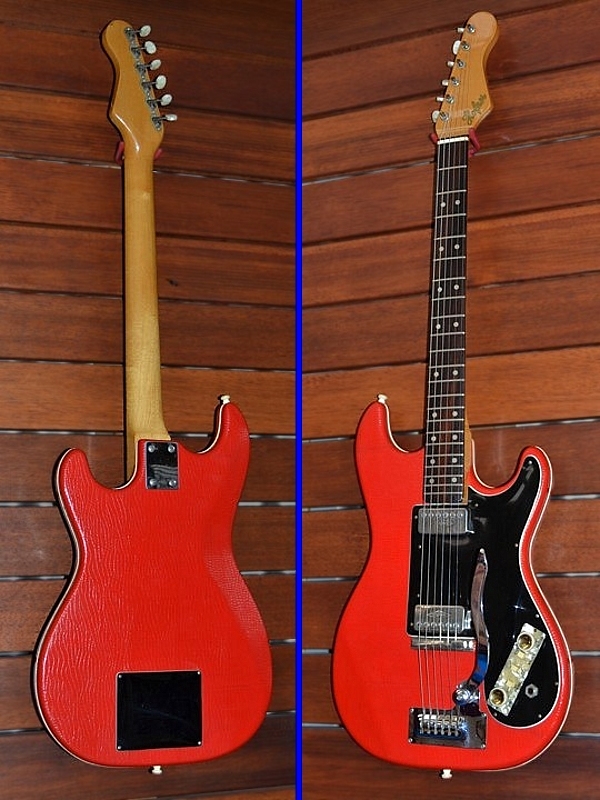
By the 1960’s the demand in Europe for guitars was so strong that Höfner began looking for an alternative to body paint, because it took too long for the paint to dry. The solution (which thankfully did not last) was a shell of the body with printed vinyl.
Höfner built a further production site in Haguenau, in order to escape the room shortage in Bubenreuth although also the complex was expanded in Bubenreuth three times.
It was in 1961 when Paul McCartney was living and working as a musician in Hamburg Germany. At the timee didn’t have a lot of money and was looking for a nice bass. The Höfner 500/1 was a great fit; he bought one.
In 1963 he was presented with another, that had a slightly different pickup configuration. This bass was manufactured in 1962. He had no idea that this would become his signature instrument and make Höfner a household word among musicians.
Later in 1961 import restrictions on goods imported from the USA were relaxed and American guitar manufacturers began to take hold in Britain and Europe. This did take away some business from Höfner. Another complicating factor was the proliferation of low priced Asian instruments into the music market.
Christian and Gerhilde Benker
Gerhilde Höfner Benker, Karl's granddaughter and her husband Christian Benker did their best to keep the company competitive.
However by 1991 Höfner was sold to the British company Boosey and Hawkes.
In their portfolio, there were already a number of musical instruments manufacturers including the bow manufacturer Paesold. By 1995 the two companies merged under the Höfner name.
In 1955, Walter Höfner designed an electrically amplified, semi-acoustic bass guitar. The hollow body made this style of guitar very light and easy to play, as well as giving it a rich tone, similar to that of the traditional double bass. The bass was first shown to the public at the Frankfurt Music Fair in the spring of 1956.
Sir Paul McCartney relates, "I remember going along to the shop in Hamburg, and there was this bass which was quite cheap. I couldn't afford a Fender. Fenders even then seemed to be about £100. All I could really afford was about £30 ... so for about £30 I found this Hofner violin bass. And to me it seemed like, because I was left-handed, it looked less daft because it was symmetrical. Didn't look as bad as a cutaway which was the wrong way. So I got into that."
McCartney had purchased his original 1961 model, and in 1963 the company gave him an updated 1962 model. Afterward, McCartney mainly played the 1962 model, leaving the original as a backup.
It was in 1964, when he had his 1961 model refinished and had new pickups and an updated pickup surround system installed. He can be seen using this bass in the "Revolution" promo video, strangely with the strap attached to the top of the headstock instead of the neck heel strap button.
Sometime during the recording of Let It Be several of the Beatles famous guitars were stolen from Abbey Road Studios. This included the 1961 Höfner 500/1model, George Harrison's Gretsch Tennessean and Harrison's second Rickenbacker 360-12.
McCartney used his 1962 model for the remainder of the album.
Sir Paul is still in possession of the 1962 bass as of 2014 and used it during the 2014 Grammy's Beatles Special TV performance as well as numerous other appearances.
The older model 500/1 Hofners have no binding on the neck as do most of the newer models.
The modern H500/1, as it is currently know is the top of the line Violin Bass. It has a spruce top with flame maple back and sides. The plastic binding on the top and back are black/white/black, while the binding on the sides is white. The bass is hollow with no center block. It is constructed in three pieces. The headstock is the traditional Höfner design with a decal logo.
The 3 piece set in and bound neck is made of flame maple/beech/flame maple and joins the body at the 16th fret. It is 21 mm at the nut and widens to 24 mm at the 12th fret. All 500/1 basses come with a zero fret. This bass has a short 30"/76cm scale. The fret board is made of ebony and has white pearl dot inlays. There are dots on the side of the bound neck. There is a white heel cap.
The nickel tuners are made by Höfner and fitted with white buttons. The bass's trapeze tailpiece is also made of nickel. The single coil pickups are made by Höfner and are called staple pickups. The electronics panel are produced in house and the potentiometers have a golden colour. The cord jack is on the instruments side.
Höfner makes some variations on the H500/1. These include the CT bass, which is quite similar to the H500/1, but comes in sunburst or black. CT stands for Contemporary Series. Note the lack of binding on the neck. This product is made in China for Höfner, and is priced as their midrange instrument.
The Cavern bass is a copy of McCartney’s original 1961 model. This bass comes with a neck pickup and a middle pickup, while the other 500/1 designs have a neck and bridge pickup. This bass has no binding on the neck and comes with an unusual headstock design.
The Mersey model, named after the British town that was home to The Cavern Club where The Beatles and many other bands got their start. This mode has a lighter sunburst finish.
The Ignition model , so called as this is the Bass Guitar that started it all. It comes with different pickups than the others. The finish on this model has a more pronounced red in the sunburst or it can be ordered with a black finish. This bass is a budget model originally made in China, but lately they are built in Vietnam.
The unique ECO model has a body finished in and ivory colour. The wood materials are similar, but the neck is topped with a light blue fret board made of a composite material and has black dot position markers. The tuners on this bass are slightly different and are called Rugby Ball tuners. The electronics panel is black with gold knobs.
Höfner also continues to build several models of the 500/2 bass, which is now known as The Club Bass. These basses have more of a traditional shape and a rounded cutaway on the body.
These basses are offered in several variation; The Höfner Club Bass, which has a traditional sunburst finish, the CT design, which has a black finish, the Höfner Club Bass Limited Edition, which has cream bindings and is finished with violin varnish, so it has a distinct brown colour. The pickups on this model are at the base of the neck and in the center position. There is also a Höfner Ignition Club Bass with slightly different pickups.
Stu Suttcliffe was The Beatles original bass guitarist. He played a 1960's Höfner HCT 500/5 President bass. Höfner no longer offers this model. $$$$The Höfner 500/5 bass was first produced in 1957 and continued until the early 1970s.
This Höfner bass guitar was presented to McCartney in 1964 and was displayed at the London music trade show at the Russell Hotel. In mid-1965, it was then sold by a Bedfordshire music store to a young bassist. It eventually resurfaced years later in 1994 when it was purchased by an English guitar dealer, who, after extensive research, discovered that the bass was indeed the one bass made especially for McCartney in 1964.
This is the same bass pictured above, but Sir Paul added a signed pickguard.
The guitar was taken to Höfner in Germany to verify its authenticity. This was confirmed by Christian Benker of Höfner Musikinstrumente. Additionally, Alby Paynter, who worked for Selmer and Co. in London between 1954 and 1967, also examined the guitar and confirmed this was the bass with which he was personally involved clearing through customs in 1964.
Additionally, Dave Wilkinson, another Selmer employee at the time, remembered the instrument being on show at its central London shop.
McCartney himself discussed the guitar in an interview that appeared in the July 1967 issue of Beat Instrumental Monthly. McCartney was quoted as saying, “I have had a Hofner Violin bass ever since I started. I’ve got three or four models but the ancient one is still my favourite …
The only difference in any of they can be seen on the one Selmers had made for me, that has gold pickups.”
Sir Paul McCartney issued the following statement,
"It is very sad to see Höfner go out of business," he writes. "They have been making instruments for over 100 years, and I bought my first Höfner bass in the '60s. I have loved it ever since. It's a wonderful instrument to play: lightweight, and it encourages me to play quite freely. It also offers pleasing variation in tone that I enjoy. So, commiserations to everyone at Höfner, and thank you for all your help over the years."
Today there is 4 inches of snow on the ground. I am stuck inside trying to stay warm. My thoughts turn to winters, and then to Christmas's from long ago. If I was younger I would be out riding my sled. But that is just an old guy's pleasant memory now.
Back in 1964 when Christmas was rolling around, we thought about Christmas presents. I wanted an electric guitar. My sister wanted a Patty Play Pal doll. My brothers wanted some toy trucks. The catalogs started arriving at our house in early November. We loved looking at those pictures in the catalogs and reading the descriptions. We each spent hours checking them out for our desired Christmas presents that we hoped Santa would bring.
We referred to these as the Wish Books. They magically showed up in the mail. We received three or four of these from different stores. I would turn right to the guitar section and carefully read each description with fascination. Those were those "olden days" long before Amazon, Musicians Friend, or the myriad other web sites which came years later. Back then we had no clue about an internet, and a web was something spun by spiders.
During this time I would beg my parents for a guitar or amplifier. My siblings would do the same for their heart's desire. As this page is dedicated to guitars, that will be my focus. But perhaps we may look into other things too.
Wow that Harmony flat top was made of seasoned wood! So it had to be great! (I had no clue at the time what seasoned wood was. I guess seasoned wood sounded more flowerily than "made from dried out old wood we left in a barn for six months.)
Later on, I was able to send away to different companies for their guitar catalogs. I wish I had kept them. Those catalogs are valuable now.
Since I was not into Chatty Cathy or Betsy Wetsy, or even Tonka trucks, let’s go back to those days and review some of those guitars, and amplifiers available years ago. And check out the prices too!
Straight out of the Sears catalog were all of these "Silvertone" instruments. The two hollow bodies on the left, and the two solidbody guitars on the lower right were made by the Harmony Guitar Company. The two teal solidbody guitars on the upper right were made by the Kay Guitar Company. Silvertone was the brand name that Sears had put on their radios, and televisions.
The company also applied that name to their musical instruments. Sears owned the Harmony Company, but also contracted with several different manufacturers to produce guitars, and amplifiers, and then badged them with that brand name.
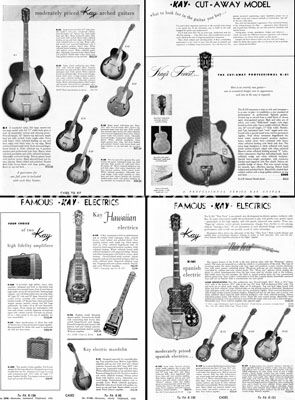
All of these guitars pictured on the left were made by Kay, with the exception of the second one on the top row, which is a Danelectro guitar.
It is a fact that the Danelectro Company sold most of their guitars and amplifiers through mail order retail companies such as Sears. Montgomery Ward, Spiegel, and JC Penny.
About six month later my friend had saved up enough money to purchase the matching Danelectro-made Silvertone model 1483 bass amp. This amp pumped 23 watts into a single 12" Jensen speaker. Though it was hardly powerful enough for a bass amp, it made a great guitar amp.
Silvertone amplifiers were much less expensive than a comparable Fender amplifier. The Danelectro speaker cabinets were even made with a compartment in the bottom to store the amplifier unit or head for transportation.
While Fender and Gibson made their amplifier cabinets out of solid pine wood, Danelectro used much cheaper particle board for construction.
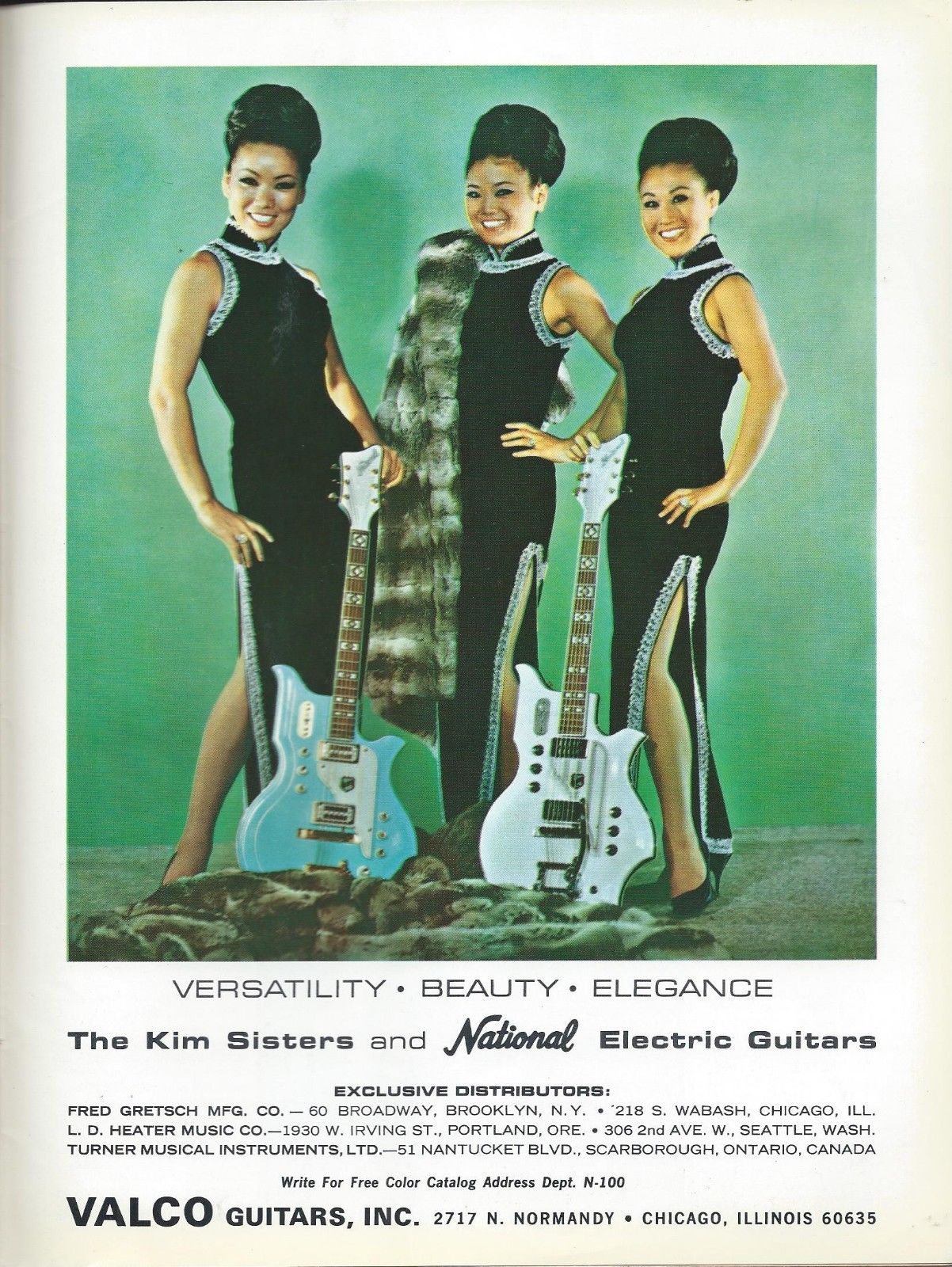
The Montgomery Ward Company used the brand name Airline for its electronic and music products. They used a number of "jobbers" or companies to procure their guitars and amplifiers, such as National, Valco, Supro, Harmony, Kay, All of these guitars were sold by Wards under the Airline brand name.
The Kay Thin Twin was the model played by guitarist Jimmy Reed. You can see it in this 1954 company catalog. Most of the other guitars and amps on this page were made by National.
A company that has probably been long forgotten was Western Auto. They were very popular in the 1950's and 1960's, and sold guitars and amplifiers under the Truetone brand. The guitars and amplifiers were made by the Kay Company of Chicago.
One of my favorite Kay-made guitars sold by Western Auto was the three pickup Jazz King aka the Speed Demon. It came with distinctive Kay single coil pickups. Each pickup had its own volume and tone control. Some models came with the Truetone decal, while others came with the Western Auto "W" logo.
This guitar came with one or two pickups, and a fixed bridge with an aluminum bridge cover. The price for the one pickup model was only $44.95, which was a big factor in the instruments popularity. These were sold by Western Auto, Sears, and under the Old Kraftsman brand for Spiegel, another catalog company that was based in Chicago.
Another popular model made by Kay was called The Value Leader. It was sold through several different catalog companies under different brand names, as well as under the Kay brand.
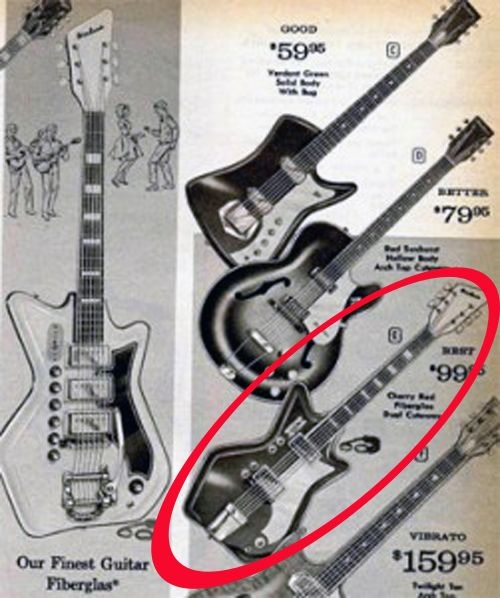
This hollow body Les Paul shaped guitar came with a fixed wooden bridge, a rectangular aluminum pickguard, a trapeze bridge, and one, two, or three pickups. The single pickup model sold for $69.95, the two pickup model sold for $87.95, while the three pickup version was $99.95. The pickups were low output to decrease feed back.
Although Fender guitars were only sold through authorized dealers, you could obtain a Fender catalog from a dealer or directly from the company. For a guitar obsessed kid, these were like finding gold. We could look at these guitars for hours and dream.
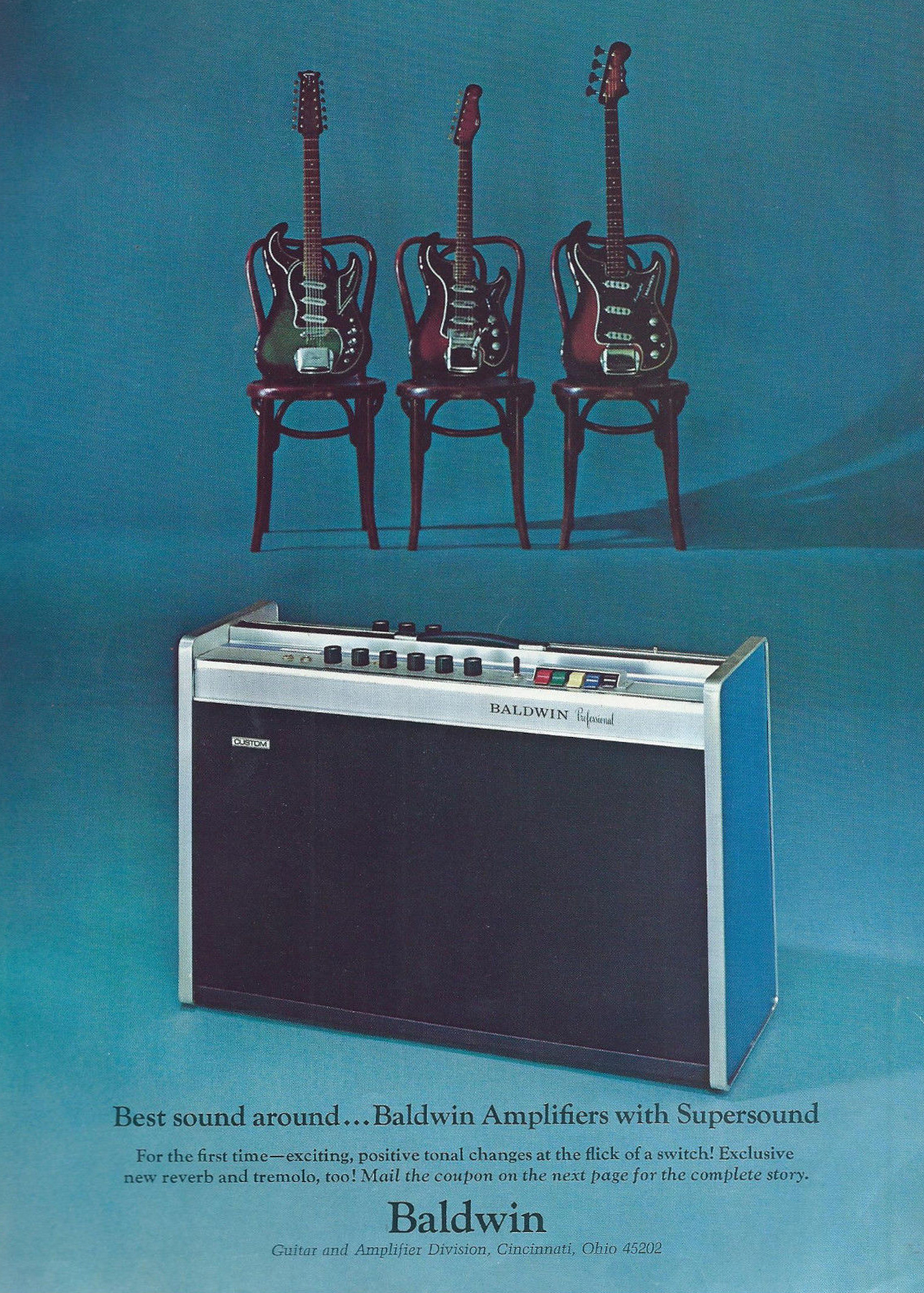
The new kid on the scene in 1966 was Baldwin guitars and amplifiers. The Baldwin Piano Company of Cincinnati had recently acquired Burns of London guitars, and the rights to Kustom amplifiers. Some of the original Baldwin guitars were still labeled as "Burns", so Baldwin put their logo on top of the Burns logo. The Baldwin amplifiers were based on Bud Ross's Kustom amplifier circuitry.
The Joseph Speigel Company was a Chicago based business specializing in direct mail order sales. They sold guitars that were made by Kay Guitars of Chicago under the Old Kraftman brand.
One of the most interesting companies that origisnally sold guitars and instruments made by other companies, but within a few years manufactured their own guitars in the mid 1960's was The Carvin Company of California. I recall sending for this catalog. It may have cost me 50 cents. It contained very interesting guitars and amplifiers, and it came with a separate price list written on a typewriter.
The Carvin Company was a family business, and remains so today but now it is under the Keisel brand name.
Years later I learned that the bodies of those early Carvin guitars were made by the California based company, but the necks, pickups, and electronics were made by Hofner of Germany. although some of the pickups were wound in house. Later on Carvin manufactured their own brand of pickups
In addition to the wish books there were a few television commercials in the mid-1960's from a toy company called Emenee. This New York based toy manufacture created several guitars that were made out of plastic. They were hoping to cash in on the British Invasion.
They also produced the "polychord electric-piano organ" aka The Audition Organ, and the "Big Bash Drum" snare drum. Well a kid could start their own band with all those seemingly marvelous instruments.
The Emenee Tiger guitar was a hollow body archtop instrument made entirely of plastic. It had a cutaway, an archtop bridge and came with a detachable contact microphone which was probably made by the DeArmond Company.
The Swinging Cat guitar has been described in internet posts as perhaps the worst toy ever made. It was a solid body style all plastic guitar with a faux pickup section molded on top of the body. It came with a contact microphone that was permanently attached to the amplifier. The child could place the microphone contraption under the strings.
Both instruments featured low watt battery powered amps housed in a plastic cabinet.
My brother's both got Tonka Trucks, that were dye cast, and made our of metal. Christmas was a great time at my childhood home back then. Those are now only sweet memories.
As for myself, I did get an electric guitar. It was a used one. A 1957 Fender Stratocaster that Dad found that was not expensive. I wish I had kept it. The current value of that instrument is $20,000 to $40,000. Oh well!
I hope that you all can sit back and check out these old catalogs. Many are online. I've posted a couple below. Dog-ear the pages for your selections,, circle them, and then make a wish. To help out, here is a link to all the Sears catalogs since 1930 in a pdf format.. Enjoy!
I wish everyone a very Merry Christmas, Happy Holidays, and a Wonderful New Year!