On February 16th of 1964, some may have been watching The Ed Sullivan Show on Sunday night. This variety show was a staple in my home. It usually featured juggling acts, dancers, popular comedians and popular songsters of the day. However, this was the night The Beatles were making their first American television appearance.
Many of us enjoyed the music and were fascinated with the Beatles distinctive guitars. I was and still am a Beatles fan. They created some of the most memorable songs and changed music forever.
But that Sunday night, my eyes were locked on the guitars. What was that huge guitar that Harrison was playing? As I got more involved with the guitar, I realized he used a 1962 Gretsch Country Gentleman. In 1964, colour television was available, but expensive. The Sullivan show at this time not being broadcast in colour. It was difficult to determine the colours of the guitars. As it turns out, George’s instrument was black.
Friedrich Gretsch founded Gretsch Musical Instruments in 1883. His goal was to manufacture percussion instruments such as drums, banjos and tambourines. According to Fred Gretsch, the current owner; Gretsch starting hand building guitars in 1890. It's amazing they have been producing guitars almost as long as Martin.
By the 1950's Gretsch Musical Instruments were producing some of the finest electric guitars every made. Gretsch Musical Instruments founder Friedrich Gretsch died at and early age. His brother ran the business until Gretsch's son, Fred took over.
 |
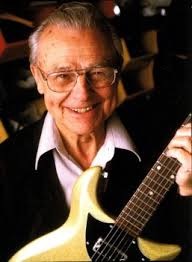
| Duke Kramer |
Fred Gretsch sold the business and assets to the Baldwin Piano company. Longtime salesman and company jack-of-all trades, Duke Kramer went with the deal, to help Baldwin start up business. The venture was a disaster. For a short time the Gretsch name faded as a memory until the late 1980's when son Fred Gretsch III repurchased the brand name.
His son, Fred Jr. took over in 2003 and with the help of Kramer and Paul Yandell the company has been revived. Nearly all Gretsch guitars are currently manufactured in the Far East.
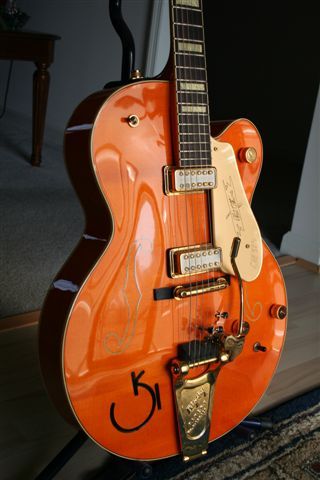
By the late 1950’s, the biggest endorser of Gretsch guitars was Chet Atkins. Chet not only played a Gretsch, but his input improved the guitars evolution. Thousands of Gretsch guitars bore Chet’s signature either on the pickguard or on a gold plate attached to the headstock.
Chet’s first Gretsch was the model 6120, but he suggested the pickups be changed from DeArmond single coils known as filter coils to a humbucking style called FilterTrons.
He also was responsible for the change from a standard “F” hole to a simulated “F” hole. This eliminated feedback in large auditoriums.
With all the modifications, the 6120 became the Chet Atkins Country Gentleman. The name came from a song Chet had recorded.
 |
| Duane Eddy |
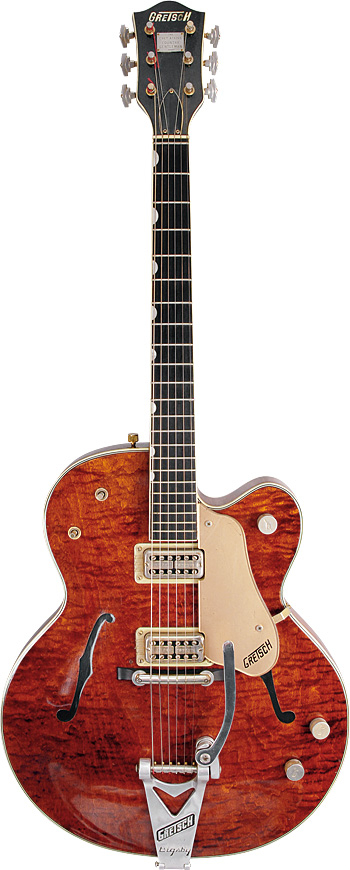
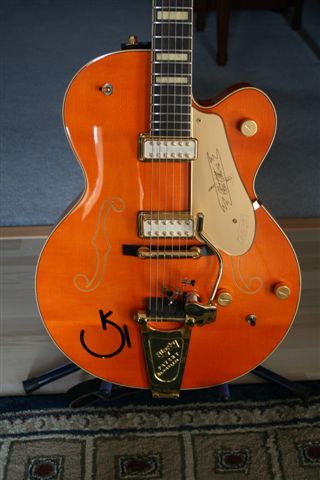
Other well-known Gretsch endorsers include Eddy Cochran, Duane Eddy and Brian Setzer. But Chet is probably the best known. He was responsible for the design of the Country Gentleman and many other Gretsch models. The original Country Gentleman had a single Venetian style cutaway. Like subsequent models, it had a laminated maple top, which was another Atkins suggestion, for feedback reduction. The back and the sides were also made of laminated maple.
The older models had “F” holes and two tone bars and a sound posts, like on a violin.
In 1962, at Chet's suggestion the “F” holes were simulated as a further measure to prevent feedback. However the guitar was hollow.
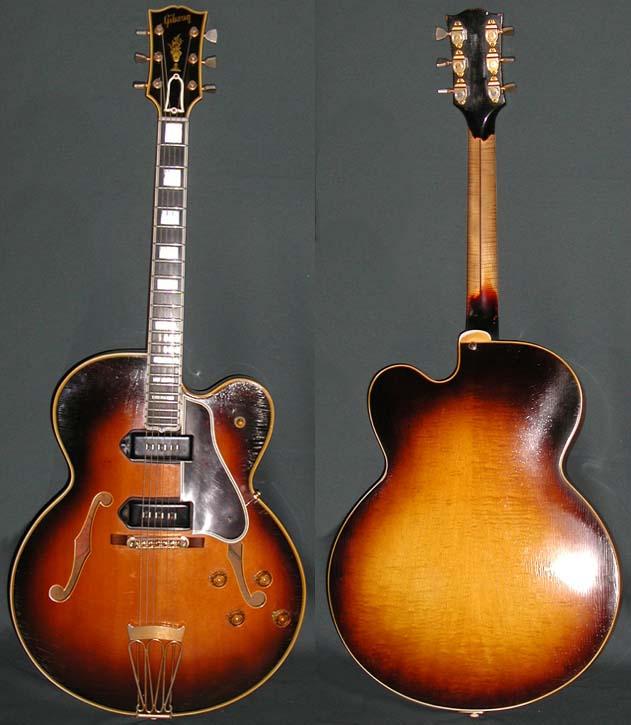
Unlike a Gibson ES-335, the Country Gentleman did not have a center black, but instead it had parallel tone bars and a sound post. The guitars neck was made from 3-piece maple. The hardware, tuners, bridge and Bigsby were all top of the line and gold-plated.
The Bigsby vibrato unit was specially manufactured to have a V shape in the trapeze-like tailpiece section embellished with the brand name Gretsch. As already stated, the pickups were FilterTrons, made by DeArmond of Ohio. Controls on Gretsch guitars are much different from other electric guitars.
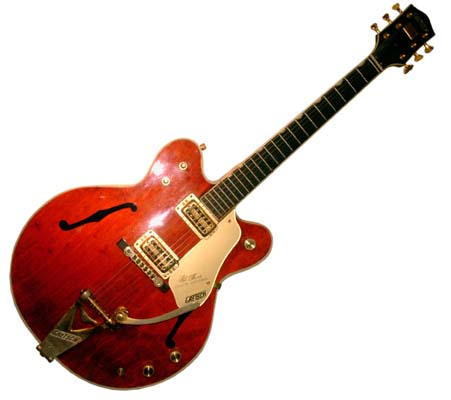
The original Country Gentleman and the subsequent double-cutaway model of 1962 came with three potentiometers for volume. Each pickup had an individual volume control and a master volume control was placed on the lower horn. On the upper bout were two toggle switches.

One switch was for pickup selection and functioned like the usual three-way selector. The other switch was the master tone control. This was a unique three position switch that yielded three distinct sounds. Position one was medium level with a high frequency roll off. Position two switch the pickups out of phase and wide open. Position three produced a slight level, with a high frequency roll off. The result is Gretschs’ unique sound. The guitars maple neck was capped with a bound ebony fretboard and at Chet’s request, the position marker were half-circles under the fifth and sixth string. These are commonly known as thumb markers, due to Chet’s propensity to use his thumb to fret the lower strings. The Country Gentleman also had a zero fret for tonality. The guitar had 22 frets, which includes the zero fret. The neck had a 12-inch radius, which is fairly flat.

The scale was 24.6 inches. The neck width at the brass nut was 1 11/16th inches. The tuners were stair-step Grover Rotomatics. On the other end of the instrument, the bridge was a rocker bridge. Although this was later updated to a Gretsch adjustamatic style.
One other unique feature of the Country Gentleman and other Gretsch guitars is the strap buttons. These are made of knurled aluminum, which is gold-plated on the Country Gent and allow the strap to lock in place.
This was standard on Gretsch long before after market locking strap buttons were offered.
The body’s depth was 2.75 inches and it was 17 inches across the lower bout. This was the same size and a Gibson thinline. The initial model was designated a 6122 by Gretsch. It was first produced in 1957. Changes occurred to the instrument through the years. The 1959 there was no signpost on the headstock. This was gold-plated engraved aluminum that proclaimed the instrument to be a Chet Atkins Country Gentleman and had the serial number. This was a feature on the 1960 and subsequent models.
The 1958/59 models had Grover Imperial tuners. 1959 brought about the addition of a zero fret. This changed in 1960 to Grover Rotomatic tuners. In 1960, the Bigsby vibrato with a V shaped insert specially manufactured for the Country Gentleman was added.
The body depth changed in 1961 to 2 ¼ inches. This same year a large, black, circular, fabric pad was added to the back of the guitars body. Twin adjustable heavy foam mutes were added to the guitar in front of the bridge saddle. The mutes, which no one used, were adjusted by means of two roller knobs on either side of the bridge.
Finally, a standby switch was added to the guitars lower bout. 1962, brought about significant changes. The body was thinned to 1 7/8ths inches. The body style changed from a single cutaway to a double cutaway style. The standby switch moved to the upper bout. The circular back pad was now made of leather and came with snaps to hold it in place.
The only change in 1963 was to the mute knobs. They became smaller this year and were a lever action design. In 1964 the FilterTron pickup in the neck position was changed to a SuperTron pickup. The bridge remained the same. This was the year the Grover Rotomatic tuners were changed to have button style pegs. The only change in 1965 was the serial number was moved from the nameplate to the back of the headstock.
In 1967, the mute was changed to a single mute, and the knobs were replaced by a single lever control and the ebony fingerboard was discontinued and replace with a rosewood board.
In 1971, the mute was gone, the fretboard was once again made of ebony, the guitar came with an adjustamatic bridge, and the model designation changed to 7670. The pickguard shape was changed. This was the year that Baldwin had acquired Gretsch. Chet preferred the single cutaway model.
The double cutaway that stands out in the mid and late 1960’s as the preferred instrument of British bands. There were so many groups on the UK and Europe side of the pond and in the US seen with the Country Gentleman and other Gretsch guitars.
It was a pricey instrument and more expensive than a Gibson ES-335 (which incidentally sold for $335 US) or its Epiphone equivalent.
However, the Country Gentleman, Tennessean, 6120 and other Gretsch guitars have a much different sound than other guitars equipped with dual humbucking pickups. You have to play one to hear it.
When Gretsch revived in 1988, the company no longer had an agreement with Chet Atkins to use his name or Chet’s trademark name, Country Gentleman.
The Country Gentleman became the Country Classic model and the Tennessean became the Tennessee Rose.
A few years ago, Paul Yandell, who played guitar behind Chet for years, worked with Gretsch on an arrangement with Chet’s heirs to use his name and Country Gentleman brand. Before his passing, Chet had mentioned to Paul that he preferred the Gretsch guitars to his Gibson models. Yandell came up with a special design known as the Gretsch Designed in cooperation with Chet Atkins’ longtime rhythm guitarist and close friend.
Paul Yandell assisted Gretsch in designing the G6122-1959 Country Gentleman® precisely replicates the world’s most famous ’59 6122 model—one of Atkins' personal favorite guitars. Features include handmade TV Jones® custom pickups, the bridge pickup is a TV Jones Hi T model and the neck is a TV Jones SuperTron model. The neck is slightly wider. It comes with Bigsby® B6GWST vibrato tailpiece with stationary arm, which Chet preferred and optional swivel arm.
The entire instrument is bound and comes with a zero fret. The body depth is 2 ¼ inches and the scale is 25 ½ inches. Gretsch also currently offers four other Country Gentleman models. The 1958 single cutaway, Country Gentleman is based on that years model. It features simulated “F” holes, a flat arm Bigsby vibrato tailpiece without the V cut-out that proclaims it to be a Bigsby, stair-step Grover Rotomatic tuners and two Hi-Sensitive FilterTron pickups.
 |
| G6122 |
The entire instrument is bound. The neck scale is 24.6 inches and the body depth is 2 ¾ inches. The nuts on the current versions are made of synthetic bone. No zero fret on this guitar. The double cutaway, Gretsch 1962 features the double mute, twin Hi-Sensitive FilterTrons, the standby switch on the lower bout, simulated “F” holes and a gold-plated aluminum emblem on the headstock and stair-step Grover Rotomatic tuners. As with the others, the entire instrument including headstock is bound. This has a zero fret and a 24.6 inch scale. The body is 2 inches deep.
 |
| G6122II |
The Gretsch G6122II is an updated model of the double cutaway Country Gentleman. The F-holes are real. The pickups are dual Hi-Sensitive FilterTrons. There is no mute and the Grover tuners have button pegs. There is no standby switch on this instrument. The Bigsby is the V cut-out model that says Gretsch on the base. The body on the instrument is bound on the body, neck and headstock. The scale is 25 ½ inches and the depth of the body is 2 ¼ inches. Finally Gretsch offers a 12-string version in the line-up. This instrument does not have a mute, but comes with a standby switch on the lower bout.
The gold-plated Grover tuners have button style pegs. As with the single cutaway, this guitar features a Bigsby tailpiece with a V shape cut-out. This one feature the standard movable handle. The guitar has a bound body, neck and headstock. The scale is 24.6 inches and the body depth is 2 inches.
All current Country Gentlemen guitars are available only with a walnut finish, except for a limited run of George Harrison 1962 models, which were issued with a black finish.
For anyone on a budget,Gretsch offers a Country Gentleman style guitar under the Electromatic brand name. It is called the G5122DC Double Cutaway Electromatic model. The shape is similar to the Country Gentleman, however the finish is not as nice. The pickups are Gretsch Dual Coil humbucking pickups. The nut is synthetic bone. The tuners are “vintage style”, the vibrato is licensed by Bigsby. The body and the neck are bound, but not the headstock. The scale on this instrument is 24 ½ inches and the depth of the body is 2 ¼ inches.
The “F” holes are real. This comes with a walnut stain or a black finish. I have seen red models in some stores. Although this guitar is not as nice as a Country Gentleman, bear in mind the real deal sells for $3400 to $3600, it has a street price of around $850-900 USD.
©UniqueGuitar Publications (text only)