Friday, March 11, 2011

The Squier '51 Guitar


In 2004, the Fender Musical Instrument Company came out with a guitar that was reasonably priced ($150 U.S dollars), superbly designed, and was an instant hit. This guitar sold under the Squier brand name and was named the Squier ’51.

Although the '51 was a guitar, the one piece pickguard and chrome control plate appeared to be taken right off of a 1951 Precision Bass design, hence the name. This guitar was a true mutant. The neck and headstock resembled a Fender Telecaster and the body resembled a Stratocaster. It was equipped with a slanted single coil Strat-style pickup in the neck position, much like the lay out of a Duo-Sonic.

A hot humbucker graced the bridge position. The bridge was similar to what you would find on a hard-tail Stratocaster, except the strings loaded in the rear of the unit instead of through the body. The C-shaped neck was made of one-piece maple topped with medium-jumbo frets.

Although some of these instruments were made using a two-piece neck with a maple cap for the fretboard. And a few came with a rosewood fretboard. The neck radius was 9.5” had a 25.5” scale typical of what one finds on most Fender guitars. The guitars body was made of basswood. The controls were unique. The first knob controlled not just the volume, but its push-pull function acted as a coil-splitter for the humbucking pickup.

The bottom knob was a three way rotary switch that controlled the pickup combinations. Squier offered the ’51 in three colours:


Black, Two-tone Sunburst, both with white pickguards and Blonde with a black pickguard. However, the early versions of the Blonde model came with a white pickguard.

The Squier ’51 was available for a short time. Production started late in 2004 and ended in January of 2007. The guitar was a bargain at $150. At the end of the run, Fender deeply discounted these to $99 at most chains and some were selling them for even less money.

Like all guitars, the short production period caused the value to increase when the supply was exhausted. Although still inexpensive by most standards, these are commanding $200 and up.

One of the aspects that has made this guitar so popular is the fact players can easily modify the guitar to meet their own specifications. Most folks that would not hack up a Strat or a Tele do not mind making changes to this bargain instrument. 


There are pages on the internet devoted to modifications players have made on their ’51. This is a guitar that has an almost cult following and one that deserves to be reissued, perhaps under the Fender label.


Sunday, March 6, 2011

James Taylor's Gibson J-50 - J-45 with Natural Finish

"Oh, I've seen fire and I've seen rain. I've seen sunny days that I thought would never end..."

Taylors J-50 with
no pickguard
James Taylor was probably around 18 or 19 years old when he penned the lyrics for his 1970 hit, Fire and Rain. The  Massachusetts born Taylor was living in London when he brought some demo tapes to Peter Asher. At the time Asher was the record producer for the Beatles' Apple label and formerly a recording star in his own right with Peter and Gordon.

During these early years Taylor relied on a Gibson J-50 guitar. Many of his most famous hits featured this instrument.

The Gibson J-50 is the natural top version of Gibson's J-45 model. The  Gibson J-45 was introduced in 1942 and as many Gibson guitars, its model number reflected its original price, which was $45.

This guitar was designed to compete with Martin's dreadnought - D series flat top guitars. Where Martin's model featured squared shoulders, this Gibson model was more sloped and rounded.


Gibson J-45
The J-45 was an updated version of Gibson's J-35 1930's guitar. Gibson had changed the bracing in the J-45 by using 1" struts to strengthen it and updated the neck to a more rounded shape, though some early models have a slight V shape. All of the J-35 neck were V shaped. This was common in older instruments to prevent the neck from warping.


The logo on the J-45 and J-50 was a Gibson decal, where the J-35 logo was silk-screen on the headstock. Both featured the Gibson motto, "Only A Gibson Is Good Enough" until 1946, when the motto was removed. The logo was script style through 1948 when it became the more familiar block style lettering.

The J-45 featured mother of pearl position markers on its rosewood fretboard.


The guitars top was made of solid red spruce, which was updated to Adirondack spruce in 1943. Some early examples had mahogany tops, as spruce was restricted to building airplanes during WWII.

The back and sides were solid mahogany, although some earlier models featured laminated backs and sides. Later models featured a black strip in the center of the back between the two book-matched sides. Earlier models did not have this embellishment.

The necks on the original J-45's were made of mahogany, but within a year changed to maple with strips of walnut.

The necks were huge due to the fact this was a war year guitar and did not have a truss rod, as metal was scarce and used only for the war effort. The guitars laminated maple and walnut neck gave it added strength. By 1945 the neck was once again being made of mahogany.

James Taylor with Gibson J-50
The strip style tuners were made by Kluson.

The neck block on the first models was made of poplar and beveled. Gibson soon made them of mahogany which was not beveled.

The rosette was simple multi layered binding. The binding around the top consisted of seven layers, while the back was only one layer. The unbound neck featured 19 frets.

The bridge appears to be rosewood and originally was rectangular with black pins. In 1950 this was changed to a belly style bridge and the pins were now white.

In 1947 Gibson introduced the J-50, at a higher price. The J-45 sunburst model could hide blemishes in the spruce top, but a natural top needed to be perfect. Because of the scarcity of spruce during the war years, it was all but impossible to find perfect spruce.

By 1950 the neck featured 20 frets.

In 1956 Gibson added an adjustable bridge feature as an option. In 1961 it became standard. This was featured on other Gibson models as well. Many players believe this bridge literally killed the tone from the guitars.

The original pick guards were made of celluloid tortoise shell material and the shape has changed slightly during the years. In 1955 they were slightly larger.

In 1963 the pick guards were made using an injected molding technique and were much thinner.

For reasons unknown, in 1968 the pick guards were screwed into the top instead of being glued.

1969 J-45
In 1969 the J-45 and J-50 changed to a square shouldered shape. The J-45 and J-50 models were discontinued in 1982.

Gibson made another run in 1984 for a year. 1984 was the year that Gibson left Kalamazoo and opened up shop in Nashville Tennessee and Bozeman Montana.

The J-45/J-50 was again in production in 1990 through 1995. Then Gibson re-introduced the guitars again in 1999 and they are currently in production, although the street price is no longer $45. A new sunburst Gibson J-45 will set you back 2,400 US dollars. It is available by special order in a natural finish for the same price, but is no longer called the J-50, but the J-45 natural finish.  The current models come with a L.R. Baggs acoustic pickup.

I'd like to think that much of James Taylor's sound came from his J-50, but like most players, his sound comes from his personal style of playing. His finger style playing method approached the guitar like it was a piano by using his thumb for the bass keys and his fingers for the treble.

Taylor has retired the J-50 and now favors guitars made by luthier James Olson.

One other notable J-50 player was Bob Dylan.


Gibson currently offers two versions of the J-45. Both retail at $2,999.00 USD.


Wednesday, March 2, 2011

Johnny Smith Guitars

Walk, Don't Run was among the first songs that I learned to play on guitar.  At that time, 1964, The Ventures had released an updated version of their 1960 original, which they called Walk, Don't Run '64.  I was not aware of the composer of the song or even listened to him play it until many years later.

Johnny Smith was born in the South in Birmingham Alabama to be precise.  Due to economic conditions, his family relocated to Maine when he was a young boy.  It was during this time Johnny got the itch to play guitar. He could not afford one, so he would hang out in pawnshops playing guitar in exchange for tuning the owner's guitars.

Eventually he was given a guitar and like most of us, he joined a band.  During his era hillbilly bands were popular, so Johnny became a Country entertainer and traveled around Maine earning four or five dollars per gig.

By his 18th birthday, he discovered jazz. This changed his musical direction. It was not before long that Smith put together a jazz trio.

Johnny's other goal was to become an aircraft pilot.  He was already licensed to fly small aircraft. In 1942, he enlisted in the United States Army Air Corps with hopes of going to pilot school.  Due to vision problems he was not accepted, but was offered a position in the military band on the condition he learned to play cornet. He learned in two weeks.

After receiving his discharge in 1946, he moved back to his hometown of Portland Maine and took jobs playing guitar and trumpet with the local radio station orchestra and in nightclubs.  To earn more income he packed his bags, headed to New York City, and took a job with the NBC orchestra as guitarist, trumpet player, and musical arranger.  He quickly built up a reputation for his chordal voicing style. 

Known for being a very diverse player, he could sight read music and was able to play in the New York Philharmonic Orchestra.  He was also a regular at the Birdland Jazz Club.  Johnny was also popular among the jazz crowd as a recording artist.

His most famous composition is Walk, Don't Run.  He had other hits and his album Moonlight in Vermont is named one of the top two jazz albums of all time, by Downbeat magazine.

Given his reputation, Gibson Guitars came out with the Johnny Smith model.  Ted McCarty, Gibson's head at the time visited Smith in 1961 at his home to discuss producing a Johnny Smith model.  Smith provided McCarty the desired specifications.  Gibson made some modifications which were acceptable to Smith and production began.

John D'Angelico created an Excel model for Johnny Smith.  Smith had visited the D'Angelico shop many times and watched the master at work. He learned a lot
about the art of creating a guitar just by observing Mr. D'Angelico.

Guild Guitars also named a guitar in his honor, the Guild Johnny Smith model.


This was actually the first guitar produced with his name on it.  In 1955 Alfred Dronge, Guild's founder and CEO approached him to design a guitar.  Smith came up with a concept, but was unhappy with the Guild modifications.  The guitar had a DeArmond floating pickup, with the control on the scratchplate.  The guitar was named the Johnny Smith Award model.

Former Kalamazoo Gibson plant workers founded Heritage Guitars back in 1989 when Gibson moved its manufacturing to Nashville and Bozeman.  Heritage came out with a Johnny Smith model.  Given the choice between Gibson continuing to produce the model at the Nashville facility or stay with the luthiers in Kalamazoo, Smith elected to allow Heritage produce the instrument. This model was dubbed the Johnny Smith LeGrand.


Bill Schultz, Fender's CEO had facilitated the purchase of Guild Guitars.  He approached Johnny Smith and asked if he would reconsider attaching his name to a Guild.  The guitar would be a Guild instrument, but it would be designed and production supervised by Robert Benedetto. Smith accepted the offer.

These guitars are all high quality instruments that all reflective of the style, reputation, and changes that Johnny Smith has brought to the world of Jazz Guitar.


Saturday, February 26, 2011

Hallmark Guitars

Joe Hall was a R and B musician from the Bakersfield California area. In 1959, Joe was looking for someone to build a custom made guitar. 


Around this same time, Semie Moseley and his brother Andy were building futuristic looking electric guitars, working out of a Los Angeles garage.  Semie seemed to be blessed with God-given talent to create wonderful electric instruments.  He had taken jobs with Rickenbacker and Paul Bigsby’s guitar company.  

Semie’s first claim to fame was building not just double neck guitars, but guitars with three necks.  

Country rocker Joe Maphis was hosting a television show called Town Hall Party. 


Maphis happened to see one of Semie’s creations and commissioned him to build a very flashy double neck instrument.  Maphis’ show featured a sister and brother act called The Collins Kids. 


Maphis commissioned Moseley to build a similar double neck instrument for 12 year old guitar wiz, Larry Collins.

This all takes us back to Joe Hall’s story.  Hall saw one of Moseley’s guitars and he decided this would be the man to build his custom guitar.  


He ordered a guitar from Semie Mosely and paid upfront by trading him $400 and his Gibson electric guitar. 


We can delve into Mosrite history later, but for now I’ll say that Semie Moseley was a genius when it came to building an electric guitar, but even he admits in interviews to being a very poor business man. 


Hall waited and waited for his instrument.  He had to pass up gigs for lack of an instrument.  He asked Moseley to speed up making his guitar. Moseley responded by inviting Hall to come and assist in building the instrument.  Hall took up the invitation and spent the next several years learning the process of how to build an electric guitar from a master builder.  


Hall never earned a penny, but came away with an education. This led him to a career in making custom made guitars.

Moseley Standel
Semie Moseley secured a deal to build guitars under that Standel name.  Standel, was a company owned by Bob Crooks, who was known for building fine amplifiers during the early 1960.  Chet Atkins and Scotty Moore both used Standel amps.  Unfortunately Moseley’s deal failed.  

Bob Hall took over the deal and made a run of guitars that bore the resemblance of Mosrite’s instruments, only they bore the Standel brand.  This deal also soured due to unforeseen circumstances.

1966 Hall Standel


Joe Hall began building custom order guitars under the Sterling brand name. 


By this time, Semie Moseley was manufacturing the famous Venture model guitar and now was heading a real factory.  


Bill Gruggett

Hall was able to hire away a luthier named Bill Gruggett that was working at Mosrite.  Gruggett had some ideas for new instruments and Hall was willing to try them.

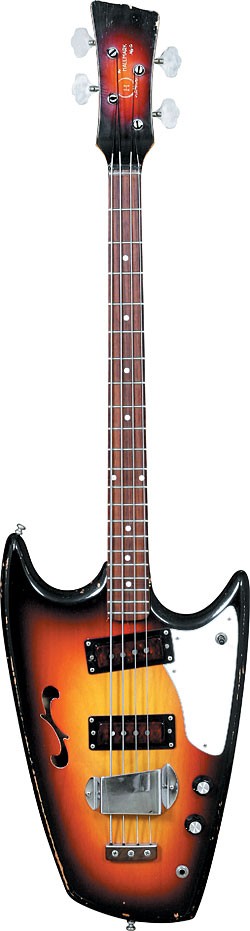
Gruggett was the designer of an unusual hollowbody instrument he called The Stradette.  This hollowbody guitar had a unique shape which was more reminiscent of a solid body instrument.

Hall’s luck seemed to change when Bob Bogle, the Venture’s bass player showed him crude drawing of an instrument, he had envisioned. This was the year when the Batman TV series was one of the number one TV shows. 


Hallmark Swept Wing


Bogie’s sketch featured a wing-shaped instrument that would become Hallmark’s signature Swept Wing guitar.  


1967 NAMM Eldorado in Front
About a year later Hall and Gruggett added a sort of 335-style guitar to their line up. This guitar was known as The Eldorado. They advertised this in publications and secured a booth at the Chicago NAMM Convention.


Unfortunately world events and a flood of cheap Asian-made guitars ended the era of the guitar boom.  Hallmark possibly gave away as many guitars as they sold.  The guitars were given to popular artists of the day in hopes of promoting their business.  Soon after Hall became discouraged and left the guitar business.

Bill Gruggett continued to build guitars and even got back together with assist Moseley.  They created the well-known Red, White, and Blue guitar that Buck Owens’ band presented him.  Buck featured this guitar on the Hee-Haw TV show.
 
Hallmark filed bankruptcy in 1968 and Gruggett closed up shop.


Bob Shade
Enter Bob Shade, a luthier from Maryland who became the well known go-to guy for restorations of original Mosrite instruments.  

As a collector, Shade was able to obtain several of the original Swept Wing guitars and other rare Mosrite guitars. He got in contact with Bill Gruggett with plans to revive the Hallmark name.  

They were able to get permission from Joe Hall to use the trademark.  Now the company is back in business building guitars on order.  


New Swept Wing
Their products include the Swept Wing, several Moserite style guitars, and the Stradette.  Hallmark even offers a guitar in the old Mosrite tradition named after player Deke Dickerson.


Deke Dickerson
If you are not familiar with Deke Dickerson, please look him up. Dickerson is a collector, player, producer, writer and band leader.


Deke is THE prominent collector of Moseley double neck instruments and other exotic guitars.  Dickerson holds an annual event in Anaheim California called The Guitar Geek Show, which features prominent guitar players such as Jennifer Batten, Jr. Brown, Duane Eddy, Del Casher, and Thom Bresh.


Also, please check out the new Hallmark Guitar page and all their new guitars. The prices are reasonable, comparable and in some cases less than what you would expect to pay for a factory made instrument. 


The Swept Wing Guitar aka Wing Bat makes appearances at guitar shows and charity events along with the original 1966 TV Batmobile, which the guitar will be forever linked with.

The Batmobile was designed and built by famous automobile designer George Barris.