Monday, May 16, 2011

Hamer Guitars

Hamer & Dantzig
The Hamer Guitar story is a most interesting tale that began as early as 1970 when graphic designer Jol Dantzig became a partner in a Chicago guitar shop called Northern Prairie Music. 


Northern Prairie was one of the first vintage guitar shops in the US. Northern Prairie did warranty work for Gibson, so they had a lot of knowledge about how the guitar was made and how to repair it and put it together. They also worked repairing guitars for other companies. Both of the partners wanted guitars that were constructer better than the ones they repaired.

Though their main business concern was to sell and trade guitars,  it was in 1973, that Dantzig built the first Hamer guitar.  This was a Flying Vee bass. This process of creating instruments, at first, became an important part of their business. 


After completing their 10th guitar, they knew building guitars was their business


When customers came in looking for a Les Paul or an elusive Explorer (at that time Gibson had not reissued this guitar and there were probably only 100 originals), 

Hamer or Dantzig would show them one of their models. Being located in a major city was helpful in spreading the word about Hamer Guitars, plus they had some connections with big name players.  


Interestingly enough, when Gibson introduced the Explorer in 1959, they could not give it away. When Hamer found success with The Special, you had better believe Gibson took note and reintroduced The Explorer.


In 1974, Hamer and Dantzig took out advertisements in popular guitar magazines. These were the days before anyone else was producing boutique guitars. Hamer was the first to take on this task.

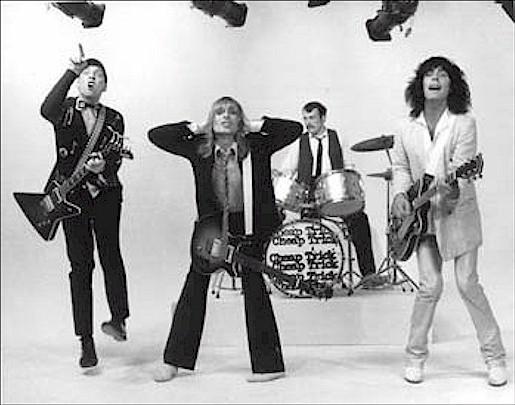
In 1977 Cheap Trick guitarist, Rick Nielsen, became acquainted with Hamer and endorsed their instruments. Dantzig had discovered a way to imprint graphics on a guitar and convinced the 3M Corporation to invent a new kind of tape that would make production of checkerboard guitars easier. 


Whatever strange guitar request Nielsen made, Dantzig and Hamer were able to produce.

Tom Petersson, also of Cheap Trick, asked Hamer to build a 12 string bass. Up until then, the only company to build a bass with double courses was Hagstrom with its eight-string model. The 12 string Hamer bass was a first and not only did it have 12 strings, it was also quadraphonic. 

The bass had a miniaturized mixer built into the controls so each course of strings could be placed anywhere in a quad mix.

One of the craziest things about Hamer Guitars is Paul Hamer and Jol Dantzig were not even 30 years old at this time.

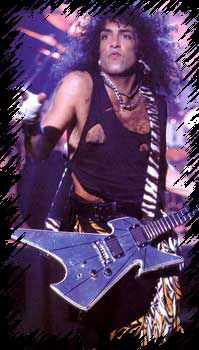
Well known band personnel such as Wishbone Ash's Martin.Turner, Bad Company's Boz Burrell and Mick Ralphs, and Jethro Tull's Ian Anderson and Martin Barre, Paul Stanley of KISS, Warren Zevon, Lita Ford, Tommy Bolin, Dave Hlubek of Molly Hatchet, Pete Townsend and John Entwhiste were all Hamer users. However, it was Cheap Trick that put Hamer on the map. Hamer had come up with all these fancy and bizarre guitars for Nielsen. Nielsen also purchased guitars from Hamer that were customized to his specification.


The first production Hamer guitar, called The Standard, was an Explorer shaped guitar. The body was British mahogany and the fretboard was ebony or rosewood. There were Standards made through 1978 and these were all handmade. The hockey-stick headstock was somewhat different from the original Gibson Explorer. From 1975 to 1985, Hamer built approximately 750 Standards. The Standard became the company’s flagship guitar and at the time sold for around $1200. It originally sold for around $800 in 1975.

Pickups on Hamers made in 1977 and before were genuine Gibson PAF's that they purchase from old parts at the Gibson factory in Kalamazoo. After 1977, Hamer used DiMarzio or Seymour Duncan pickups. Later Hamer manufactured their own pickups, called Hamer Slammers


Interestingly, Hamer had the pickups mounted with no pickup covers and was the first company to take this approach. They had the pickups specifically designed with cream and black bobbins. 

Grover tuners were used on the neck and all instruments had a tune-o-matic bridge and stop tailpiece. The guitars were 24.75” scale, similar to Gibson’s standard. The guitars came with individual volume controls and one tone control. 


Dantzig worked on that tone control. Many of us find our guitars tone control provides only subtle differences based on turning the capacitor on or off. Dantzig made sure the tone control gave a full contour of sounds. Hamers came with a 3-way toggle switch. 


The bridge was what Hamer called The Sustain Block. This was somewhat similar unit to that found on a hard tail Stratocaster, with the strings going through the body; however the aluminum bridge was mounted on a raised shim of either rosewood or ebony.

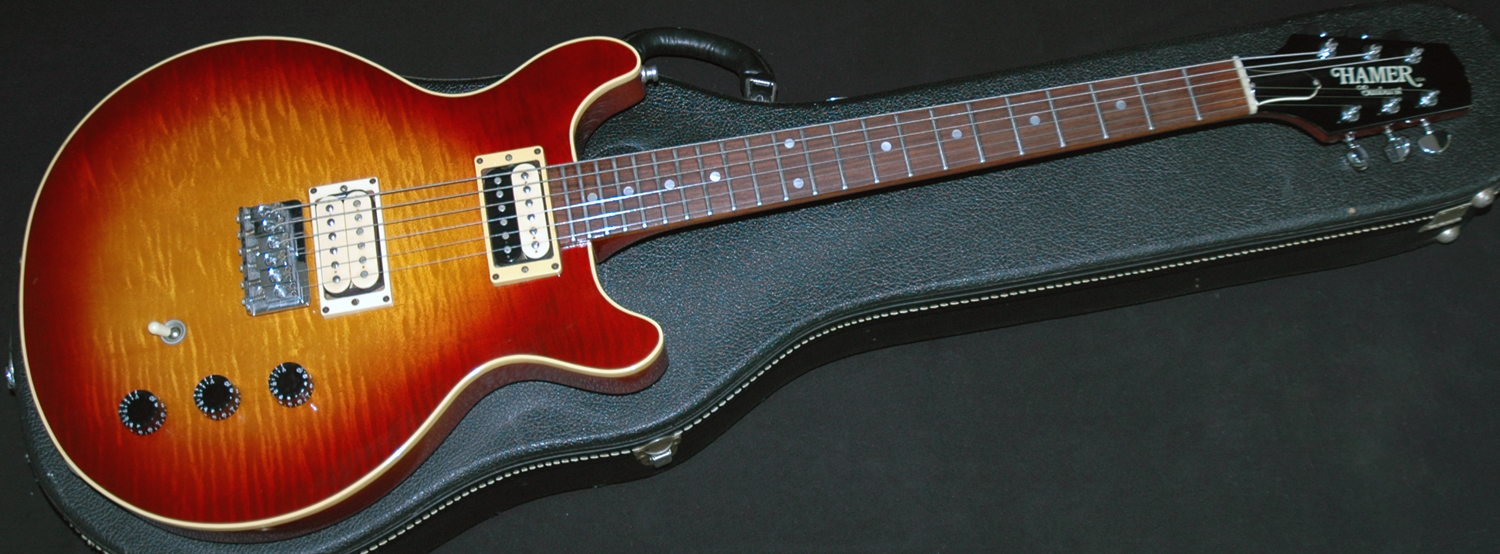
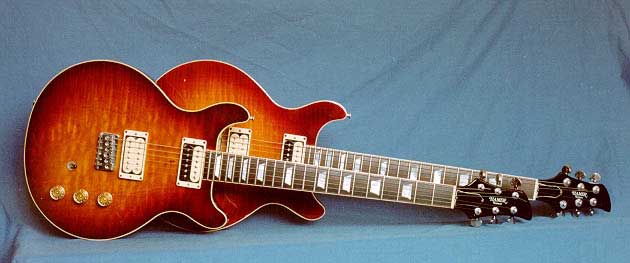
The Sunburst Archtops shape had its basis on the Les Paul Jr. Double cutaway. However, it was certainly an improvement. The arched top was finished in a variety of colours. 


The Honduras mahogany body was beautifully polished. The controls were similar, with twin volume knobs and a master tone knob and the toggle switch placed on the bottom bout, behind the bridge, where it was out of the way. 


The 22 fret fingerboards were rosewood with trapezoidal or dot inlays. The headstock bore Grover kidney bean tuners on early models. Later productions used Schaller tuners. The Sunburst was the first guitar to have Hamer’s familiar trapezoidal headstock with the indention. These instruments came with DiMarzios or Seymour Duncans, which were wired out of phase. Prototypes were on display at the 1977 NAMM Show. It proved to be one of Hamer’s most popular guitars with some 1500 guitar built by 1980. By the time the company moved to Arlington Heights they were producing 2000 Sunbursts per year. Some later models, produced by Kaman, used a flat top instead of the arch.

The Hamer Special was a Sunburst without any of the frills. The two-piece mahogany body had a thin maple top. Body and neck were unbound and position markers were dots on the 22-fret fingerboard. Hardware included Schaller tuners and the Sustain Block Bridge


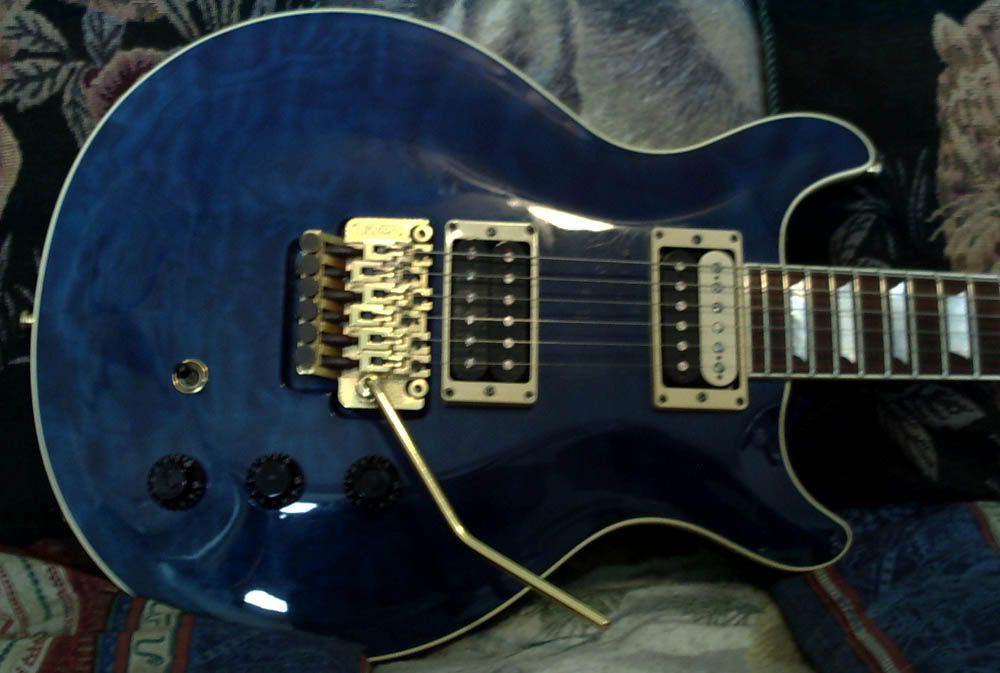
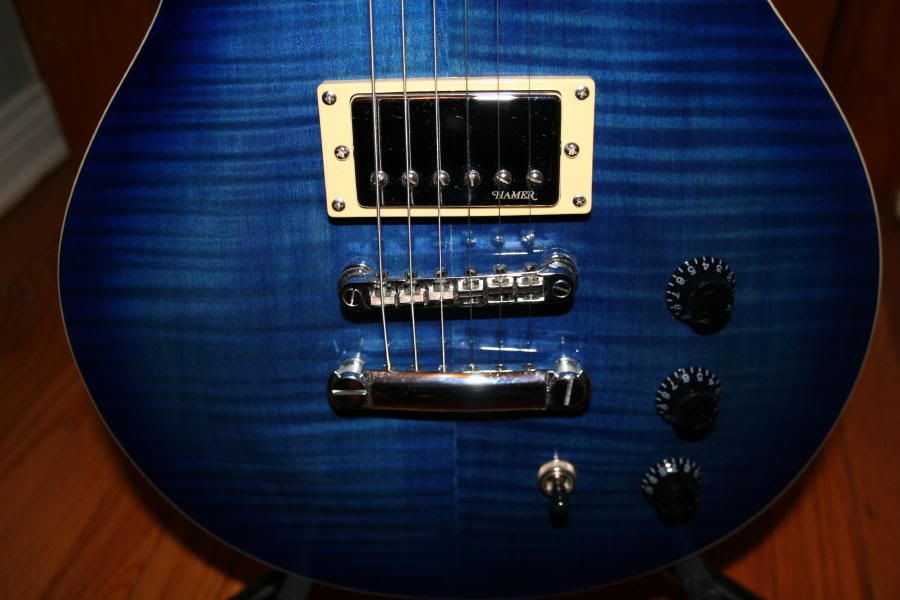
The guitar came in a variety of colours. A Floyd Rose Tremolo System was an option. By the early to mid 1990’s, the guitar was available with a flamed maple top. 


It is interesting to note that Hamer was the first guitar manufacturer to utilize the Floyd Rose Tremolo system on their instruments. Additionally, they were the first to produce guitars with locking tuners.  Because the Floyd Rose system on many of their instruments was black-plated, Hamer also was the first to utilize black hardware.>By 1978, Hamer set its sights on world markets. By 1980 production warranted moving to larger quarters in Arlington Heights, Illinois due to rapid sales expansion.

It was in 1981 when Hamer introduced a custom order Vee style guitar they called The Vector. 


The Vector had similar accoutrements as the aforementioned guitars on a Honduras mahogany top that could be ordered with or without a maple top, in a variety of colours. Tuners were made by Schaller. It also came with the Hamer Sustain Block Bridge.

During the 1980’s and the age of Metal and Hair Bands, Hamer introduced some guitars aimed at this market. The Scepter was based on another Hamer Explorer guitar called the Blitz. The Blitz was more of an affordable basic model. The body was beveled and it came with a Floyd Rose Tremolo system. 

The Scepter V was an updated version of the Vector. It too came with a beveled body and boomerang inlays.

The Hamer Scarab had its basis in the Explorer style body, but the guitars bottom had a unique curved cleft cut.

During the Metal years, Hamer came up with some interesting concepts, which included adding 27 frets to the neck, adding 36 frets to the neck, introducing a fretless guitar, introducing a 3 coil humbucking pickup, adding hologram images to the body, and they were the first to introduce a seven string guitar.

Early on, Dantzig had recognized the issue of stress on the neck. Because of this Hamer changed building techniques to use three-piece maple that was made so the center strip had the wood grain reversed from the outer laminates. This is a method utilized by a number of guitar manufacturers and prevents warping. 

The necks are dovetailed into a hand- chiseled cavity for a tight fit.  The control cavity is flawless and painted with nickel-based paint, then covered with an anodized aluminum cover. This prevents RF interference and hum. The bodies and necks receive a special method of applying lacquer to assure a beautiful finish.

By 1987, Paul Hamer left the company that carried his name. He served as sales manager and was ready to move on to another career. In 1988, Kaman Music, the parent company of Ovation guitars purchased Hamer and moved manufacture ring to Hartford Connecticut


Dantzig left Hamer five years later, but returned as a technical consultant in 1997.


At the end of 2007, Kaman Inc sold its music division to Fender Musical Instrument Company. Dantzig stayed on until 2010 and left to start his own high-end, boutique guitar company, known as Dantzig Guitar Design.
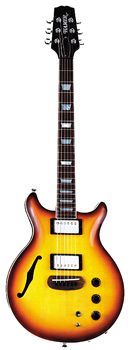
Hamers current ownership has recognized “the times, they are a’changin’”, and has abandoned to Metal market to take a more traditional approach to guitar design. Hamer still offers its original models, including the 12 string bass and the Vector bass. 


They have introduced the Duotone, which has a belly bridge with a piezo pickup in addition to the humbuckers and the Hamer Artist, which has sort of a PRS shape.  Hamer manufactures its guitars in the USA, but also produces the Hamer XT series of Asian made guitars that have a considerably less expensive price tag.

One very interesting fact about Hamer concerns Dean Zelinsky, the young creator of Dean Guitars. Dean worked as a roadie for Dantzig and Hamers band.  Dean took advantage of his lessons from watching and being with these fellows. It was after that experience when he launched his own business.




Tuesday, May 10, 2011

The Gibson SG - Happy 50th Birthday

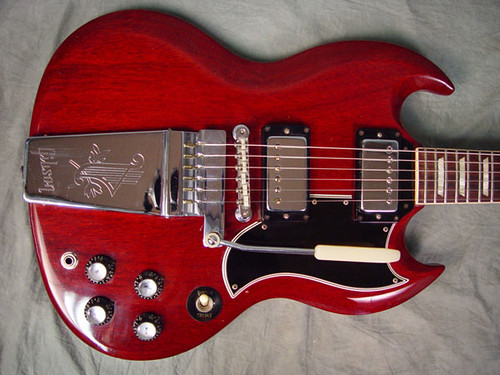
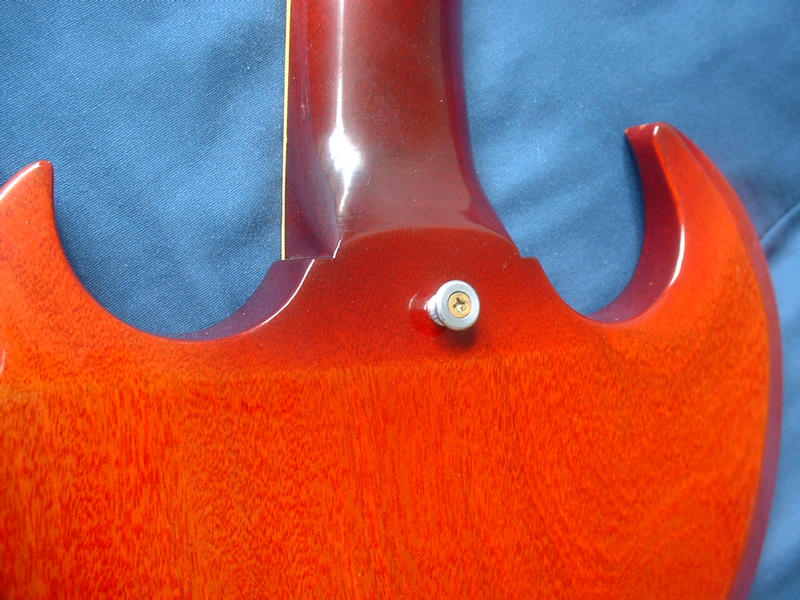
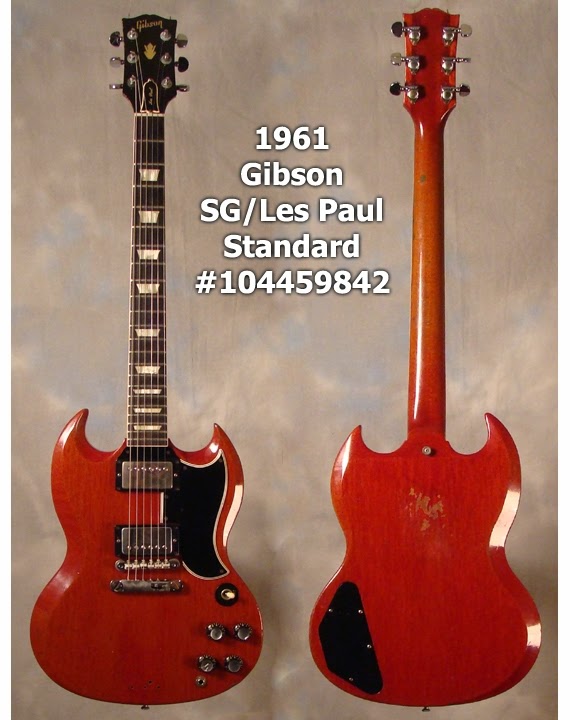
The Gibson SG is one of the more unique electric guitar shapes to come down the pike. It was designed by Gibson guitars as early as 1959; however, it did not actually make its debut until 1961. That makes it 50 years old this year.

By 1958, Gibson’s sales of the various Les Paul models were slowing down. The following year was when Gibson, led by Ted McCarty, decided to produce some radically different guitars, in hopes of striking competing with Fender and Epiphone.  


The Flying Vee, the Explorer and the elusive Moderne were all offered in 1959.  But sales of these extreme instruments were dismal.  Gibson was looking to produce a twin cutaway, solid body instrument, to boost sales and cut costs. McCarty came up with the Les Paul SG.

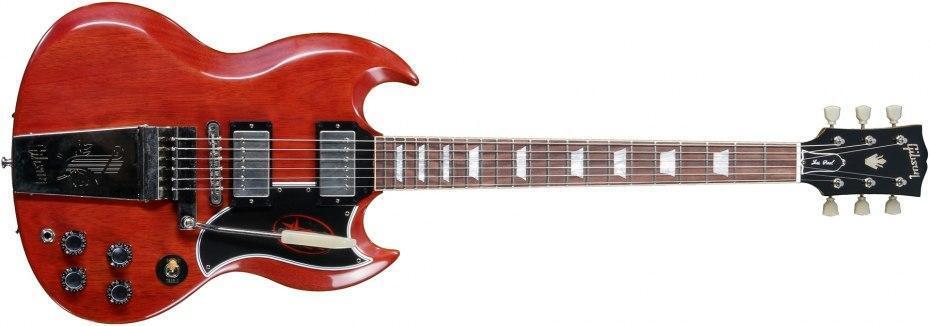
Originally, it was labeled The Les Paul SG, SG standing for solid guitar. It was flat-topped, with neck access to the last fret.  The 24.75” scale neck joined the body at the 19th fret. The neck had a thinner profile than The Les Paul guitars. Likewise, the neck heel was very shallow. 


The mahogany body was beautifully finished in cherry, as was the neck.  The guitar came with a tune-o-matic bridge, a trapeze tailpiece or more commonly either a Bigsby vibrato or a Maestro side-to-side Lyre Vibrola.

This instrument was equipped with twin humbucking pickups, with volume and tone controls for each pickup and a Switchcraft 3-way selector switch.

The upper sides of the body were beveled to accentuate the symmetrical twin horns.  The bound rosewood fretboard had trapezoidal position markers. The headstock veneer was black with a Gibson flowerpot inlay and the truss rod cover was emblazoned with "Les Paul."


However, Mr. Paul was not at all happy with the changes to his model and asked that his name be removed.  This was done in 1963.  There are pictures of Les Paul and Mary Ford holding their Les Paul SG’s. By 1963 
the guitar was dubbed The SG Standard.

The Les Paul SG outsold the Les Paul guitar in its first 3 years of existence.

If you recall, Les Paul originally designed two colour schemes for his guitar. The more popular was the Gold top model, that was based on the ES-295 guitar. He also designed a solid black guitar, especially for players who wore tuxedos.


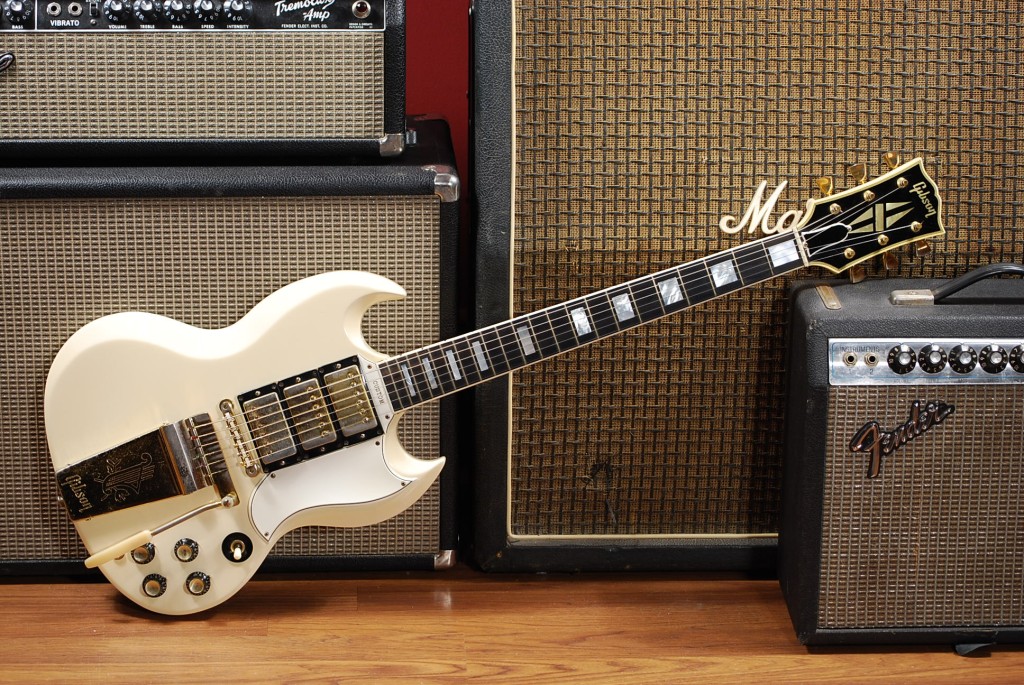
This was the close of the big band era.  Gibson decided on a similar strategy for the Les Paul SG and came up with a fancy model called the Les Paul SG Custom. It came with a Polaris white finish and gold hardware, including pickup covers, tuners, the Maestro Vibrola, and its cover. This guitar had 3 humbucking pickups and an ebony fretboard, which was dressed with very thin frets, similar to those on The Fretless Wonder (Gibson Les Paul Custom).  In fact, this guitar was dubbed by some, The Fretless Wonder. 


The bound fretboard came with block pearl position markers. The headstock was bound with a split trapezoidal inlay. It had the smaller 3-ply scratch plate that came on the cherry model, only it was white instead of black. This was a beautiful instrument; however most players are not fond of the thin fret wire that promised to make playing faster. 

Gibson called this model The Les Paul SG custom and after 1963 The SG Custom.

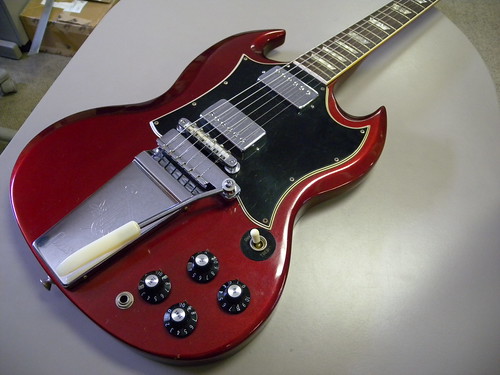
The small pickguard was offered through 1965. The neck joint was thickened in 1962 and in 1966, a redesigned neck joint was added, as was the enlarged pickguard, which aided in wiring the guitar. 


One of the flaws in this guitars design was the thin neck joint. If the guitar was dropped, the headstock joint generally cracked, rendering it unplayable to be sent back to the factory for warranty work.


1966 SG
Late in that year, a larger pickguard was also added to the model. This surrounded both pickups.

Other models came into being. They were all variations on the original design, but generally with less features. 


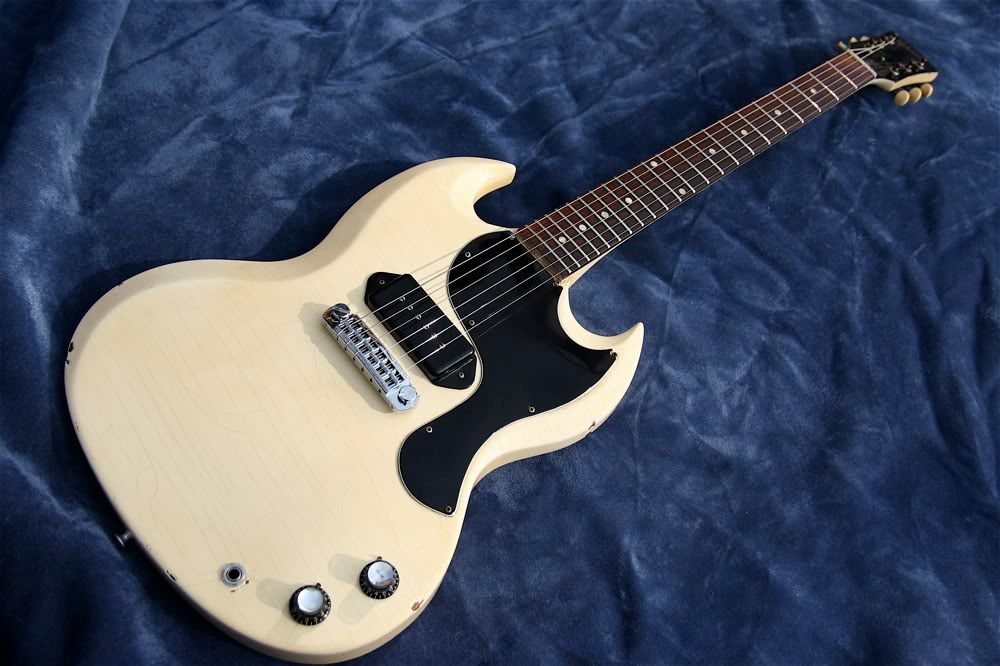
A Gibson Les Paul Jr.SG.  was available as early as 1961. It was a beautiful and simple guitar. There was one 90 pickup in the bridge position. The pickguard was enlarged to cover the body where the neck pickup might have been placed.  There were only two controls; for volume and tone, along with a jack. 


Most models came with a wrap-around tailpiece, which doubled as a bridge-saddle and bridge. There was a model that came with a tremolo unit which had a compensated non-adjustable metal bridge saddle. The vibrato are on the early guitars was a chromed metal bar although some model had a vibrato bar with a white handle. The strings on this guitar were anchored on a flat metal lip that allowed for movement. 


All of these models came with rosewood fretboards with white dot position markers. The headstock had a Gibson decal and the tuners came with white plastic buttons. 


The Gibson SG Special was a less stripped down version of the Standard. It featured one or two P-90 pickups with the usual controls. The neck was the same as the SG Jr. with white dot markers on a rosewood fretboard and a plain headstock. This model came with a tune-o-matic bridge and a stop bar tailpiece although it was made with an optional vibrato.

There have been numerous changes to the SG since the early 1970’s, which have included differing colour options, further changes to the fragile neck and changes to the pickguard and control placement. 


Around 1980, Gibson had Robert Moog design active electronics, similar to those in the Gibson RD Artist guitar. This became the Gibson SG-R1 and later the SG Artist.  


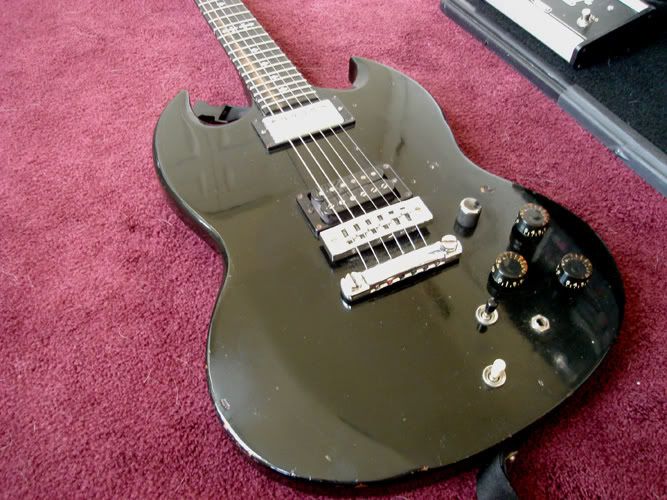
The mid 1970’s a version was offered with carving in the body.  The SG-100 was a budget version, in which the controls were mounted on the top under a metal cover. A limited run of The SG Standard3 was offered not too long ago. This guitar came with 3 single coil pickups, a single volume and tone control and a chicken head style knob as a pickup up selector switch.

Most recently, Gibson has experimented with the instrument as a limited edition robot guitar. Motorized tuners, which attached to a computerized tuner, automatically brought the instrument into perfect tune.


In 1965, the Gibson Melody Maker guitar was reinvented with the SG shape and was available with one, two or three pickups and with or without a vibrato.  Some people mistake the Melody Maker for an SG, however the pickups on this guitar are single coil with a plastic cover.


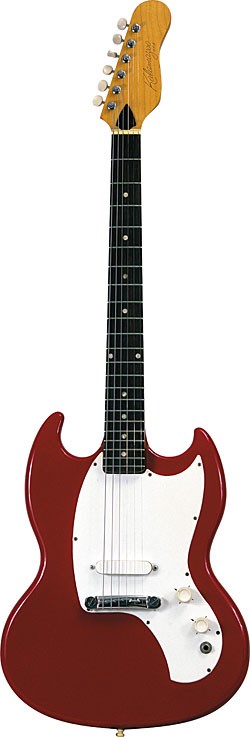
Gibson also produced a Kalamazoo line of electric guitars and basses. One of the models bore a resemblance to the Melody Maker SG, however this guitar was made out of MDF (medium density fiberboard).


Gibson’s short scale basses, including the EB-0 and EB-3 also received the SG shape.

The original price for a 1961 “Les Paul” SG standard was $310.  This was similar to the price one would pay for a Fender Stratocaster.


Monday, May 9, 2011

Charvel Jackson Guitars


Wayne Charvel

Wayne Charvel ran a guitar repair business in southern California, in the town of Azusa.  Charvel had begun this endeavor in the late 1960’s and was successful.  One of his employees was a Tennessee native named Grover Jackson


Grover Jackson
Charvel sold the business to Jackson in November of 1978. 

The company had been building guitars under the Charvel name, and had built up a good reputation, so Jackson continued to use the trade name. 


Jackson was able to offer his line of Jackson built Charvel guitars at the 1979 Summer NAMM convention, which was held in Atlanta, Georgia at the time.

If you are unfamiliar, NAMM, the National Association of Music Merchants, holds a trade show twice a year (it might have been once a year in the 1970’s) so that manufacturers of musical instruments and related products can display the wares to wholesalers and retailers.  

It has grown over the years, and one can bump in to not just the merchants, but also some of the world’s great players. 

These were the days leading up to Heavy Metal Music. Marshall Amplifiers and pointy guitars were the forte of the day. Record labels were hot to sign contracts to promote Metal.  


In 1980, the management of Ozzy Osbourne’s band, Black Sabbath asked Jackson to build a special guitar for their new guitarist, Randy Rhoads. Rhoads had just left Quiet Riot and signed on to play lead guitar for Ozzy.  Jackson and Rhoads got together for dinner and lay down their plans for the style of what would later become the Jackson Concorde.


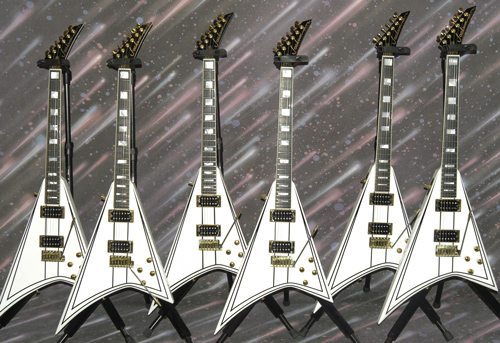
The guitar was sketched on a paper napkin. It was V shaped with an offset and very angular. The distinctive six-on-a-side headstock bore the Jackson name and became Jackson’s trademark.

Rhoads began using this instrument in concerts, but soon asked for changes to the guitar. The second version is the Randy Rhoads Concorde that most associate with him. It later became known as the Jackson-Rhoads guitar.

1986 Charvel Model 4
The more traditional looking Charvel guitars continued to be manufactured; however, Metal players preferred the radical looking Jackson models. 

This was the era of the Super-Strat. Many of these guitars were loosely based on a Stratocaster design, but had smaller bodies and pointy horns, the necks were fast, the pickups were wound to be hot, and the headstocks pointed down or upwards. 

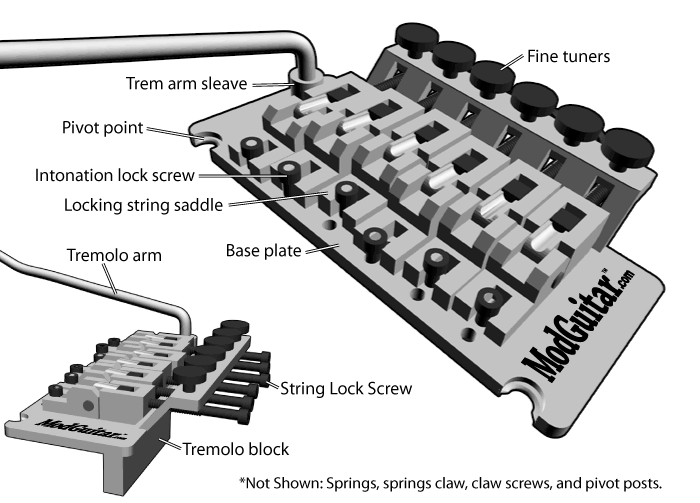
Floyd Rose had designed the locking-tremolo system that allowed for a variety of effects including the dive-bomb sound.  This system not only kept the strings in tune, but the strings pitch could be adjusted by violin-like mini tuners on the guitars bridge.

Jackson included DiMarzio Sustainer-Driver pickups in some models, such as the Phil Collen signature Dinky. Active electronics were added to Charvel model 4 and model 6.  The Charvel Surfcaster 12 string had a headstock similar to what you would find on a Rickenbacker 12 string guitar.

Many of the Jackson models, such as the Rhoads, either had a built in neck joint or were neck-thru-body guitars.  


'88 Jackson Dinky
The Jackson Dinky was his first bolt-on neck model. The Dinky was a 7/8th style guitar, which gave the player a shorter scale, enabling faster changes. Jackson guitars preferred DiMarizo pickups.


The unique Jackson headstock served a couple of purposes. First, it prevented the company from patent infringement since it was different from the Fender headstock and second the strings had a somewhat straighter pull than those on a Fender guitar. 

As of 2002, Fender Musical Instrument Company owns and distributes Jackson and Charvel guitars. You will find a Fender style headstock on current models.

Charvette Guitar
Grover Jackson was associated with his company through 1989 when it was sold to Japanese manufacturer AMIC. The company continued to build high-quality Jackson and Charvel guitars through 1991.  A Korean budget model named the Charvette came out during this era.

It was in the 1990’s when music styles changed and Grunge music outpaced Metal.  Grunge players favored cheap old guitars. The era of pointy guitars and hair bands for the most part ended.

Fender has maintained the same look and feel of traditional Jackson guitars.

Ibanez guitars copied the look of Charvel Jackson, and are still building pointy guitar models. 


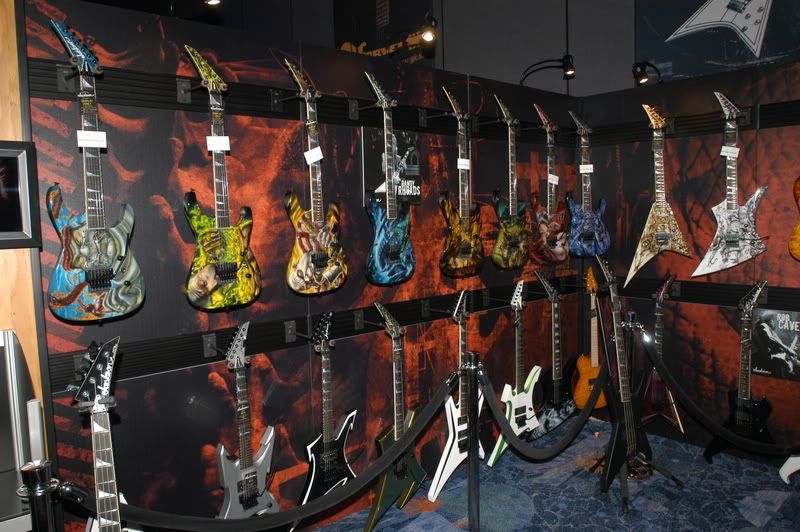
Besides the Rhoads and Dinky guitars, some other models worth mentioning are the Soloist, which was designed with a neck-thru-body and a super strat style, the Kelly, which was based on the Gibson Explorer, the King V, which was had a symmetrical V style body with long wings, and the Warrior, which had 4 pointy ends on its body.


Jackson Kelly

During the time that Jackson ran the company, he moved the business to differing sites several times. 


Glendora, California became the first new home of Charvel Jackson. In 1986, he moved his company to Ontario, California.


The address listed on the back of some of the U.S. made guitars lists a P.O. Box in San Dimas, California. These “San Dimas” guitars are the ones that are now prized and highly sought after by collectors. 

2014 update, Grover Jackson now works at Rickenbacker guitars.
©UniqueGuitar Publications (text only)