John Dopyera holding a resonator violin and George Beauchamp
The National String Instrument Corporation based in California was founded in 1927 by luthier John Dopyera and steel guitar player George Beauchamp. The men had met a few years earlier when Beauchamp, a vaudeville performer was looking for a louder guitar.
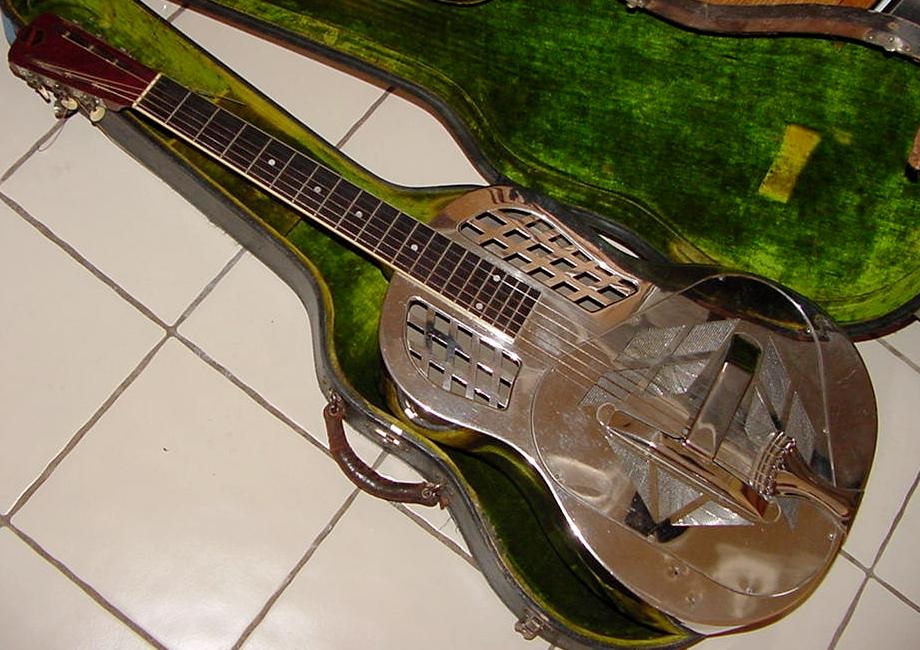
Dopyera had been building guitars, banjos, violins and other stringed instruments along with his brothers. It was in 1927 when Dopyera created the first tri-cone resonator guitar which had an aluminum body. Later models had wooden bodies, but still had the aluminum resonator.
In 1928 John Dopyera left the National String Instrument Corporation to start his own business, the Dobro Manufacturing Company.
This left his brother Louis Dopyera in charge. By now National was having financial difficulties.
The last thing that John Dopyera designed was a single cone or biscuit resonator. Dopyera never patented this before leaving the company. Beauchamp went on to obtain the patent.
Beauchamp went on to invent the “Frying Pan” steel guitar, which was probably the worlds first electric guitar. At that time he was working in partnership with Adolph Rickenbacker in a company called the Ro-Pat-In Corporation. Beauchamp was also responsible for designing the Bakelite electric steel and Spanish guitars produced by this same company.
Though John Dopyera had left National, he still retained some of the rights of the company. He changed his own companies name to National Dobro.
By 1934, Louis Dopyera, in an effort to save the struggling company, took on two partners who were business men, Victor Smith and Al Frost.
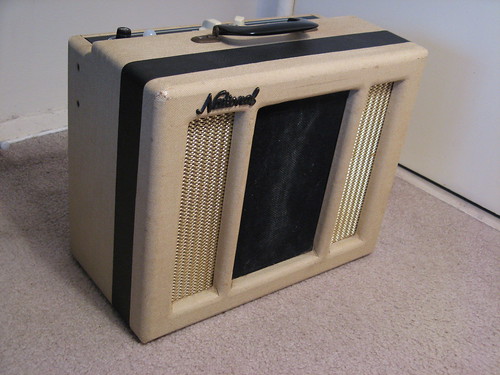
The business were relocated to Chicago and renamed by using the first letters of the three partners names; VAL Company or Valco. The company produced not just resonator guitars, but also lap steels, artchtop guitars, mandolins and amplifiers, sometimes using parts from other companies.
In 1942 the company reorganized. The war effort was on and “essential manufacturing” meant only building war related materials. By 1947 the companies focus was once again on guitars and amplifiers and once again Valco utilized parts made by other manufacturers including Gibson, Kay, and Harmony.
In 1952 Valco had produced its first solidbody electric guitar and by 1955 had offered their top-of-the-line Town and Country model under their National brand name.
Valco also introduced what the called The Silver Sound PIckup. This predated the popular piezo pickups of today. The Silver Sound was a coiled pickup in the base of the guitars bridge with two magnetic polepieces suspended from the saddle. It was an early attempt to capture the acoustic guitar sound from an electric guitar.
Around 1958 Valco produced an unusual line of guitars under the Airline brand name that were meant to be sold through Montgomery Ward stores. Unlike conventional wooden bodied guitars, the bodies on most of the Airline guitars were made of fiberglass material which they called Res-O-Glass.
Holes for the electronics were drilled in the bodies top and were fitted. The body pieces were then glued together and binding was placed around the middle of the body on most instrument.
One of the oddest Valco guitars was a fiberglass or Res-O-Glass model put out under the Supro brand name and called The Folkstar.
If you think back to the early 1960’s; briefly before The Beatles and the rest of the British Invasion, Folk Music was in vogue. Young folks wanted to be the next Peter, Paul, and Mary, or Joan Baez. Kids were buying acoustic guitars and trying to learn the chords to "Michael Row The Boat Ashore."
Valco decided to cash in on the fad in 1964 and came out with the Supro Folkstar Model S444, which combined features found on other Valco guitars. Unfortunately they were too late to the party.
The body, as mentioned was molded out of two sections of fiberglass. The “Kord-King®” neck had the Valco style headstock. And like the National Guitars, this came with a resonator that the string went over and attached to a trapeze tailpiece. I recall seeing one at my favorite music store when I was a kid.
They advertised it as a guitar that did not need an amp.
It only came in red. There were two sound ports on the guitars upper bouts. How did it sound? It was very tinny and not too loud.
In 1953 National came out with a really nice instrument they called The Belaire, model N-150. The body and neck were made by Gibson. The body was the same one on a Gibson ES-175, while the neck was similar to an L-50, but with a National style headstock.
This guitar had 3 volume knobs on the upper bout and 1 tone knob, located on lower side of the body. It also had a 3 way selector switch on the cutaway.
The design is great; Two symmetrical cutaways on the upper portion and a rounded bottom on the basses black Res-O-Glass body, a Brazilian rosewood fingerboard and bridge and the Kord-King® headstock that topped off its thin neck. It also had one pickup in the neck position and a Silver Sound® piezo pickup under the bridge. The bass had two knobs, one was for volume and the other was for pickup blend. The tuning pegs, made by Kluson were nothing special.
The body for this instrument was actually made for Supro and Airline guitar; a version of the Town and Country guitar produced by Valco under their Airline brand name. The only difference is the pickup, neck and bridge. These basses were produced for around four years.
Valco made an Airline model, that was the same bass, but the Res-O-Glass body had a slight sunburst finish. On later models, such as this 1966 version, the headstock was updated to the slanted style.
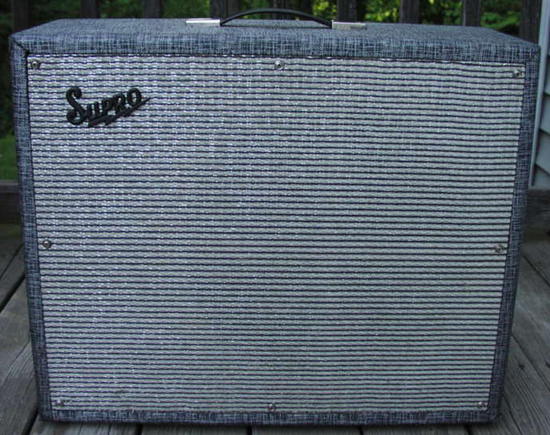
One of their most popular was the Supro Thunderbolt. It put out around 15 watts and came with a 15” Jensen speaker. It was supposed to be a bass amp, but was better suited for guitars.
Valco merged with Kay in 1967. The guitar boon had ended and sales ground to a halt. The Res-O-Glass bodies were abandon and guitar manufacturing was moved to Japan. By 1968 Valco had declared bankruptcy.
In 1989 a new company emerged called National Resophonic that was founded by Don Young. They built wonderful resonator guitars in the style of National Dobro/Valco, but had no relationship to the original company.
In 2001 Canadian Michael Robinson established Eastwood Guitars. The guitars and basses his company offers are replicas of vintage and classic designs mainly from the 1960’s. The guitars are made in three different factories in Korea and China and imported.
This is Der Fledermaus. the guitar, not the operetta by Johan Strauss. It was the most unusual thing to ever come out of the Höfner factory. Der Fledermaus translates to The Bat in English.
This was a nice guitar in the Höfner tradition; rectangular controls, just like on their famous violin bass, a zero fret, mother-of-pearl block position markers, toaster style type 1 pickups, and a two-tone sunburst finish. This guitar not only had bat wings, but it also had a built-in 4 watt transistor amplifier. There were only twelve of these guitars ever made.
And speaking about Bob Shade and Hallmark guitars, the Wing-Bat Guitar was based on the Hallmark Swept Wing Guitar, but was an enhanced version, which included bat-style wings that were based on the tail section of the George Barris’ Batmobile.
It also comes with an indented tail section, which has a working tail light, a turbine “power boost’ switch, a Mosrite style vibrato and a Hallmark 60 Custom single coil pickup.
Bernardo Chavez Rico owned a wonderful music store in Los Angeles called Bernardo’s Guitar Shop. Rico had purchased the building from the Candelas Guitar Shop, which had a rich history unto itself. But that is another story.
Bernardo’s son, Bernie, worked alongside his father. Bernie was an accomplished Flamenco player and became involved in luthery work. This shop became a hang-out for musicians in-the-know in the LA area.
Around 1968 Bernie began work on a solid body guitar. This started a venture that we know as B.C. Rich guitars, which became world famous. One of their best sellers with the Heavy Metal set was The Warlock, which was welded by such players as Mick Mars, Lita Ford, C.C.Devile, and Paul Stanley of KISS.
For the past decade, Epiphone, as owned by Gibson Guitars, has never been shy about jumping on a fad. Guitarist Wen Shang-Yi of the Taiwanese band MayDay is endorsing their lasted creation, The MayDay Monster Epiphone Guitar. This was introduced last August and is actually a very nice instrument. It has a 1960 rounded D profile neck, a glued-in neck, a rosewood fretboard with trapezoidal inlays, and twin USA manufactured Gibson Burstbucker pickups. MayDay is a very popular band throughout China.
Though he is really not a monster, he certainly has monster chops and has a nice costume. Buckethead has been playing his own style of guitar for a longtime, For a while he even wrote a column for Guitar Player magazine.
Gibson Guitars unveiled its Buckethead model several years ago. This Les Paul style guitar comes with an Alpine White finish on its two piece maple top and features a pair of Gibson contemporary-voiced Ceramic series humbucking pickups that are very hot. And it features two kill switches. It is indeed a gorgeous instrument.
Frying Pan - Gibson ES-150 - Ro-Pt-In Electric - Les Paul's "Log
In the scheme of things, the electric guitar is not that old. Since its inception, designers have thought of interesting ways to change its sound. Guitar players, in general, have been attempting to alter the guitars tone, even before pickups were added.
I recall watching a video of Andre Segovia in which he described by playing closer and farther away from the instruments bridge, one could change the timbre of the guitar to give it a more bright or mellow sound.
Guitar tone-shaping pedals came about in the mid 1960’s and by 2016 have evolved into devices that make your guitar sound like an altogether different instrument.
Electronics companies have also introduced guitar synthesizers, that essentially use the guitar as a controller that is connected to a sound producing device.
But before all of these pedals and synthesizers came into vogue, guitar manufacturers and designers were attempting to get alter the guitars tone by using some pretty zany pickup designs, lots of pickups, and unusual placement.
Some of these designs worked and some were just plain bizarre.
Probably the most well known is Leo Fender’s slanted pickup placement on the Fender Esquire, Telecaster, Broadcaster, Stratocaster, Duo-sonic, Bullet, and Mustang. I honestly do not think the treble is enhanced that greatly by slanting the pickup, however it does look cool.
However Fender was not the first to use a slanted pickup. In fact in 1940 Gibson had placed a 7” pickup on an ES-300 guitar that was anchored just below the end of the fretboard below the 6th E string and then anchored just above the bridge above the 1st E string.
A year later the pickup was redesigned into a much shorter version on the ES-300 that was placed just in front of the bridge.
The guitar craze reached epic proportions in the mid 1960’s. This was after the British Invasion that affected not just the United States, but Europe as well.
Countless youngsters wanting to be the next big music group went out and purchased a guitar or bass. Businesses were importing a lot of instruments not just from Japan and Asia, but from Germany, Sweden, Russia, Norway and other European countries. So designers were getting creative with the pickups.
The Framus Atlantik came out around 1966 and was available with either two or three pickups. The body was based on Gibson’s ES design and came with one or two cutaways. The pickups were slanted, but were not parallel. It was definitely not designed by someone with OCD.
The Japanese made Greco Shrike was one weird guitar. The twin pickups seem to be “L” shaped and placed opposite of each other. There are 3 electro-magnets in each pickup. Two are in the longer section and one is in the shorter section. By using the slider switches on the upper bout different combinations of the magnets can be turned off or on. How does it sound? Surprisingly it sounds very nice.
A player would need two amps to properly use this guitar. The biggest problem was the coil in each pickup was not wound enough to get any useful signal. But it looked great on paper. Sekova was a brand name that Kawai Music Company used on some of their guitars at that time.
This St. Moritz guitar is something of a mystery. It is a stereo guitar and was probably made in Japan by the Fuji Gen Gakki company, although the name conjours up images of Switzerland.
Although the pickups on this guitar appear to look fairly normal, they actually are stereo pickups. This 1966 era guitar was made by a woodworking firm from Neodesha Kansas caled Holman-Woodell for the Wurlitzer Music Company They produced guitars from 1965 through 1968, including the LaBaye 2 x 4 guitar. This is a Wurlitzer Gemini guitar and has Holman-Woodell made Sensi-tone single coil pickups.
Gretsch created a stereo guitar for that was designed by Gretsch demonstrator Jimmie Webster back in 1956. It was based on the top-of-the-line White Falcon model and made to be played through a pair of amplifiers.
It was called "Dark Eyes." If you look closely at the upper frets on the neck of this instrument you will see 6 pole pieces on the guitars fretboard that are actually pickups placed inside the neck positioned under the 5th and 6th strings, designed for Chet to run the 5th and 6th string through an octave box and into a second amp. A truly unique instrument. The project was deemed to expensive for the public and was shelved. The only model in existence is the prototype. At one time it was owned by Les Paul.
The USA was not immune to guitars with unique pickups. The Fender XII (that’s 12 for anyone whose school did not teach Roman numerals), came with four pickups and a 4 way pickup selector. This placement enabled the guitar to be played with the both neck pickups, the lower neck and upper section of the bridge pickups in series, the lower neck and upper section of the bridge pickups in parallel, or both sections of the bridge pickups.
Many recording artists preferred the Fender XII since the strings were back-loaded instead of attaching to a trapeze tailpiece, as on a Rickenbacker and each string had an adjustable bridge saddle.
The Fender Performer came out in 1985 in an attempt to win over the Heavy Metal players who had gravitated to super-strats. The Performer featured oddly shaped humbucking pickups that slanted upward. The pickups had plastic covers with no exposed pole-pieces.
This instrument came in two models; the Standard and the Elite. Both came with twin single coil pickups, although some models may of had three single coils. The pickup design was rather odd since it was an elongated quadrangle shape. Both instruments were originally made in Japan at a time when Fender had no US based production facility and were designed by John Page.
The Fender Starcaster was somewhat of an oddity in itself. It was built to compete with Gibson ES double cutaway thinline series guitars. The pickups on The Starcaster were Fender Wide Range pickups which were designed by Seth Lover, the man credited with inventing the humbucking pickup. Instead of AlNiCo magnets, the Fender Wide Range pickups used CuNiFe or Copper/Nickel/Iron magnets. The pickups pole pieces were staggered with 3 on the pickups bottom strings and 3 on the pickups top strings. This pickup was also used on some Fender Telecasters. It had a DC resistance of around 10 kΩ.
Gibson Guitars also came out with some unusual pickup designs. The Gibson Flying Vee - Model V2 was offered in 1978 with twin V shaped pickups aka boomerang pickups. The body was sculpted and it is a beautiful guitar. The pickups are single coil models with noise reduction features.
The Gibson Recording Les Paul is an excellent guitar if you appreciate Les Paul style of playing.
Les was a pioneer in recording and invented multi-track recording. His technique was called sound-on-sound, which could be accomplished with a tape recorder that had three heads.
Once the first pass was recorded, then laid subsequent passes were laid over over the first track. With high-impedance pickups or microphones the original sounds dissapated after about three or four overdubs. Les discovered the solution was to record with low-impedance pickups and microphones.
These instruments were equipped with low-impedance pickups for the clarity of their sound, that were meant to plug directly into a recording console, but came with switches and electronics to use with an amplifier. The twin stacked-humbucking pickups were slanted downward.
Gibson came up with some unusual designs during their Norlin years. One of these was The Maurader. It was a single cutaway guitar with a 12 1/2” body and a bolt-on neck. This guitar came with a humbucking pickup in the neck position and a single coil blade pickup, encased in epoxy in the bridge position. The bridge pickup slanted downward.
In 1973 Gibson came out with the Grabber Bass. This was a long scale bass, designed to compete with Fender instruments. The headstock on the Grabber was in the same pointed style as the Gibson Flying V guitar. The unique feature about this model was the sliding humbucker pickup.
It was a very bright sounding pickup and was placed in an indention in the center of the insturments body. The pickup could “grabbed” by the player and moved forward or backward to make tonal changes.
Goya Guitars were originally made in Sweden as Levin Guitars. A US guitar distributor named Jerome Herschman once saw Levin guitars at a trade show and suggested a name change to something that sounded Spanish. He suggested Goya. By the mid 1960’s, Herschman was importing Goya guitars to the United States. He sold his share to a company called Avnet in 1966, which branched into electric models.
The electric guitars produced under the Goya brand were actually made in Italy by the Polverini Brothers. One of these models with unusual pickups is the Goya Rangemaster. And though the guitar was produced in Italy, the vibrato system on this instrument was made in Sweden by Hagstrom.
The twin double pickups on the Goya Rangemaster yielded a variety of sounds and were controlled by the guitars selector switches.
The controls on the upper bout allow the following pickup combinations. The first is the two neck pickups together, the second switch activates the lower neck pickup and the upper bridge pickup, the third switch turns on the treble side of the neck pickup and the bass side of the bridge pickup and the fourth switch activates both bridge pickups.
The switches on the lower bout control the tone and there is a volume potentiometer.
The Hoshino Gakki company of Japan had been using the brand name Ibanez for some years. They were well known for producing a lot of copies of US made guitars and were eventually sued by Gibson guitars in the Gibson vs Elger action in 1977. It is a fact that Ibanez saw the writing on the wall a few years prior to the lawsuit, because in 1975 the company came up with a very original design called The Ibanez Iceman.
The Ibanez Iceman model 2663TC, introduced in 1975 and originally called the Artist model, is quite interesting because it has only one pickup; A triple coil pickup.
A Japanese company named Atlansia has created the Atlansia Breeze Bass. Instead of the usual humbucking or single coil, H. Nobel has placed 8 single pickups on this bass.
Each pickup, called ARS pickups, has two pole pieces. The bass is an extremely modernistic design.
Norma Guitars was the brand name that a United States distributors used on some Teisco guitars. This guitar seems to have a pickup layout similar to the aforementioned Greco guitar, but in reverse.
The switch on the upper bout controls the pickup configuration.
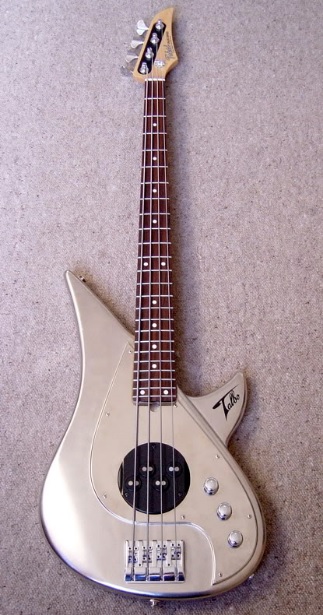
The Tokai Company of Japan began making copies of Fender and Gibson guitar around 1977. By 1983 Tokai introduced an aluminum body guitar and bass called The Talbo (Tokai Aluminum Body). The guitar comes with the usual humbucking pickups