One of Rock-a-billy's greats has passed away. Lorrie Collins, the beautiful half of the Collins Kids, died on August 4th as the result of a fall. She was 76.
Many folks now may not be aware of the popularity of this duo during their heyday.
The Collins Kids, Lorrie and Larry, were very big in Southern California in the late 1950's and early 1960's due to their appearances of popular television shows, such as Town Hall Party in 1954 where they were regulars, Western Ranch Party in 1957 and The Adventures of Ozzie and Harriet in 1958.
The duo was discovered by Leon Leon McAuliffe, the steel guitarist of the Bob Wills band when they were playing music in a Tulsa Oklahoma ballroom. She was 12 and her brother Larry was 10 years old.
Lorrie, whose actual name was Lawercine, had begun at age 8 appearing in and winning talent shows. Her father was a dairy farmer and crane operator, while her mother was an amateur singer, and mandolin player. After hearing the kids,
McAuliffe urged the family to move to southern California. Their act consisted of Lorrie, singing and playing guitar, and looking gorgeous, while her little brother played amazing guitar breaks, and danced around the stage. Both wore customized Western clothing.
Guitarist Joe Maphis trained Larry, and he did a great job. Maphis made sure that Larry was equipped with a one-of-a-kind handmade, double neck guitar from Semie Moseley. Though it appeared to be similar to Maphis' instrument, Larry's guitar was equipped with 2 six on a side headstocks, while Maphis' guitar had 3 on a side headstocks on both necks.
Lorrie played a Martin D-28 guitar, that had been re imagined by Moseley, by replacing the neck with one of his custom-made creations that had a six-on-a-side headstock.
He also put on a bridge that looked almost like the one on a Gibson J-200. Moseley also crafted a huge black pickguard, that had white eighth notes, a flying eagle, and flowers. Her name was inlaid on the fretboard. It was an impressive instrument, made to stand out.
Though she was just a youngster at the time, hear voice was amazing. Lorrie was right up there with Wanda Jackson, Brenda Lee and Patsy Cline.
Back in that era, California had experienced an influx of workers migrating from the southern states, Texas, and even Detroit, in search of work in the newer factories. They brought with them their love of Country Music.
Locally produced black and white television shows picked up on this, and the performers became stars.
It was on Town Hall Party that Lorrie met Ricky Nelson. Although it was never mentioned on the Adventures of Ozzie and Harriet, Ozzie Nelson got his start as the leader and vocalist of his own big band. His wife Harriet was the singer. The show had a great following in the late 1950's.
When Ozzie discovered Ricky had a great singing voice, he talent was put on display. Ricky Nelson met Lorrie on the set, and eventually dated her. She was asked to appear on two episodes, and played identical twin sisters.
Larry pursued a career as a songwriter, and scored a hit with the song, Delta Dawn. The Collin's Kids eventually reunited in 1993 for a performance at a rock-a-billy festival in England, and continued to perform right up until Lorrie's death.
Her brother Larry recalls “We grew up with Johnny Cash, Patsy Cline, Carl Perkins,” Larry Collins told The Post. “Everybody that came to California when they first started did ‘Town Hall Party.’ All those acts, Lorrie and I got to meet them, know them, travel with them, work with them.” “Lorrie and I had the luckiest childhoods of anyone that you can imagine.”
Matsuki Seisakujo, the name of the original company, was founded by a cabinet maker’s apprentice Mr. Mitsuo Matsuki and friend Mr. Atsuo Kaneko. If you read my previous article on Teisco guitars, it will become evident that Atsuo Kaneko was also the partner of Doryu Matsuda, and one of the principle founders that started Teisco Guitars in 1946. However, Guyatone was in business over a decade, before Teisco.
Mr. Matsuki was an apprentice at a cabinetry firm, and enrolled in night classes to study electronics. Mr. Kaneko got his start playing Hawaiian music in Japan, which was popular at the time. Kaneko also played Spanish guitar.
Kaneko was a friend of Matsuki, and he suggested that they build electric Hawaiian guitars. So by the late 1930’s the Matsuki Seisakujo (company) was set up. The name translates to the Matsuki Joiner Company. They began by building electric lap steel guitars in the style of that era’s Rickenbacker guitars for domestic use. These early instruments sold under the Guya brand name.
In 1940 the company had to halt production since Matsuki was drafted into the Japanese Army to fight in the war between Japan and China. This last until 1945 when the war ended.
Upon returning Matsuki formed his own business and called it Matsuki Denki Onkyo Kenkyujo or Matsuki Electric Sound Laboratory. This would explain the departure of Atsuo Kaneko, who had become involved with Teisco during the ensuing years.
After the war, Matsuki production restarted and the Guyatone name was used on the companies instruments and products. This company not only made electric guitars, but also built amplifiers, and cartridges used for record players.
For those unfamiliar with “record players”, may I digress for a moment.
Record players were originally called phonographs, and played vinyl records on a turntable. By the late 1940’s these “record players” contained an amplifier. The grooves on the vinyl disk were read by a needle on the end of an arm or aperture.
These vibration were turned into electrical signals and sent it to the amplifier. The cartridge essentially worked like a guitar pickup. In fact Chet Atkins and Les Paul both took apart old phonographs to use the cartridges as pickups on their first acoustic guitars.
So let us get back to the Guyatone story:
Guyatone was manufacturing a lot of record player cartridges and this market was boosted after their products were being used by NHK, a government owned broadcasting station.
In the early to mid 1950’s the company’s name was changed to Tokyo Sound Company (which also leads to some confusion with Teisco). It was later changed to Guya Company Ltd., but later was changed back to Tokyo Sound Company.
By July 1956 the Tokyo Sound Factory began large scale production. During the late 1950’s to the early 1960’s they were producing up to 1500 electric lap steel guitars, 1600 electric guitars and basses, 2000 guitar amplifiers, and 5000 microphones every month. These were distributed and exported under different brand names.
In the United Kingdom, the James T. Coppock Leeds Ltd imported Guyatone products under the Antoria brand name. Some well know players got their start playing these guitars including Hank Marvin, Marty Wilde, Rory Gallagher, Johny Guitar, Jeff Beck, and even Ringo Starr, who played drums and guitar with Rory and the Hurricaines.
In the United States, Buegeleisen and Jacobson of New York City were importing Guyatones and badging them under the Kent brand, the Saturn brand, the Starlight brand, and the Royalist brand.
In 2013 the Tokyo Sound Company closed up shop and transferred ownership of the Guyatone name to Hiroshi Matsuki, the son of the company’s founder, and brother of the company’s current CEO.
It took about a year, but the company reorganized, and reopened. The company manufactures mostly parts and effects pedal now. They currently maintain an office in Oswego, Illinois. Guyatone built some excellent and unique instruments from the 1950's through the 1980's.
Another model that was popular in the mid 1960's,was the model GT-70 Star.
One method of distinguishing Guyatone guitars from Teisco is the slanted string bar that is on the instruments peg head just above the nut. This model was sold under the Star brand, and the Ibanez brand. The body shape is used today on the Ibanez Talman models.
One of the most famous artists that was known for using this model was Bluesman, Hound Dog Taylor. It was also known as the Rhythm Maker model 1860. Another famous artist that used this guitar was a young Jimi Hendrix, who traded his Danelectro for one of these guitars.
One of the most well-known and respected Irish blues musicians was Rory Gallagher. During his early career he owned and played a Guyatone LG-60B. This is his guitar and is on display at Harrod's of London. Hank Marvin started out playing an Astoria LG-50, in his early days of playing guitar for Cliff Richard and the Drifters.
These are the Guyatone guitars that I recall being sold in pawn shops and some music stores back in the mid-1960's: the model EG-90, the model 1202 bass, the model 1830 small body, and the model 1830 large body, and the set neck model 1860.
Some of these were sold under the Guyatone brand, and some under the Ibanez brand, and of course some jobbers put the retailers brand name, such as this 1960's Guyatone sold under the Tulio brand name.
As the 1960's progressed, the sound of the 12 string electric guitar gained popularity in pop and rock music. This is a mid 1960's Guyatone electric 12 string guitar.
Here is a mid 1960 Kent model 820 hollow body electric, with a gorgeous stripe on its side. The neck is a bolt on type, and has a skunk stripe down its middle.
Most all of the major department store chains sold Guyatone guitars at their stores and through their catalogs. Here is a late 1960's Silvertone 1445, which was heavily influenced by that era's Mosrite guitars, right down to the German carve.
This is a Guyatone model LG-350T DX, that was sold only in Japan. It may have been built as a homage to professional motor sports legend Nobuhiro Tajima. This was an original and very unique guitar. It has a bolt-on neck, a blue sparkle finish, and an unusual vibrato system.
One of the more unusual Guyatone models was the model LG-160T Telstar. This was considered a very good instrument in its day. FYI, Telstar was the first communications satellite launched in July of 1962, and was a very big deal at the time. It even inspired a popular song, of they day produced by Joe Meek.
I have an old guitar that my Dad gave me back in 1965. He owned a grocery store, and took it in as pawn from a customer that could not pay their bill. Although there was no metal name plate on the headstock, by it’s pedigree, I can tell it was made by Teisco at a time when the United States and the United Kingdom were being flooded with cheap electric guitars made in Japan.
These guitars were normally sold by brokers, who usually re-branded them or had them rebadged them prior to shipment, then sold them to music stores, department stores, and even pawn shops.
I cannot describe the incredible demand for guitars and basses after the British Invasion. It was a fad, but many companies saw it as a bull guitar market and rushed in to make money.
By 1956 the name was changed to Nippon Onpa Kogyo Company, then in 1964 it was changed to Teisco, which most sources explain is an acronym for Tokyo Electric Instrument and Sound Company. However, according to the company founder, Mr. Kaneko, that was not the case. He simply liked the name Teisco. There was another company called Tokyo Sound Co Ltd, that built Guyatone guitars. Teisco is the name that gave the company it’s recognition.
The Teisco brand lasted until 1967 when the company and assets were purchased by the Kawai Musical Instrument Company. At that time, Kawai discontinued the Teisco brand on their guitars, but kept the brand name for use on their electronic keyboards.
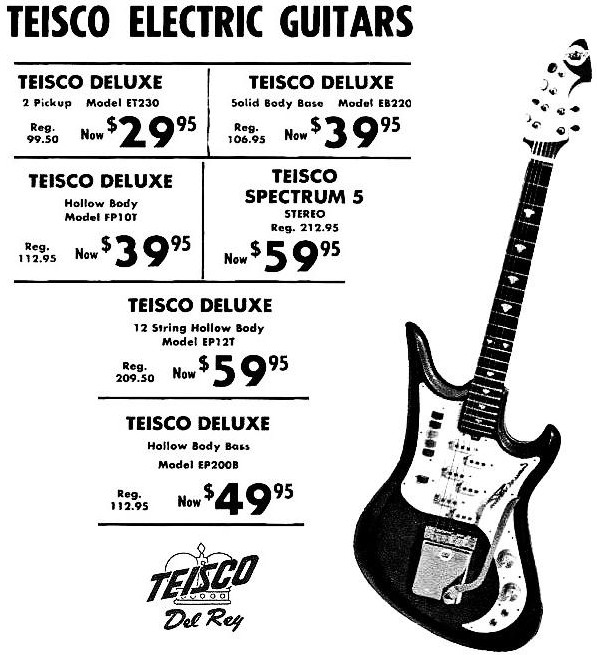
The original company produced guitars for domestic use. Tariffs made importing foreign instruments unreasonably expensive. The company didn't begin importing guitars to the United States and United Kingdom around 1959. Typically these instrument were re-branded Teisco Del Rey (Teisco, the King), at a time when manufactures believed adding a Spanish sounding name to a guitar. ie. Greco, Alvarez, El Degas, made the instrument more appealing.
By the time Teisco guitars arrived in the United States, most were sold under different brand names including Silvertone, Kent, Duke, Cameo, Encore, Hy Lo, Kimberly, Heit Deluxe Kingston, Norma, Sonatone, Zim-Gar, Kay, and Audition. Sometimes this was a name associated with a particular business. Many were sold in department stores such as Sears, Montgomery Ward, and Woolworth.
Teisco guitars were affordable and sold in the twenty to one-hundred and fifty dollar range during an era when the average salary of a family in the United States was less than $5,000 a year.
In 1965 a new Fender Stratocaster cost $200, so Teisco seemed to be a great alternative for many families of budding rock stars.
Many Teisco guitars were purchased by importer named Jack Westheimer, and his Chicago company W.M.I., then wholesaled to one of the aforementioned retailers. Those guitars sold under the Kent brand name were imported by Bugeleisen and Jacobson of New York. In the U.K. Rose Morris Music imported Teisco guitars.
The Teisco guitar bodies were generally thinner than domestically produced guitars. The pickups were not nearly as advanced as those of U.S. guitars, and could be microphonic.
Guitarist Ry Cooder, has replaced the pickups on several of his guitars with Teisco pickups. He likes the sound,
Teisco necks were sometimes thicker, and on some the intonation was off as you went up the neck. This was probably not a problem for those who did not advance beyond 3 chord strumming.
The hardware on these guitars was very basic. The machine heads were usually open gear style, the nut was plastic, the bridge and saddle were not tunable, and if the guitar had a tremolo unit, it was a very simple arrangement with one spring housed under a metal plate at the instruments distal end.
The earliest Teisco guitars were produced at a time when the Japanese market found it difficult to import US made instruments, so Japanese companies made “replica” guitars. This eventually lead to problems.
The earliest models designated for domestic use and import tended to resemble Gibson guitars. These were Spanish guitars, and Hawaiian electric guitars
The Spanish guitars had thin hollow bodies and one of two single coil pickups, and sometimes a very basic tremolo unit. The earliest Teisco electric guitar, from 1952, is the model EO-180. It resembled a full size hollow body guitar with a slot peghead, round sound hole, and belly bridge. Just below the sound hole is a single coil pickup. An input jack is mounted on the lower side of the guitars body.
By 1953 Teisco produced a series of guitars under the designation EP. These bore more of a Gibson-like shape.
The TG-54 had a slab Les Paul body, with a single pickup, but a Telecaster-like control panel, and a huge bridge cover/palm rest. The model J-5 was based on an original and unusual shape.
The 1960's came, and Teisco guitars took on more of a Fender-like quality.
This guitar was modeled on Fender's 1959 Jazzmaster, but with some modifications.
The scratch plate was made of metal, and it had 3 single coil pickups. Controls included a single volume and tone control, and a selector switch near the lower cutaway. The bridge/saddle unit was similar to the one on a Telecaster, with 3 adjustable saddles, though the strings attached to the bridges distal end.
Perhaps the most distinctive feature of this guitar were the cut-outs on the body, and the matching one on a headstock. Another unusual feature were the fret markers on the instruments rosewood neck. These looked a bit like croquet hoops, with a rectangle to mark the 12th fret.
A bass guitar came out around this same time, the Teisco EB-1. It was a "replica" of a Fender Precision bass, from different eras. The sunburst body was similar to a 1960's P-bass. The scratch plate was made from metal, and had a one single coil pickup in it's center. The controls were tone and volume. The bridge/saddle was a two-piece adjustable affair, with the strings attaching at its end.
The neck was capped in rosewood, and had small block markers on the lower edge, except the 12th fret had small block markers on both sides.
The headstock was similar to the one on a 1951 Precision bass, except it was finished in sunburst. A friend of mine owned one of these. They retailed for about $60, compared to the cost of an early 1960's Fender Precision bass, which sold for around $240.
Teisco produced many guitars, but a few that stand out from the early to mid 1960's. I saw dozens of Teisco ET-100's, and ET-200's in pawn shops back in the mid-1960's.
The ET-100 featured a tulip shaped sunburst body, a bolt-on neck with a six-on-a-side headstock, and a single coil pickup that was mounted on a black plastic pickguard that had a lovely white floral leaf design. It came with the obligatory volume and tone controls, and a simple metal bridge. The tailpiece was covered by a metal palm rest. This model was made in Taiwan.
A several prior models with the same designation came out in the early 1960's, only it had a different shape that was similar to a double cutaway Gibson Melody Maker, only the lower horn was more set in. This guitar was not as elaborate, and came with a smaller metal scratchplate.
The ET-200 had similar features, including the elaborate pickguard, but it came with twin single coil pickups, with on/off rocker switches, and a tremolo unit. An earlier model came with the smaller scratchplate, and the non-tulip shaped body.
The other Teisco guitar I recall from that era came with a built-in amplifier. This appealed to those folks that didn't want to spend any more money on an amplifier for their kid, however the built-in amp was useless except for practicing guitar.
This was the 1964 Teisco TRG-1 which came with a "gold foil" single coil pickup, the volume and tone control were mounted on the top side of the guitar, along with a switch to turn on and off the amplifier. The amp worked on two 9 volt batteries that mounted in the rear. The 2" speaker was under the pickguard on the instrument's lower bout.
Teisco also produced some four pickup guitars under the ET designation. The ET-440 to be precise. These had four, count 'em four pickups, and four rocker switches.
But Teisco also made other four pickup guitars under the Checkmate brand, the Norma brand, and the Kimberly brand to name a few. Some came with rocker switches, while others had simple slider switches. Some came with a single volume and tone control, while others had volume and tone controls for each pickup.
I fail to see the point of more than three pickups, but I guess it was a way to sell more guitars.
One of the most unusual Teisco guitars was the May Queen. Most sources date its origin in 1968. This was hollow, sort of a artists palette-shaped guitar, but with a large cutaway. This guitar was produced after Teisco was acquired by Kawai.
May Queen
It came with twin single coil, and somewhat microphonic, pickups, and a tremolo unit. On the guitars upper side was a long cats-eye "f" hole, while the lower side had a long white pickguard that read "MayQueen, and TEISCO". On it were a volume and tone control, a thee-way selector switch similar to a Switchcraft switch, and the input.
The 6-on-a-side headstock had an unusual shape and its colour matched the body. The body on this guitar was very similar to the one on the 1967 solid body Vox Mando Guitar. The May Queen came in black, red, and yellow. It was a most unique design.
I am saving the best for last; the 1966 Teisco Del Ray Spectrum 5 guitar. Teisco had made other guitars under the Spectrum series, but the Spectrum 5 was the top-of-the-line.
The headstock was like no other up to this point. There were four tuners on one side, and two on the other. It had a very unique shape. The colour of the headstock matched the guitars body, but the headstock also had a white plastic cover that set it apart.
The bolt-on neck was capped in ebony was topped with unique position markers.
The white scratchplate bore a metal name plate that declared this to be a Spectrum 5 in stylized script. The guitar was so named due to the five different tones that were available. The guitar had one tone and volume control, but there were five different coloured slider switches to control the pickups.
The guitar's three pickups were unique, as they were split and staggered with three pole pieces on bass side, and three more on the treble side. This was because the Spectrum 5 was a stereo guitar.
A switch on the pickguard turned on the stereo feature. This guitar came with two input jacks. The top jack was used for monaural play. For stereo, two cables were necessary. The pickups under the three bass strings would be routed to one amplifier, and the others under the treble string would go to another amplifier. It was a unique instrument.
Teisco was acquired by Kawai guitars in 1967. By then Teisco had built over 1 million guitars. Kawai did maintain the Teisco brand name until 1969 on imported instrument, but kept the Teisco brand it on guitars sold in Japan through 1977. Guitars built and imported after 1969 seemed to lose the originality of the original Teisco instruments, and became copies of popular instruments.