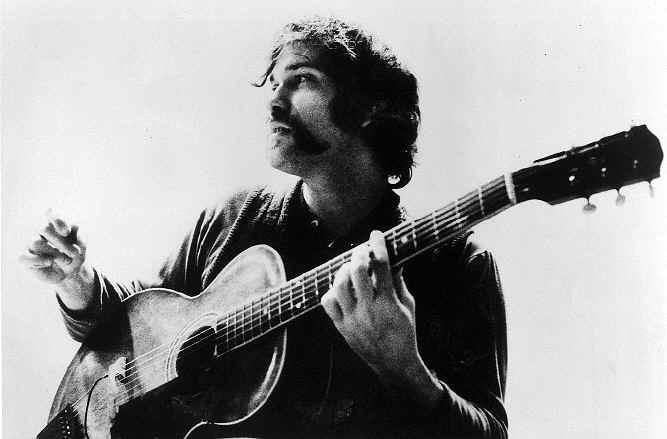
John Abercombie, passed away on August 22nd of this year. Abercrombie was a well-know, world class jazz guitarist, with a lyrical style that is hard to pin down to one genre. Abercrombie was aslo a composer and bandleader. His style changed and evolved throughout the years.
Born in 1944. Abercrombie took up guitar at age 14 and learned Chuck Berry, Bill Haley, and Fats Domino tunes. He later discovered Jazz by listening to Barney Kessel recordings.
John attended Berklee College of music where he gigged with other students at a local jazz club. It was there that he was invited to join a band made up of Hammond organist Johnny Smith, sax player Michael Brecker, and his brother, trumpet player Randy Brecker.
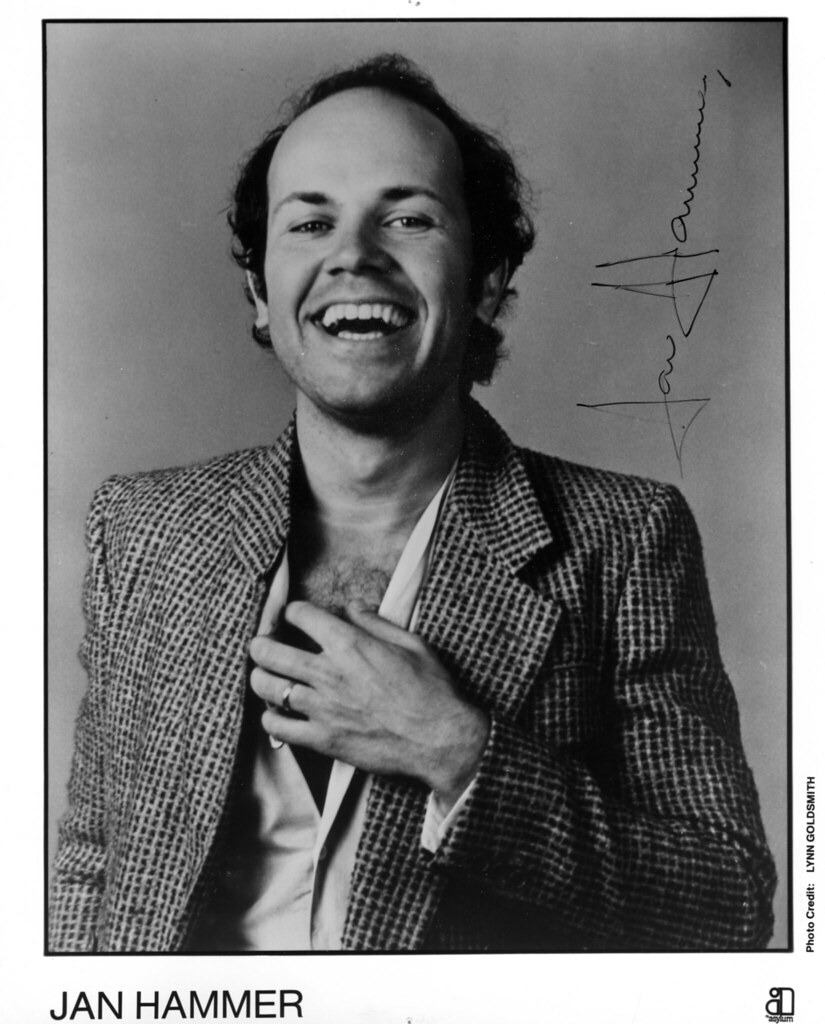
For awhile, Abercrombie shared a room with fellow student Jan Hammer.
When the gig with Smith ended, Abercrombie moved to New York and signed on to play in drummer Chico Hamilton's band. He was soon in high demand as a sideman.
Abercrombie attributed the beginnings of his style to Kessel, Wes Montgomery, and Jim Hall. He also drew inspiratation from Miles Davis and Bill Evans. John Abercrombie became one of the pioneering figures of Jazz/Rock, which he states was developed out of necessity due to lack of role models.
In an interview he said, "I had to figure things for myself. I grabbed onto every device in my arsenal, including my knowledge of harmony and the guitar, the few little fuzztone or pieces of gear that I used at the time, and tried to fit it in. When I'd play with Jack and Dave Holland, or some other players, I responded to what I was hearing around me, and let the sound of it all teach me what I was supposed to do." (excerpted from an article by Ted Panken.)
At one point on the tour, Abercrombie decided this was not the direction we wanted to pursue for his music or life style.
He moved back to New York and became an in-demand session player, recording with Gato Barbeiri, Barry Miles, Manfred Eicher (who founded ECM records), and Gil Evans.
By 1974 he teamed up with college acquaintance Jan Hammer and drummer Jack DeJohnette for a recording called Timeless. This album was critically received and established a foothold for Abercrombie with ECM records.
In 1975 he formed the band Gateway with DeJohnette and bassist Dave Holland, and recorded two albums Gateway and Gateway II.
After the Gateway albums Abercrombie altered his style to a more traditional Jazz style. He recorded several LP's and was leader of the group.
The Abercrombie Quartet, which recorded the LP of the same name and another simply called M.
Abercrombie went on to perform with the groups bassist, George Mraz and guitarist John Scofield. Abercrombie's style included Jazz Rock, Jazz Fusion, and plain, but very lyrical Jazz.
In the mid 1980's he experimented with a guitar synthesizer in performance. From the 1990's to the 21st Century Abercromblie performed with an ever-changing group of players, settling usually on trios with a drummer and organist, though occasionally other instrumentation was added. Throughout his career he remained loyal to the ECM label.
John Abercrombie played a variety of different electric guitars throughout his career. The earliest photo I can find shows him playing a Guild Starfire. Around the same time he was also playing a Guild F-50 acoustic guitar.
He tried to play in fifths, the way most mandolins are tuned, but did not want to learn new fingerings. So ever since he has tuned it in fourths, as on a guitar. Since then he acquired several more electric mandolins, that appear to have been made by Kevin Schwab of Minneapolis. Since his mandolins are tuned an octave higher than a guitar, Abercrombie refers to them as Piccolo guitars.
At some point early in his career, John Abercrombie became acquainted with luthier Roger Sadowsky. Sadowsky had already made guitars for John Scofield. Abercrombie acquired a Telecaster style model with 3 pickups, two humbuckers in the bridge and neck position, and a single coil in the center.
Around the same time Ibanez provided him with two Artist 2619 model that he used for quite a few years. These guitars have been in the Ibanez catalog since 1976. He stated he preferred the Ibanez to his gold top Gibson Les Paul, which had small humbuckers. He also stated that the Ibanez pickups had a fatter sound.
Around 2015 he had a headless guitar built for him from Spanish luthier, Fernando De Oleza, who creates extraordinary guitars under his brand, Soulezza Guitars.
During Abercrombie's final years, he seemed to favour guitars made by Brian Moore. At first Abercrombie used a Brian Moore model DC1P. The body shape was similar to a Les Paul, however it had Moore's unique headstock, which has two strings on the top and four strings on the bottom.
Many later photos show Abercrombie playing his own signature Brian Moore model DC1P.13USB John Abercrombie signature model. This guitar has a beautiful semi-hollow spruce top, mahogany back, and side, twin Seymour Duncan pickups, a unique 7 way switching system, Moore's back loading input system, and two very unusual F holes.
The guitars headstock has Moore's 2 on the bottom, four on the top tuning machine arrangement.
Walter Woods amplifiers were class D, and had a very high output, from 120 to 1200 watts, which aided to project the bass signal. Despite the output, the amp itself was in a fairly small package. It needed to be paired to a separate speaker cab.
On the road Abercrombie preferred Roland Jazz Chorus amplifiers; either a JC-120 or a JC-77. He did not carry these with him, but in his contract rider, the club or facility where he was playing was required to rent one of these amplifiers.
I'm dedicating this one to our own Glenn, my son-in-law. We nearly lost him in a tragic automobile accident on the very weekend I started writing this article. I am so glad you are still with us. You are a terrific father and husband. It will get better. Hang in there buddy.
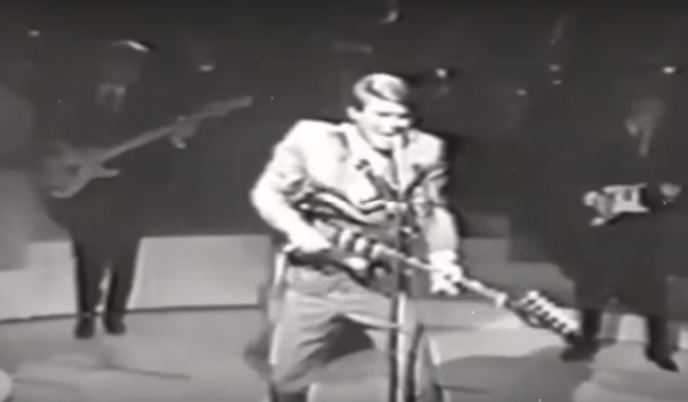
The first time I saw Glen Campbell play was on a television show called Shindig It aired from 1964 to 1966, and it featured some top musical acts of that era.
The “house” band on the show were called The Shindogs and comprised of some of Los Angeles’ best session players, whose players alternated from time to time.
The band members included Glen Campbell, Joey Cooper, Chuck Blackwell (drums), Billy Preston, James Burton, Delaney Bramlett, Larry Knechtel (on bass), Leon Russell (on piano) Glen D. Hardin and bass player Ray Pohlman.
Campbell was featured as a solo act on this show, singing and playing an unusual guitar that he seemed to favor. The guitar was a 1960 Teisco model T-60, that featured a set neck, and a hand carved body that had an unusual cut-out on the guitar lower bout and the headstock.
It was equipped with 3 pickups that were made by the company, and a three-piece bridge/saddle unit that resembled the one found on early Fender Telecasters.
The metal pickguard covered much of the body. On it was mounted a volume and tone control and a 3 position rotary switch that chose the pickup. It would be a few years before Teisco (the Tokyo Electric Instrument Company) began flooding the US and European market with cheap electric guitars.
Glen seemed to favor this guitar and used it during his days as a LA studio musician, with The Wrecking Crew. When he first made television appearances, he played this same guitar.
Glen was born into a family of 12 children, His father was a sharecropper. He grew up and lived in a town near Delight, Arkansas. He received his first guitar at age 4 and took to it immediately. Since the neck was not adjustable and the strings were high, his father fashioned a capo out of an old inner tube. His extended family included several musicians. He was fond of reminding people that he was the seventh son of a seventh son.
At age 16 Glen dropped out of high school to pursue a career as a guitar player. His first job was with his uncle Eugene aka Boo, at a nightclub gig in Casper, Wyoming.
In 1956 they traveled to Albuquerque, New Mexico in a group called The Sandia Mountain Boys, which was led by another Uncle named Dick Bills.
Within a couple of years, Glen Campbell had formed his own band called The Western Wranglers. By 1960 he moved to Los Angeles California and had a daytime job working for the American Music publishing company, writing songs and performing demo recordings. Word got out about this talented singer/guitar player and he was in demand.
Around this same time, Glen Campbell was hired by several session producers to play guitar with other anonymous back up musicians that later were came to be known as The Wrecking Crew.
Campbell played on recordings for such well-known acts as Bobby Darin, Ricky Nelson (Travelin’ Man), Dean Martin (he played on the hit Everybody Loves Somebody), Nat King Cole, The Monkees, Nancy Sinatra (These Boots are Made for Walking).
He aslo backed up Merle Haggard, Jan and Dean (Surf City), The Beach Boys (he played acoustic guitar on Be True to Your School, Pet Sounds and other recordings), Ronnie Dove, and Frank Sinatra. Phil Spector sought him out to play on some of his hits recorded by the Righteous Brothers.
Glen Campbell played on recordings for Elvis, striking up a friendship with The King. Both men came from the same humble Southern roots. Glen played guitar on many demo recordings for Elvis and on the album Viva Las Vega.
By 1961, Campbell had left The Champs to pursue a solo career and was signed by Crest Record, which was a subsidiary of the music publishing company where he worked. His first recording, “Turn Around, Look at Me” peaked at #62 on the Billboard Hot 100 that same year. It later became a hit for The Vogues.
That same year Campbell formed another band called the Gee Cees with some of the members of The Champs and played at local clubs.
He continued to record and write music. However his forte at the time was the session work. He was featured on an incredible 586 recorded songs, despite the fact that he could not read music. He would have someone at the session sing or hum the part and he immediately played it “by ear”.
Not only did he play guitar, but doubled on banjo, mandolin, and bass guitar.
It was in 1964 that Campbell got into television, as a regular on several shows including a California series called Star Route, and the Shindig!, and another California series called Hollywood Jamboree.
Around this same time, Beach Boys founder and song writer Brian Wilson had succumb to a mental breakdown and quit touring with the band. The Beach Boys hired Glen Campbell to tour with them. For a year, Glen Campbell played bass guitar and sang harmony with the act.
In 1965 Glen Campbell finally had a a solo hit record with a song called Universal Soldier. This anti-war song (the US and allies were in the midst of the Vietnam War) was written by Buffy Sainte-Marie.
The following year, Campbell was hired again by The Beach Boys as a session player for their Pet Sounds album.
John Hartford wrote and recorded Gentle on My Mind and Glen had heard Hartford's version. Campbell hired fellow session players to come into the Capitol Record studio and make a demo of him singing this song so he could pitch it to producer Al De Lory.
During the session, Campbell shouted directions to the players. He left the rough cut for De Lory to hear.
The next day De Lory listened to it and fell in love with the song and Glen's recording. De Lory immediately went to work on it, removing Glens directions to the musicians, but keeping Glens vocal and the music. Without telling Campbell, De Lory went ahead and released the song. It went on to become a mega hit for Campbell and won a Grammy for John Hartford.
The road was straight and seemed to go past endless lines of telephone poles. He saw a solitary lineman that was strapped at the top of one of these poles, doing repair work, causing Webb to think about the loneliness of this job. The phrase “singing in the wires” came from the vibrations induced by the electric current flowing through the lines.
In his arrangement he tried to mimic this through the droning of the string parts and the sort of Morse code at the end of the verse. Webb had made a decision that Wichita Lineman had a better ring to it than "Washita" Lineman, so the songs working title was changed.
Campbell's recording was also produced by Al De Lory and charted for 15 weeks in 1968. It is listed among Rolling Stone Magazine’s list of 500 greatest songs of all time.
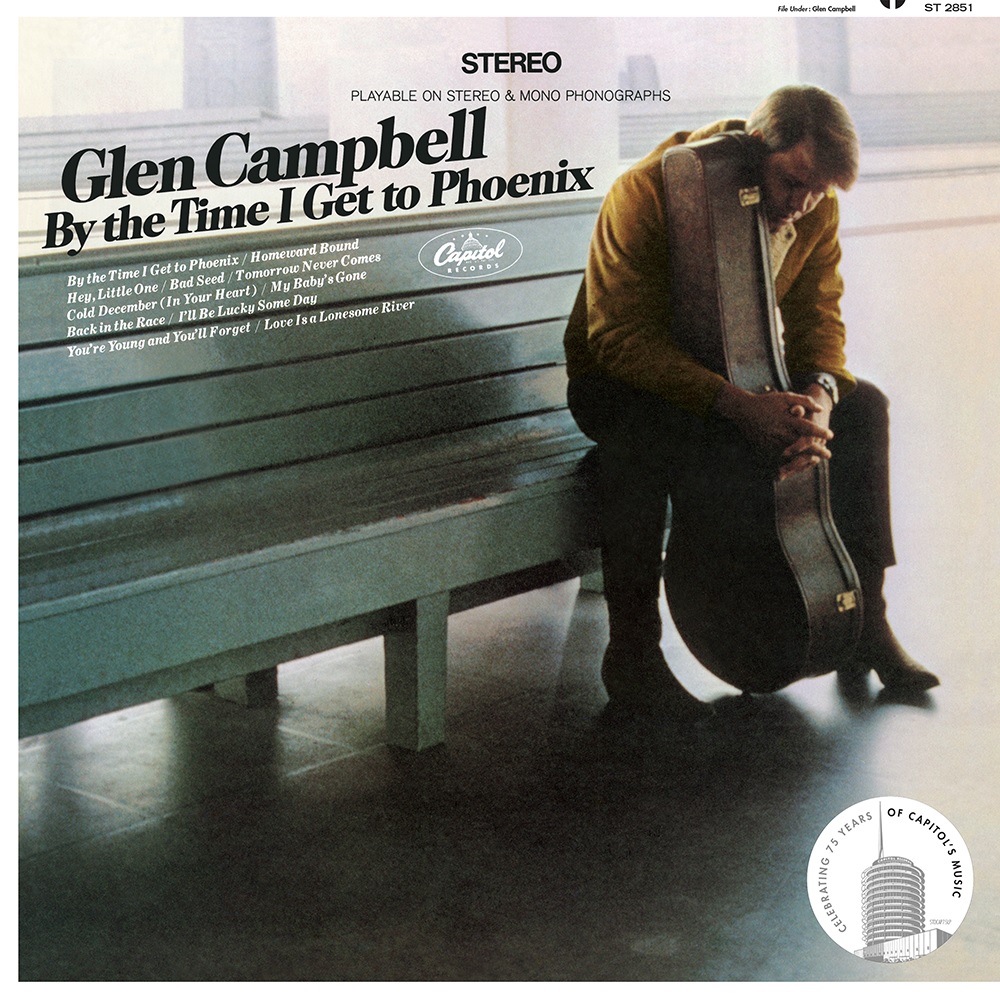
Campbell followed this up with two other Jimmy Webb songs; By the Time I Get to Phoenix, and Galveston. By the Time I Get to Phoenix was inspired by Webb’s break up with his girl friend. This song was originally recorded in 1965 by Johnny Rivers but failed to chart. Glen added it to his album in 1967.
The song Galveston was Campbell’s follow up hit, released in 1969. Webb had written it as a war protest song during the Vietnam War years. During the Civil War the Battle of Galveston took place in 1863. I do not know if this battle influenced Webb. What I do know is that Webb imagined a soldier who had come to the realization that he was fighting for a cause that he felt was disingenuous.
Webb imagined the soldier thoughts and put them into these lyrics; "Wonder if she could forget me, I'd go home if they would let me, Put down this gun, and go to Galveston.”
In 1968 Glen Campbell won 10 Grammys, three Hall of Fame Awards, a lifetime acheivement award, and the Country Music Association's Entertainer of the Year award.
Hawaiian singer Don Ho introduced Glen Campbell to the song. However that profound verse was deleted and changed to; “I still hear your sea waves crashing, While I watch the cannons flashing, I clean my gun, and dream of Galveston.” This made it less of a protest song, more of a love song, and a number one Billboard hit for Campbell. This song came out in 1969.
Due to his popularity 1968 Glen Campbell was asked by CBS to be the summer time replacement host of the successful Smothers Brothers Comedy Hour variety show. The audience loved him and the following year he was invited to host The Glen Campbell Goodtime Hour.
Campbell introduced a lot of wonderful musicians on this show, including his friends Jerry Reed, John Hartford, Doug Dillard (the banjo player for the Dillards), and Mason Williams. Toward the end of the show, they would all sit together and play a few songs in the “Pickin’ Pit.
This show introduced a lot of people to Country Music that would not have listened to it otherwise.
Campbell also turned his talent to the movies, making appearances in one flick called Norwood, and the John Wayne movie, True Grit.
While touring Australia Campbell heard a tune by Country Music writer/singer Larry Weiss, called Rhinestone Cowboy. Campbell related to the song and upon returning to the United States took it to Capitol Record and recorded his version. It charted at number one on the Billboard Hot 100. (For those not familiar with Nashville, Tennessee, Broadway is the street where you can find all the music clubs.)
New Orleans pianist and song writer Allen Toussaint has left us with some incredible music. In 1975 he wrote a song based on the childhood memories of the evenings he spent with his Creole grandparents on the porch of their home.
Later in his career Campbell continued to tour, had three failed marriages, a fling with Country Music singer Tonya Tucker and had battled substance abuse. Most of this occurred during the mid 1970’s,
During the 1990’s he became a successful performer, owning his own Goodtime Theater In Branson, Missouri. He still toured the world giving concerts, sometimes with symphony orchestras.
In 2008 Glen decided to record a project called Meet Glen Campbell. This featured some songs by Green Day, The Foo Fighters, Dave Grohl, Tom Petty, Jackson Browne, John Lennon, Lou Reed and others. Backing him on this recording were Wendy Melvoin, who played keyboards for Prince, Tom Petty, Rick Neilsen, and Danzig guitarist Todd Youth. In addition to others that sang background, were Campbell's own children.
The tour was filmed and the results showed his regression as the disease ravaged his brain. Though he could no longer remember lyrics to songs, he did not forget how to play guitar.
Sadly, he went into the studio and recorded one last song called I’m Not Going To Miss You. The recording was backed by several of his friends that played in The Wrecking Crew.
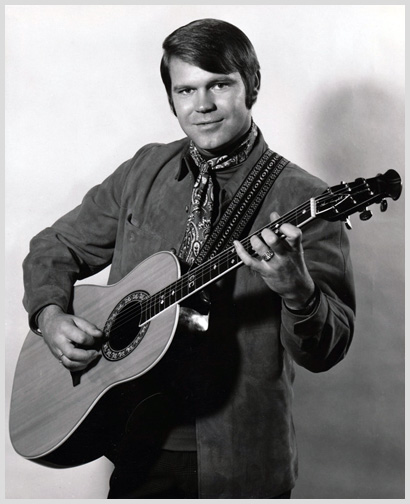
Campbell passed away last week on August 8th when the disease robbed his brain of the ability to control his central nervous system. Throughout his career Glen Campbell used a vast collection of guitars. One of the first guitar companies to have a relationship with Campbell was The Ovation guitar.
Ovation guitars were a fairly new comer to the guitar market, having its start around 1965, with the development of an acoustic guitar with a round fiberglass back. Glen Campbell like the rugged concept of the guitar.
He encouraged the company to produce a model with an acoustic pick up, since he did not like to have a microphone stand in front of him.
He also did not think the guitar was loud enough. CEO Charles Kaman took his advice and obliged by having his engineers develop one of the best under-saddle acoustic transducer/pickups that was ever designed.
Among those guitars were the Ovation Balladeer (this one was redesigned especially for Glen and designated The Glen Campbell model 1627), an Ovation classical acoustic electric model 1613, an Ovation acoustic electric 12 string model 1615.
The Tornado guitar that Glen can be seen playing on his TV show is an interesting guitar. Ovation did not build the bodies. They were manufactured in Germany by the same company that made bodies for some Framus guitars. The pickups were made by Schaller, another Germany manufacturer. The bodies and parts were sent to the Kaman factory in Connecticut for assembly and bolt-on Ovation necks were added. Even after the TV series ran its course, and late into his career.
Glen also played an Ovation Breadwinner. This was a uniquely shaped guitar that essentially looked like a battle-ax. The body was made of mahogany, the neck was bolt on, and the electronics were active.
Campbell continued to play Ovation guitars at his concerts throughout his career.
Later on Semi phased in his own components and concepts. This guitar was made with Dobro parts and a Mosrite neck and pickups. Glen's name is inlaid on the fretboard.
He owned two other Mosrite electric guitars and one rare Mosrite acoustic guitar.
The acoustic model is a 1965 Mosrite Serenader. The body is solid spruce, the back and sides are solid mahogany. The dove tailed neck has the Mosrite headstock. The unique pickguard has a tortoise-shell appearance. Glenn owned two of these guitars.
Much later in his career he routinely played a dark blue Fender Stratocaster. On one of the forums that I used to visit, a guitar tech said that one of Glen's guitar techs brought it into his shop for some quick repairs and adjustments. He commented on the forum that it was a great guitar. Glen also owned a Lake Placid Blue stratocaster, a black stratocaster, and a red strat with twin humbuckers.
You can see from one picture towards the top of the page, Glen started out playing a Telecaster that was equipped with a Bigsby B5.
This Tele had the Bigbsy as an add-on, longer before Fender offered this option in 1967. The photo is from around 1956. He is playing at a store that sells house paint.
Later played a beautiful Hamer 12 string electric guitar that he used in concert when he played Southern Nights.
Glen was an amazing guitarist and vocalist. In fact he is one of the most versatile guitarists ever.
As a session player he played on many of the Beach Boys songs, and also played on Frank Sinatra's classic recording of Strangers In The Night. He loved his family, and made a life with his music that many of us can only dream about.
He remained an incredibly talented man right up to the end. He will be missed.