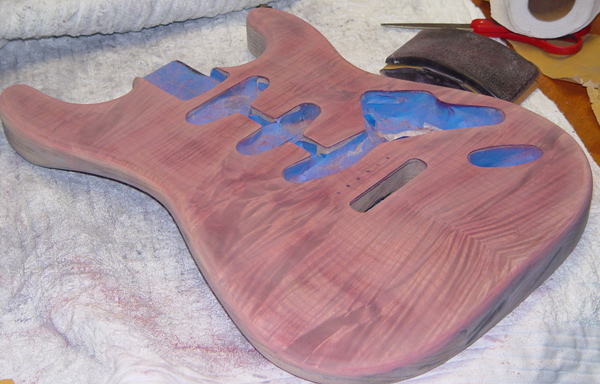
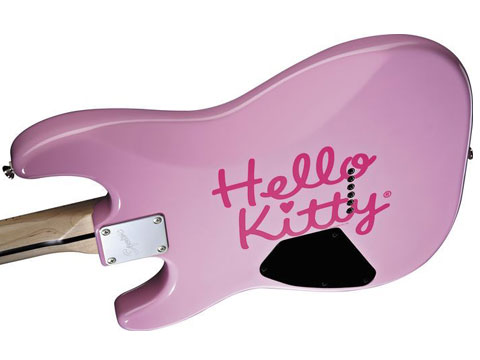
Today, my friends, I will show you how you can take a vintage 1956 Fender Stratocaster and update it to the more contemporary 21st Century look of a Hello Kitty® Strat. It's much easier than it sounds. Just follow along.
Remove the neck, then sand the body and neck down to the bare wood. Nice lookin' wood, huh? Don't forget to sand the headstock and neck to get out those darn aged-in finger marks. To heck with patina. It is overrated.
I suggest routing out the bridge pickup area to accommodate the Hello Kitty® humbucking pickup. You may want to get some wood filler or Bondo™ fiberglass filler to fill in those routed sections of the body. Then sand it again until the surface is smooth.
Now this might be the hardest part. The 1956 Fender Stratocaster neck came with black dot inlays that were made of baked clay buttons. These were then glued into routed out spaces in the neck. You will have to get a knife, or some kind of tool to pry those pesky buttons out.
Then get some #0000 sand paper and scrape out the remnants. Fortunately in our modern times there is a readily available substance called polymer clay, which is available at hobby shops. Get some that is already colored pink. You can even get it at most Walmart stores, Michaels, or Hobby Lobby stores.
Shape the pink polymer clay into tiny flat buttons. You can air-dry these, or put them in an oven and bake them for 15 minutes. Once cooled, put a dab of glue on the back of your pink buttons and place them in the routed area of the neck. You will have to do some further sanding, but it will look great.
Next, get a couple cans of Mambo Pink acryllic spray paint. Krylon® glossy ought to do the trick. Hang the body up and spray it until it looks good. Repeat this step eight, or nine times until you have a shell-like look on the body of your Hello Kitty® guitar.
There are a number of companies that supply guitar parts, such as Musician's Pal, and Guitar Parts-R-Us where you can get a pre-wired Hello Kitty® pickguard. Buy one. But, don't ditch those old original parts. Some folks love the sound of vintage pickups hand wound by Abigail Ybarra, so you can sell them on eBay, along with the old wiring harness, and potentiometers for a lot of money.
Now for the final touch, get a Shocking Pink Sharpie permanent marker and in your best cursive hand, write Hello Kitty on the back of the body. Better yet, get your girlfriend or wife to do this step. Girls seem to be able to do that flowery cursive script, better than guys. And if you are a lady, then you got this step!
The current world crisis brought to mind the stories that my parents told me about growing up during the years of World War II. All industrial manufacturers were required to convert production to help the war effort. This massive effort affected virtually all Americans. Every aspect of life from politics to personal savings changed when put on a wartime footing. Rationing was demanded of everyone. Meatless Mondays and Victory Gardens were strongly encouraged.
However in Nazareth, Pennsylvania, C.F. Martin & Co., the first guitar manufacturer in the U.S. in 1833, remained in production during the war with only four female employees at its North Street plant.
Gibson has alternated between claiming no guitars were made during the war, then admitting that a handful were produced. And while production was slim across the board, the guitar factory with the most female employees, over 200 between 1942 and 1946, who were hired to make munitions, not guitars.
Dr. John Thomas, a Connecticut law professor and music journalist, wrote a book called “Kalamazoo Gals: A Story of Extraordinary Women and Gibson’s Banner Guitars of World War Two”. This book was published in 2013. This publication got less than a cherry reception from the Gibson Guitar Corporation before and after it was released.
These past few weeks might bring some understanding and appreciation of the huge effort undertaken by United States citizens during the 1940’s war years. Most all able bodied men enlisted in the military.
Those that did not were drafted. The fact that we were fighting against fellow human beings was not met with the same empathy that the media presents to us these days. In the 1940's the enemy was evil and the United States and the Allies were out to defeat them from usurping our freedom.
Due to the shortage of men, Gibson management recruited women. This was not an uncommon practice for factories during these war years. Rosie the Riveter was a public relations painting that encouraged women to leave their lives as house keepers and enter the job market.
The other part was uncertainty over whether consumers would buy guitars made by women. So between 1942 to 1945 although Gibson was building guitars, they denied this fact.
Instead they established the rumor that these guitars produced during this three year period were made by “seasoned craftsmen” who were too old for war and were stockpiled until after the war was over to be sold as "new old stock".
Understand during the war years manufacturers and the general public were under strict government restriction on the use of metal, wood and other products, such as fuel, oil and rubber. These items were to be used only for military needs.
Dr. Thomas became interested in the Kalamazoo Gals in 2007, after taking his own 1943 Gibson guitar to be re-inspected by its original inspector. It was at this time he saw a photo of around 75 ladies that was taken in 1944 in front of the Gibson Guitar facility. He was able to locate a few of these women through a classified ad placed in a local paper. Thomas then invited them to tea and even visited some at their homes to hear their stories.
The guitars these ladies produced were Gibson “Banner” guitars; the ones with the scrolled decal that said “Only a Gibson is Good Enough”. Thomas was also able to search at least one-thousand pages of wartime documents that mentioned Gibson Guitars. He also talked his way into getting access to shipping records and discovered that 24,000 Gibson guitars were shipped during WWII and at least 9,000 Gibson guitars were made during the war years of 1942 to 1945.
However the Gibson company public records show the company had shifted to producing goods for the war effort and not musical instruments, and that most of the men who made those Gibson guitars at the Kalamazoo headquarters were off fighting the war during the years 1942 to 1945.
It is a fact that the “Banner” Gibson guitar is considered one of the finest acoustic guitars ever made. The Banner decal went on the guitars headstock in 1942 and was removed in 1945.
To test the quality of these Gibson guitars made during the war years and after, Dr. Thomas enlisted the help of friends and was able to x-ray different Gibson guitars made before, during and after the war.
He discovered that the guitars made by the women were more refined and sanded thinner, smoother, and were better braced than those done after the war. This is no doubt the reason that they sound better.
In an interview one lady described her experience working at Gibson. She said, that a neighbor knew she had just gotten out of school and was looking for work.
The neighbor told her that Gibson was hiring and they would train her. This lady went on to say that it (working for Gibson) was a crummy job. She was making strings. But continued that Gibson was paying 20 to 25 cents an hour, which was fairly good wages in 1942. She states that she had a goofy job, sitting there making (guitar) strings.
When Dr. Thomas’ book came out in 2013 he contacted Gibson’s acoustic division in Bozeman, Montana to get their take. Gibson gave him airfare and furnished him with credentials to attend the NAMM show in Los Angeles.
There he asked Gibson representatives to comment on his book. Gibson management demanded to know who gave him access to shipping records, Dr. Thomas declined to comment. Gibson threatened to sue him. (Perhaps they were not aware that he is a law professor.)
From then on he was given the cold-shoulder by Gibson representatives. Though Gibson had planned a corporate event to announce the publication of the Kalamazoo Gal’s book, they apparently changed their mind with no notification. He was eventually told privately by a company representative, that Gibson had nixed the project and wanted no part of it. If anyone at Gibson talked with him, they could lose their job.
Leo Fender got his start in 1938 when he opened a small radio repair shop in Fullerton California. He repaired radios, phonographs, home audio amplifiers, public address systems and musical instrument amplifiers. He also rented public address systems.
Sensing that he could improve upon the industry standard, Western Electric amplifier schematics, he partnered with Doc “Clayton Orr” Kauffman to build electric musical instruments (lap steel guitars) and amplifiers under the K & F manufacturing name.
One employee that has become famous through the years because of her skill as a pickup winder was Abigail Ybarra.
Ybarra began working for The Fender Electric Instrument Company in 1956 and stayed on through the CBS years.
Ybarra remained with the Fender Musical Instrument Company when William Schultz and his partners purchased the organization. Ybarra retired in 2013, but even after being with this company for 57 years, her legend lives on.
She states that, “Doing it (winding pickups) with an automatic coil winder, it winds really uniformly,” Winding it by hand it winds it different. It’s not as uniform as a machine.” Unlike machine winding, hand winding produces “scatter winds” that are irregular.
The wires are not placed as closely to one another as they would be with standard machine winding. This results in more air space in the coil and the lowered capacitance allows more high frequencies.
Fender Custom Shop Pickup Specialist Josefina Campos has been apprenticing under Ybarra since 2010, mastering Abigails technique. Campos, has been with Fender since 1991. Campos has since taken Abigail's place with The Custom Shop at Fender.
Although Martin Guitars, in an effort to protect privacy, does not acknowledge last names, it is quite apparent that the C.F Martin company is very dependent on its female staff in its luthery department and places great value upon them.
I read in their in their company blog that one lady identified as Diane has worked as a neck fitter for Martin guitar for the past 10 years. They go on to state that the fit of the neck can be one of the most crucial and challenging parts of a guitar build, particularly if the guitar sports a dovetail neck joint.
It involves a long process of carefully carving off excess wood, fitting, refitting, and sheer strength to ensure that the fit is absolutely flawless. Otherwise, a guitar can wind up with tuning issues and problems with the action.
"It requires physical strength, but also mental agility" says Diane, "because each and every neck is different." This means no two sets of problems to solve are alike, just as no two Martins are alike. Diane has been doing this job with Martin for the past ten years.
Another Martin employee, Phyllis has been with Martin Guitars since 1985, when she started in what was then the string division. Now she cuts and installs end-pieces and routes blocks. Her daughter also works here, as did her granddaughter, her son in law, and her grandson in law. Earlier in her career here at Martin, Phylllis worked building bodies by hand, as the only woman in a department full of men.
C.F. Martin guitar spokesman states that one of the most skilled brace-shapers is Diana who has been with Martin for over 10 years. The art and science of shaping braces strong enough to support over 150 lbs. of string tension while remaining supple and elegant enough to provide beautiful, resonant tone.
This task requires the utmost precision. So why not use something like a laser-guided to cutting machine for these parts? "I worked with a machine once," says Diane, "but I could cut them by hand faster than the machine could, so they got rid of it!"
The blog identifies another employee, Mary, has been working in Martin's stringing division for 10 years. When she started, she was the only female in a department that now, a decade later, has many women working alongside her.
She puts the absolute most care into making sure each Martin that crosses her bench leaves with pitch perfect intonation and play-ability. She states, "Someone could have been saving up their whole lives for this guitar and I want to make sure the instrument they get lives up to that. This could become a family heirloom."
When we hear the name Bozo, the thoughts of people that grew up in the 1950's and '60's turn to the kiddie show that was called Bozo, The World's Most Famous Clown. If you are younger, the term Bozo might bring to mind a rude, insignificant man. In Spain, people who speak the language poorly are called 'bozos'.
However, the name Bozo is a South Slavic masculine name meaning 'Divine Gift'.
This can certainly be applied to Bozo Podunavac, who was a Serbian born master luthier. He was raised in Belgrade, Yugoslavia. He served his apprenticeship with Serbian master luthier Milutin Mladenovic which concluded in 1950.
Bozo Podunavac emigrated to US in 1959 and settle in Chicago. There he began working in the repair shop of a musical dealer and manufacturer.
In 1964 he opened he opened his own shop and began building guitars with his name "BOZO" on the peghead.
During his lifetime built over 700 guitars. He passed away on June 2, 2015. At the time he was living in Port Charlotte Florida.
Bozo built guitars for Leo Kottke, Reverend Gary Davis, Peter Lang, Bob Gibson and many other artists. In his later career he licensed his name and style to be used by Yairi Guitars of Japan. Bozo made some gorgeous instruments during his lifetime.
They sell for between $5,000 and $12,000 USD.
This is a nice Dreadnought guitar in the typical Bozo style (Spruce top and rosewood back and sides) with beautiful inlays and decorations. It was made by Yairi, because at some time Bozo decided to let his guitars be produced under licence by Yairi.
The Bozo Podunavac B-100 12C, like all Bozo guitars, is spectacular. It is heavily ornamented, but that’s not to mask or make up for some deficiency in the quality of construction or tone. The body is Indian Rosewood for the back and sides and spruce for the top, with herringbone binding on the back and doubled Abalone and herringbone on the top. The decorated rosette shows Bozo’s European influences – flowers, more herringbone, and more Abalone. The ebony bridge is heavily shaped and inlaid, again with Abalone.
The headstock has a Bozo rendering of his name and a traditional ‘Flowerpot’ – of course in Abalone. The position markers are of Bozo Podunavac's own design, using three rectangles. The neck block is signed by Bozo Podunavac.
One popular guitarists that played and owned several Bozo guitars is Leo Kottke. Although Leo plays six string guitars, he is best known for using a 12 string instrument. He is also know for his unconventional tunings and unusual style of finger picking. Kottke owned and played these three custom-made Bozo 12 strings.
Mr. Podunavac built this beautiful archtop guitar in 2007 it as a back and sides are hand carved from solid maple, and it comes with a carved and solid spruce top, with a Venetian cutaway. The finger rest is made from a piece of carved ebony, with an inlaid border and design. The five piece laminated neck goes right through the headstock, which has gold Grover Imperial tuners. The bridge is solid ebony, which is also inlaid with abalone. It is a gorgeous instrument.
I have always had a fondness for parlor guitars. I even own two of them. But they are not nearly as ornate as this beautiful instrument made by Bozo Podunavac, and previously owned by singer/songwriter Janis Ian. She has played this guitar all over the world in many concerts.
Some of Bozo's early instruments were not as ornate as the guitars he made later in life. This one is owned by a gentleman that was fortunate enough to visit Bozo's home and have him inspect the instrument he had purchased on eBay. This guitar is a 1969 Bell Western model and features Indian rosewood back and sides, which Mr. Podunavac prefers more than the currently unavailable Brazilian rosewood. The guitar had maple binding and a German spruce top with "rope" purfling, not "herringbone", as many people call it. The nut and saddle are both made of scalloped ivory which was added to the instrument by the previous owner. The owner says the guitars craftsmanship you don't see much these days except for high-end, boutique guitars.
On the same website Bozo shows off a unique double-neck instrument he had created. As I have mentioned, Mr. Podunavac moved from Chicago to San Diego, California, opening his own workshop and teaching guitar construcion in his school of lutherie. It was during this time he "licensed" several of his designs to a Japanese firm, M.G. Company Inc. who was representing K.Yairi / Alvarez Yairi guitars.
The manufacture proceeded to build "Bozo guitars" including the B60, B80, and B100 models, some with laminated back and sides, some all solid wood construction. The production of these guitars started in late 1974 and was terminated somewhere in 1984. Dependending on the instruments quality, in today's market a Japanese made Bozo can be purchased form $1,000 to $2,500 USD.
Here is another Bozo guitar. This one is a classical instrument. Although the label lists it as a B3 without the country of origin, I am certain it was also a product of Japan. The head stock carving is exquisite.
Most of the instruments that Bozo produced in his later years feature much ornamentation on the body, and head, and herringbone binding on the neck. They are known for their beautiful appearance, and their clear, loud voice.