In 1979, Don Lace started an electronics company in the family garage in Huntington Beach, California.
One of Don’s first production jobs was developing a pickup with Fender that had a low rejection rate during production. In the mid 1980's, Don came up with the Lace Sensor. The Sensor was a uniquely designed single-coil pickup that reduced hum. Fender used it on their Lace Sensor Stratocaster and on other well known artist models.
In 1992, Don Sr. passed away, but his two sons Don and Jeff Lace, took control of the family business. They not only carried on the family tradition, but introduced some wonderful innovations in guitar and bass pickup design.
Don and Jeff’s latest innovation is the Alumitone series of pickups.
We will talk about this new design and Lace pickups some other time. For now, the focus is on a unique guitar that Lace produced in the earlier part of this decade.
In an effort to make an ergonomic guitar, the Lace brothers came up with the idea of twisting the neck slightly to make playing feel more natural and match the position of the wrist and hand. They called this the Lace Cybercaster with the Lace Helix neck.
The Cybercaster's Helix neck features a 10.8º twist on the first frets that straightens out as you go up. The guitar comes with two Lace Hemi Humbuckers.
It bears a slight resemblance to a Fender Jazzmaster that has been run over by a steamroller. The body is ash; the bolt on neck is maple. The bridge pickup has a Tele-style aluminum plate. The input is like that on a Fender Stratocaster. It comes with one volume and one tone potentiometer and a three way throw switch on the lower bout. Gotoh makes the tuners. The truss rod cap is also aluminum. The scale is 25.5” with 21 frets on the natural maple fretboard.
I know that Lace still produces the Cybercaster in several variations, but I am not certain if they have continued with the twisted Helix neck.
The Fanned
Ralph Novaks has been making guitars under the Novax name for sometime now. His specialty is guitars with Fan Frets. Novaks philosophy is that strings should have differing tension and different lengths to optimize tonality and performance.
This allows for ease of playing, since the string tension is reduced. By fanning the frets this creates a more even harmonic response.
Novak compares his method to that of a grand piano or a harp. These instruments not only use strings of different diameters, but also different lengths to achieve their sound. Novak has applied this to the guitar.
He also utilizes the Novax Proprietary Individual Bridge system that he describes, “Our individual bridge system overcomes this by separating each saddle and “base plate,” taking advantage of the natural acoustical damping properties of wood vs. metal. The signature overtone series of each string in a chord remains intact, making the chord sound more “in-tune” and keeping the harmonic interest of the different voices.”
The fanning of the frets results in changing the scale length for the bass to the treble strings. Not only does this facilitate tonality, but also the guitar is also more ergonomic.
Most Novax guitars come with seven or eight strings. He makes bass guitars as well. Other manufacturers, such as Jeff Traugott and Eric Schoenberg, use a similar fan fret process .
The Slanted
Rickenbacker came out with slanted frets a long time ago. However this was an original concept. The idea behind this was ergonomics. It made sense to the designer that most folks had to bend the wrist to play a barre chord.
Therefore, by slanting the frets and compensating by changing the angle of the bridge, it would make for ease of fingering.
Klein guitars also tried this method. The concept just did not catch on.
There are a few bass guitar companies produce instruments with slanted frets.One is Moses Graphite necks. This company produces bass guitar necks with slanted frets as replacement necks for Fender style basses.
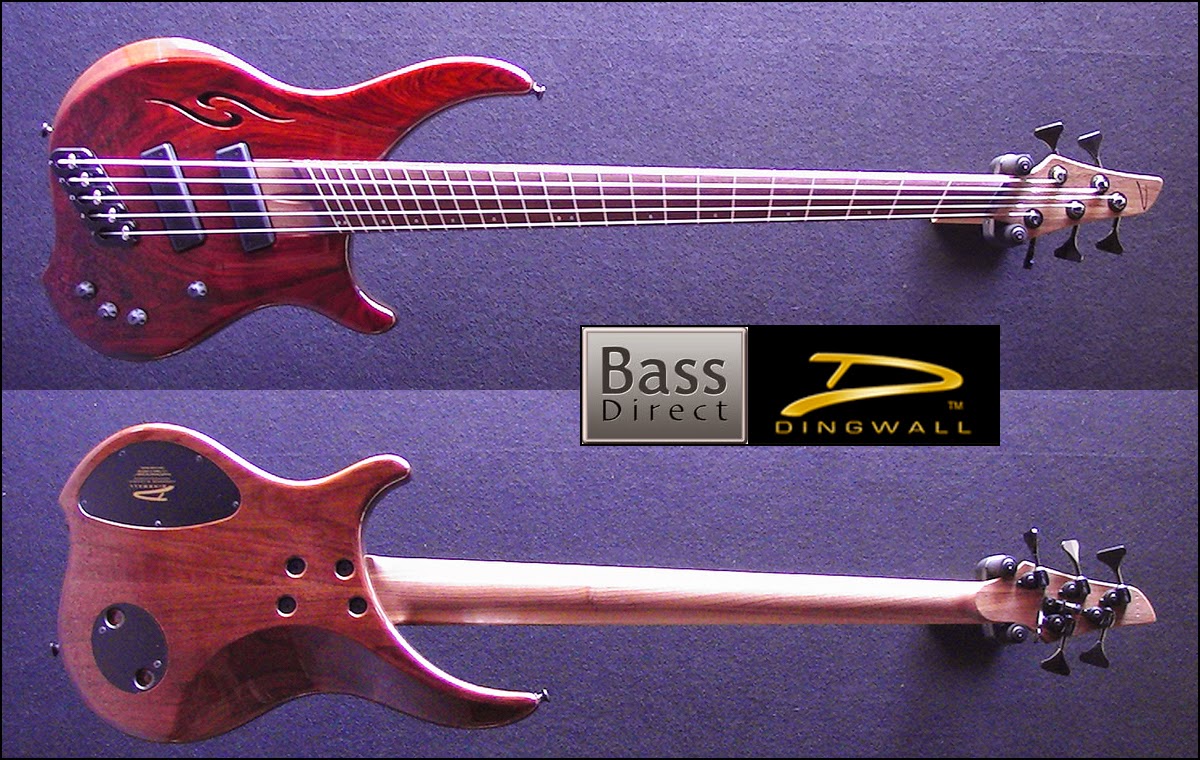
Dingwall Basses also utilizes the slanted fret concept.
Jeff Babicz (Ba-bits) has a background in IT. Which is sort of an odd occupation for a luthier. Perhaps this makes him more inquisitive about how things work and how to make them work better.
He worked his way up from doing maintenance work to plant manager at Steinberger guitars. He then went on to work in the semi-conductor industry, while working on guitar design. He introduced his unique concept guitar at a Tom Ribbecke guitar workshop. This was his "Voila" moment.
Jeff re-invented the accoustic guitar design to the point where in some other companies have licensed his technology.
A guitars main sound producer is the sound board or top. For years luthiers have tried differing ways of bracing the top to allow it to vibrate more freely.
On most acoustic guitars, the sound hole has to be reinforced, which can result in a dampening effect. There also is the problem of pressure being excerted on the guitars sound board as the strings are anchored on the guitars top. One of the most common guitar repairs is replacement of the tailpiece on flat top guitars due to the bridge section pulling up after years of strain.
Babicz came up with the solution by not anchoring the string to the guitars bridge, but attaching them to the distal section of the guitars lower bout. By placing six bridge anchors semitrically around the sound board in a fan shape, the pressure is taken off the bridge.
What this means is the soundhole no longer needs additional bracing for support. There is also no need for traditional X bracing, which is found on most steel string flat top instruments.
Instead Babicz guitars have two longitudinal braces running the length of the body. He calls this the lateral compresion sound board or LCZ.
The usual pin-type saddle has been replaced with what he calls the torque-reducing split bridge. This is more efficient.
The strings pass over the bridge, then go through a separate wooden retainer that diverts the strings to the bridge anchors at the distal perimeter of the lower bout.
Babicz has also redesigned the way the guitars neck is fastened to the body.
On the majority of the popular acoustic models the neck is fitted in a dove-tail joint and glued to the body. The angle of the neck has to be just right.
As a guitar ages and comes in contact with different weather conditions, the original angle set can change.
Once the neck is set, the easiest way to adjust the action is to sand down the bridge saddle. Good luck with plastic bridges. Or you can steam the glue out of the dove tail joint, remove the neck, clean off the old glue and then reset and re-glue it to the guitar. Guitar manufacturers have taken differing approaches to solve this issue including bolting the neck to the body.
Babicz has designed a unique rail system for his instruments neck joint. You can raise or lower the neck to your preference, which in turn changes the action. This is all done with a wrench.
The key clips to the back of the guitars headstock so you don’t lose it. You insert the wrench into a small plate on the back of the guitars body to make adjustments. He calls this the continulally adjustable neck. Genius!
Johann Georg Staufer is possibly the most famous builder of Viennese style guitars. Any vintage guitar afficianado is aware of the Martin-Staufer guitar, is the original Martin guitar.
I mention this because Staufer used a similar approach in making his instruments. There is no bracing on a Staufer guitar. It instead utilizes a harmonic bar. The result is a very quick response to the strings being plucked, which is different than most Spanish style instruments.
Check out the neck design
Staufer used a unique neck adjustment mechanism. The neck in essence is a bolt on style. A key which resembles the wind-up key for a grandfather clock fits into the back of the neck heel which allows the neck to slide up and down.
I must note that Staufer lived from 1800 to 1845. This adjustable neck design was also employed on a lyre-guitar made by Fabricatore which was an Italian school of guitar luthery that existed from 1770 to 1845. So it was not a Staufer invention.
But I am digressing. I have no idea if Jeff Babicz was aware of Staufers technology. In any event he took it a step farther in creating the adjustable rail system for the neck, he also has created a unique bridge that can be raised or lowered with the wrench.
Jeff Babicz has also developed some inovative designs for electric guitars by way of his Full Contact Hardware. This is designed for Gibson style stop action models, for Stratocasters, for Telecasters and for four and five string basses.
Instead of using bolts and hex screws to raise or lower the strings action, Babicz uses a unique system of cams which each string passes through. These are adjustable by a screw on the back of each cam. It’s pretty amazing.
In an older article that I found Jeff Babicz says that he personally creates only ten or so guitars a year by hand.
Since then it appears that he is producing his Signature series of USA made instruments in Poughkeepsie, New York. Although at one point it was rumored he was going to set up shop in Ft. Wayne Indiana.
His Identity series is manufactured off shore. At one time he used the Hohner Company of Germany, but I am not certain if this is still the case.
The guitars are made using solid woods; spruce for the top and either mahogany or rosewood for the back and sides. The necks are made of mahogany with a two-way truss rod. The fretboard is made of rosewood with dot position markers. Babicz guitars come in either dreadnaught, jumbo or cutaway sizes. The tuners are made by Grover. The guitars come with a case and are available with L.R. Baggs acoustic piezo pickups.
Jeff offers an acoustic electric model he calls the Octane 818 series. This is made of solid woods, with a rosewood fretboard and bridge. The Blue Flame has a flamed maple top. He also offers tobacco sunburst and black finishes. This guitar comes with a Seymour Duncan Pearly Gates pickup in the neck position and a George Lynch Screamin’ Demon in the bridge position. For single coil fans, the Octane comes with a Duncan Cool Rail pick up in the neck position and two Hot Rails for the middle and bridge positions. The guitar includes a pickup blending knob to combine the electric and piezo pickups.
I have not recently seen many dealers for Babicz instrument. However you can buy direct from Babicz by going to his website.
His Full Contact Hardware for electric guitars and basses is available through most online music stores.
2014 Update: I haven't seen Babicz guitars in music stores as of late. It looks like Jeff Babicz is selling them online only at his webpage. The prices run from $1200 to $1400, which is a bargain for a handbuilt guitar.
Maybe the Fender Telecaster Thinline is not the most unique guitar I’ve discussed, however it’s designer is unique in the world of electric guitars, plus the reason it was created shows something about the thought process that goes in to guitar design.
When we talk about those who created and designed the electric guitar, one man stands out as being responsible for the creation of many guitars that became the best known and most desired. That man is Roger Rossmeisl.
Roger Rossmeizl
I have discussed Rossmeisl before, but just to recap; his father, Wenzel Rossmeisl, was perhaps the best-known maker of jazz style guitars in Germany. He also made flat top guitars and mandolins.
Wenzel put the name Roger as the logo on his instruments. Roger Guitars are somewhat similar to the Gibson L-5 and L-6, but with Rossmeisel Senior’s own touches.
Roger Rossmeisl was sent to Luthery School to learn this craft, and get away from the hardest hit areas in WWII, before returning to work with his father. Roger wanted to go to the United States and subsequently found employment with Gibson, Mosrite, Rickenbacker, and Fender. That must have been an education in itself.
During the British invasion years, perhaps the most desirable guitar was the Gibson ES-335, a thinline, semi-hollow instrument. Fender had nothing similar. All their instruments at the time were built with solid bodies.
Rosmeizl was hired at Fender during the CBS years and these were the years that Fender was functioning more like a corporation. In 1968, orders were handed down to the design team to come up with a hollowbody thinline instrument.
Except for the P. Bass Rossmeisl designed all of these guitars while a Fender
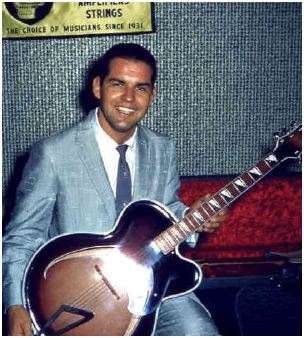
At the time, Roger Rossmeisl was working alongside long-time Fender associate Virgilio “Babe” Simoni. Babe began working for the Fender Guitar Company in 1953.
Babe Simoni
Simonis father worked in the plant and Babe was just a teenager when he was hired to work in the factory. Babe left his mark on just about every style of guitar the company produced and stayed with the company during the CBS years.
Later he joined Leo Fender and George Fullerton when they founded MusicMan.
During Rossmeisl’s tenure at Rickenbacker, he had designed most of their popular guitars, so he used the same method to manufacture the Fender Thinline.
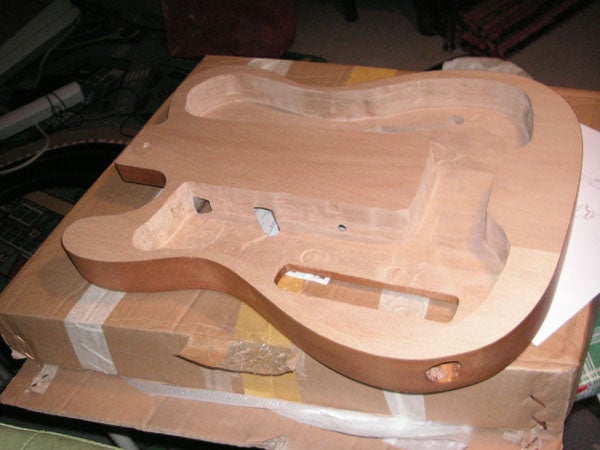
Babe took a Telecaster body and cut a thin slice off of the back side. He then routed out the right rear side of the guitar. A distinctive “F” hole was cut into the bodies top side above the routed area.
The “F” hole design on the Thinline (and subsequent Fender guitars) was Rossmeisl family trademark design.
This same F-hole cut was used on Roger guitars and on earlier versions of Rickenbacker 325’s and 330’s.
The back panel was then glued over the guitars back and sanded. Then the usual routing for the pickups and electronics was performed on the guitars top.
The Thinline was a plus for Fender not just because they now had a semi-hollow guitar and it reduced the guitars weight. Fender’s supply of light ash wood was dwindling, so heavier ash wood or mahogany could be used on the Thinline, thus saving the light ash for other guitars.
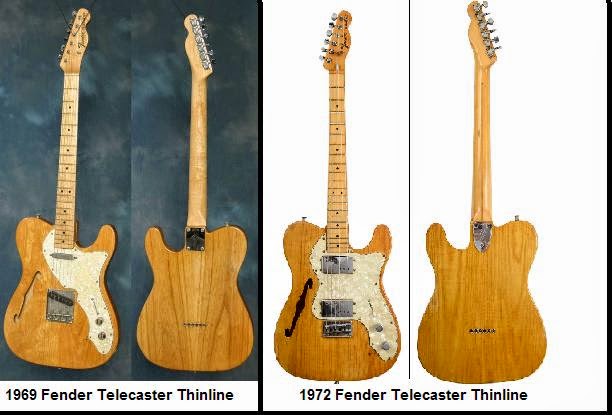
The chrome bar that Leo designed to hold the volume and tone controls was replaced by a reshaped pickguard made of white pearl celuloid.
The pickup selector switch, volume, and tone controls were set in somewhat different positions, but the serated chrome knobs were still used.
The 1968-69 version maintained the same pickups and the same style bridge unit as all other Telecasters including its seldom used cover.
The guitar’s neck was originally offered with a maple cap, which was later replaced with a one piece maple neck bearing the typical Fender headstock. The words Fender Telecaster Thinline were spelled out in large letters to show up on television cameras. There was a skunk stripe down the necks rear side on the non-capped models.
The body was offered with a natural or sunburst finish.
The Thinline Telecaster was updated in 1972. Perhaps the motive was to make the Thinline more like a Gibson semi-hollow instrument. I do not believe the public ever equated the Thinline Tele with a Gibson ES semi-hollow body instrument.
Seth Lover had left Gibson and was now working with Fender. Lover had designed a humbucker pickup that was different than what he had produced for Gibson.
He called this the Wide-Range Humbucker.
A new version of the Telecaster Thinline was designed to use these pickups. This guitar’s body remained the same, but the pickguard was again redesigned to accomodate two Fender Humbucking pickups.
The bridge unit on this model was replaced with the same tailpiece that Fender was using on hard-tail Stratocasters. By 1972 Fender was using the 3 bolt adjustable neck and bullet trussrod which became a part of the Thinline Humbucker Tele.
The Fender Thinline guitars never reached the popularity the company desired and they were discontinued in 1979.
By the 1980’s Fender had opened a facility in Japan. In 1986 Fender Japan produced two version of the Thinline Telecaster; the ’69 Thinline and the ’72 Thinline. These were in production until 1996.
Back in the USA, John Page and Michael Stevens started the Fender Custom shop and produced a 1968-69 style thinline for the USA market. This was available from 1997 to 2000. A special run of the Thinline was also offered in 2005.
Both the 1969 and 1972 versions are offered in Fender’s current line-up. Squire also offers a version of the 1969 Classic Vibe Thinline.
One of the most popular guitars owned by top guitarists is perhaps one of the most unheard of guitars.
Mark Farner owned several of these guitars. So did Mark Bolan, Greg Allman, Johnny Winter, Eric Clapton, Ace Frehley, Todd Rundgren, Ronnie Montrose, Robbie Krieger, Jeff Lynne and many other top performers.
This guitar has built up its following and reputation solely by word of mouth.
John Veleno worked as a master machinist and manufacturing engineer.
In the early 1960's he found work in Florida making components for the early manned spacecraft and the lunar “Rover.”
Veleno's expertise lay in designing and routing out a billet of aluminum for use as a chassis for electrical components used in the aerospace and computer industries. Veleno was a member of The American Society of Tool and Manufacturing Engineers. He had also designed parts for the first mainframe computer systems used in large businesses such as banks.
During the 1950’s Veleno had worked in a few Rock bands and taught guitar at several music stores. He had a love for the guitar, but it was only a hobby.
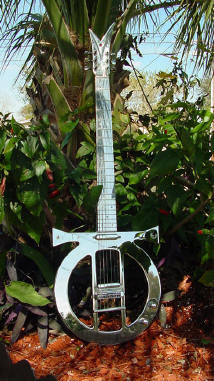
Veleno also gave guitar lessons out of his home. To promote teaching guitar, he built an aluminum guitar shaped mailbox. In the early 1960’, one of his friends complimented him and told him the mailbox would make a great guitar. That was when an idea took place. Veleno made a highly polished aluminum guitar by using a 17-pound billet of the metal. Not only was the body made of carved aluminum, the neck and headstock were all aluminum as well.
John Veleno created his first instrument as a sideline, with no thoughts of going into business. An acquaintance with some connections suggested that he could get John backstage at a James Gang concert.
He suggested that John should sit backstage, polish his guitar, and wait for some of the guitar players to take notice and inquire about this unusual guitar. No one took notice. He went to see Santana and the results were better.
Santana used his guitar on stage, but did not like the six-on-a-side tuners or the bird-shaped headstock. Although he didn't buy John's guitar, he suggested that a few changes be made to the guitar.
Veleno went home and reworked the design, changing the headstock to a Vee shape with three-on-a-side tuners.
He struck gold at a T-Rex concert. Guitarist Mark Bolan took immediate notice. He played the instrument and ordered two guitars on the spot. Bolan kept one, but sent the other to Eric Clapton as a gift.
After that, many other well-known players sought out John Veleno guitars.
Veleno’s engineering skill aided him in creating an instrument with a neck that would never warp, which was fretted to within a 1/1000th of an inch. This allowed it to be refretted as often as necessary.
The neck was made of cast aluminum, while the body was carved from a billet of aluminum.
The minute tolerances he worked with made this instrument one of the most tonality accurate guitars ever made. Not to mention the polished mirror finish on this instrument was stunning.
One of the advantages of the Veleno guitar due to the aluminum body was that it is completely grounded from external or internal electrical interference.
The fretboard had a radius of 11”, which aids in preventing fret buzzing. The electrical harness was made in one-piece helps for easy repairs. Because the neck was aluminum, there was no need for a truss rod.
Veleno used pickups from other manufacturers, such as DeArmond, Guild, Gibson or EMG.
The Gibson pickups have more of an edge and grit. The Guild and DeArmond pickups have a cleaner sound. He had originally used bridges manufactured by Guild or Gibson before going on to create his own guitar bridge and tailpiece. Outside companies manufactured the guitars tuners. The guitar’s electronics consisted of a tone and volume control for each of its twin pickups, a three-way pickup selector switch, a phase switch and a coil tap switch.
Veleno’s engineering background played into all aspects of his guitars design. He was not concerned just about the guitars outward looks, but the best way to get the best sound for his invention.
He consulted electrical engineers that worked for Bell Laboratory. They advised him single strand wiring was preferred for phone transmission over multi-strand because it produced a cleaner sound and tone.
Bell engineers had experimented with both and the single wire method was superior. The downside of this method of wiring is a slight delay in the transmission of the signal. The good news is that it is the delay is so infinitesimal it is almost indictable to human ears.
However, it provides the clear glassy tone associated with Veleno guitars.
Perhaps the most unusual Veleno guitars are the ones ordered by Todd Rundgren. These consisted of a set of three ankh shaped guitars and an ankh shaped bass for Rundgren’s stage show. One of the ankh guitars was destroyed in a warehouse fire.
Veleno experimented with different types of aluminum until finally settling on 6061 grade because it did not discolor. After carving the bodies shaped out of aluminum billets, many of the bodies were then chrome plated. Others were anodized with red, green, blue, or gold finishes.
The necks were made of cast aluminum, which included a fretboard that was either chrome plated or black plated. The first the necks had 21 frets.
Later models came with 22 frets. At first Veleno guitars were made of cast aluminum, before Veleno decided to go with the carving method. Each Veleno guitar has a hand engraved serial number on the neck plate. The necks on some of the later instruments are coated with a Martin Hardcoat finish. (This is a process used for anodized aluminum products and has nothing to do with C.F. Martin guitars.)
There is no label on the Vee headstock. Each headstock is adorned with a ruby. The weight of the Veleno Original guitar is around eight and a quarter pounds.
With the exception of the ankh guitar, Veleno only produced two versions of his guitars. I have described the original model. The other style was a traveler-sized instrument.
The Veleno Originals weighed about eight and a quarter pounds.
When John Veleno approached B.B. King with his guitar, the Blues Boy was not interested, but said, he would be interested in a travel-sized instrument. Veleno came up with the Veleno Travel guitar.
This instrument has a total length of 27 1/4" and is 8 1/2" wide. It came with 24 frets. This allowed the player two full octaves per string. Only about 10 Travelers have been built to date.
In 1976, after creating nearly 200 Veleno guitars, John Veleno suffered two strokes, which left him paralyzed for a short time and unable to work. John’s son Chris Veleno stepped into to help by assembling left over bodies, necks, and parts.
Chris also continued with repairs for players that had contracted for warranty work. At present, Chris has produced around 20 instruments, using his fathers method.
John Veleno is alive and well. The Veleno family is currently selling new production guitars and basses. The price tag is rather high. The Original retails for $8,995. The Ankh model retails for $13,995. They do take direct orders on line at a discounted price.
Unlike some manufacturers, John Veleno has never given away guitars in exchange for promotion. Veleno guitar are quite rare, because his clientele were all major artists who have held on to their Velenos, it is unusual to see one for sale. When one does come up for sale, the price varies from ten to twenty thousand US dollars.