Sunday, March 17, 2013

Mosrite Guitars and Semie Moseley


Mosrite Guitars
When I was 13 years old, I used to hang around Dodd's Music Store in Covington, Kentucky. This was perhaps the hippest place for musicians to hang out. The proprietor, Jules Jacobs, kept up on all the latest rock instruments and stocked them before the other local music stores.
I can recall the first Mosrite guitars that came into his store. This had to be around 1965. 

In the store were two Venture models, a Joe Maphis model and a matching bass guitar, a double neck and a Venture's budget model. These were the greatest guitars I had ever seen up to this point in my life and perhaps one of the reasons that I love guitars.


Semie and Andy at Mosrite Records
Semie Moseley and his brother Andy Moseley were young evangelic Christians from Bakersfield California. It is quite probable that their faith lead the Moseley's to start building Mosrite guitars.


As a young man of 13 years, Semie traveled around California with his good friend and pastor, the Reverend Ray Boatwright.  Semie would play guitar guitar for the revivals and tent meetings while the Reverend preached. 

After a while, Boatwright eventually recognized that Moseley's talent lay more in woodworking. To reward him, he bought Semie his first band saw in the early 1950's.

Rickenbacker with German Carve
It was around 1952 when Semie moved to Los Angeles and found work as an apprentice at the Rickenbacker guitar factory. It was there he learned building techniques from luthier Roger Rossmeisl. As a native of Germany, Rossmeisl was apprenticed to his father and learned the luthier trade. A trademark of Rossmeisl was the German Carve. This is a technique were the perimeter of the guitar is carved and beveled to give the instruments body a raised surface.

This carve is evident on Rickenbacker guitars, Mosrite guitars, and some of the Fender guitars that Rossmeisl designed in the mid-1960’s.
Bigsby Guitars
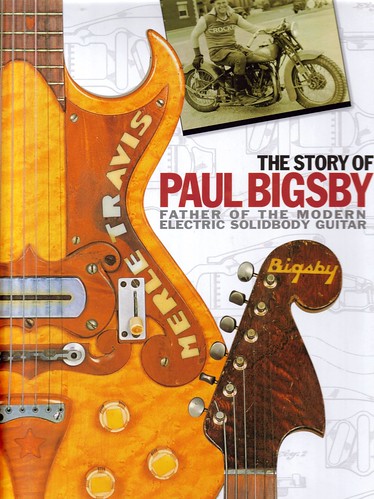
After his stint at Rickenbacker he gained employment by apprenticing with Paul Bigsby. Bigsby would be considered to have created the first solidbody electric guitar, but for the fact that his guitars actually had a hollow chamber. Bigsby also created the famous vibrato bar that is still favored today on many, many guitars.
You can see the influence of Rossmeisl and Bigsby in Semie Moseley's creations. The early guitars have a touch of Bigsby and the later creations show Rossmeisl's influence.
It was around 1954 when Semie created a triple neck guitar. This instrument included a guitar neck, a short guitar neck tuned up an octave and a mandolin neck.

The Moseley brothers took a chance and launched the Mosrite Guitar Company. The company name, Mos-Rite paid honor to Boatright, who purchased the equipment for the upstart enteprenuers. 

Semie and Andy began by building customized electric guitars  These instruments were not like any other guitars. The had shapes and designs unlike any other guitars on the market.
Semie was just nineteen and had put together his first triple-neck guitar and was even repairing guitars for Merle Travis. He built a custom double-neck instrument for TV artist Joe Maphis, who was billed as the King of Strings. 

Maphis and his wife, Rose, were stars on a locally produced, popular television show called Town Hall Party.  

Maphis had discovered a young brother and sister act called the Collins Kids. Teen-aged Lorie played acoustic guitar and sang, while her brother, 10 year old Larry Collins, played the electric guitar with lightening speed. 

The Collins Kids

Joe Maphis saw to it that Larry was provided with a double-neck guitar that was almost the twin of his own double neck Mosrite instrument. The difference was while Joe's guitar head stocks were both had 3 tuners on a side, built in the traditional Mosrite fashion,  young Larry's guitar came with six on a side tuners for both necks, which were similar to a Bigsby or Fender guitar.


Teenage Lorrie's Martin was modified by Moseley with the addition of a new bound neck with her name inlaid on the fretboard. The headstock was a six-on-a-side model that matched her brother's instrument and the guitar was topped with a new fancy pickguard.

Moserite Pickups
Semie's talent lay not only in woodworking, but in all aspects of building electric guitars. He built all his own parts except for the tuners. 

He learned how to sand cast so he could build the guitar's metal parts, which included the vibrato bar. He also was adept in winding his own single coil guitar pickups.

Andy Moseley
The Moseley’s continued to struggle to make ends meet. They were building all the guitars by hand by themselves and selling them too. Word of these wonderful instrument reached session players. Andy traveled to Nashville and sold some guitars to Grand Ol’ Opry performers.


Gene Moles
One evening California session player, Gene Moles, was displaying his Mosrite guitar to Nokie Edwards of The Ventures. Edwards feel in love with that guitar. He asked Moles to take him out to visit that guy that builds these wonderful guitars. Edwards came home his own Mosrite. 

Soon after the encounter, The Ventures hooked up with Moseley to build custom made Ventures guitars and basses.


“It was a beautiful guitar,” said Gene Moles, the Bakersfield session guitarist, member of Jimmy Thomason’s TV band, and assembly-line inspector for Mosrite guitars.

Gene Moles on the left

Mole's is quoted as saying  “It was a well-designed instrument. It felt good to a guitar player when he grabbed it. It had a narrow neck and a low profile, so you didn’t have to push down as hard on the strings to play it. 


And it had what we called ‘speed frets,’ where you could slide up and down the neck without getting held up on high-profile frets.

But the client who turned Mosrite into a household name, at least among guitar enthusiasts, was Nokie Edwards, lead guitarist for the kings of ‘60s surf-rock, the Ventures. 

Edwards fell in love with the guitar, and by 1962, the entire Seattle-based band set their trademark Fender guitars aside and were playing Mosrites.


The band, having signed a special distribution agreement with Mosrite, featured the guitar on its album covers.


Ventures II Model


Mosrite made at least 4 versions of The Venture's model that included a budget version and a six string/12 string double neck.


Mosrite 6/12 

In the early and mid 1960's, how many of us fledgling guitar players cut our teeth by learning the Ventures songs? The Ventures were huge during that era in the United States, however their following in Japan was phenomenal. And it exists even to this day.  

By now Mosrite guitars were no longer being built in tin outbuildings. 

By 1960 Mosrite employed over 107 employees and were building 700 to 1000 guitars each month.

Mosrite News Article

Sales of the Bakersfield-built guitar gained steadily over the next five years, and Semie did well for his family. His fortune did not affect his staunch religious convictions. He was raised in a Pentecostal family and carried on the tradition. 

He even managed to continue touring the country, playing gospel music in churches of all denominations.

Around 1966, Moseley purchased the Dobro Company from Emil (Ed) Dopyera, in an effort to broaden the company's line.  Gene Moles stated, “we had Dobros coming out of our ears".


Californian


Mosrite soon came out with a Dobro style guitar called The Californian, which had the Dobro resonator and a Mosrite pickup. He also made a hollow body Mosrite named The Boatright guitar. This instrument used a European body that looked much like a Gibson ES-335, but the neck and all the parts (except the tuners) were made by Mosrite.


The Venture line by now had expanded to several different models. The Celebrity 1,2 and 3 acoustic models were also part of the line-up. Moseley also produced a guitar under the brand name, Gospel Guitar. This was a celebrity model, but the headstock was different from the usual Mosrite "M" headstock.


The Mosrite Company never actually made amplifiers. What happened was that 1968, when it appeared that all was going well, the Ventures contracted with a manufacturer to build an amplifier for them. They also requested that Semie allow the use of the Mosrite brand name to be used on the amplifiers.

This arrangement turned out to be unfortunate because the all the amplifiers this company built were defective. 


None of the amplifiers worked. The Ventures had sold every one manufactured to music stores. 

Due to the goodwill of the Mosrite name, Semie had to take control of the distribution company since he was profiting from selling Mosrite guitars to these dealers. He offered to compensate the dealers with a 10% discount on guitar orders.

Mosrite Records
Semie and Andy also branched off into the recording business with their label, Mosrite Records. They recorded primarily Gospel music.  An Oceanside music-store owner who sold Mosrites, saw to it that his talented teen-age daughter, Barbara, was signed to the label. When Mandrell broke her ankle, Semie pieced together an electric guitar from her crutch.

Then, late in 1968, within a short period of a few months, it all collapsed. Mosrite’s distribution arrangement with the Ventures came to an end after five years and was not renewed. 

Moseley had hoped to cut a deal with the Vox Guitar Company, which was owned by Thomas Organ Company, but that was not to be. Thomas organ outsourced their Vox guitars to an Italian accordion and guitar manufacturer.

Mosrite filed for bankruptcy on Valentine’s Day 1969.

Following the bankruptcy, the Moseley's tried to deal directly with stores, and they sold 280 guitars in 1969 before they came to the shop one day and found locks on their doors by their creditors.


Two years after his bankruptcy, Semie was able to get back use of the Mosrite name. Then in 1970 he started making guitars again. 


Since his agreement with The Ventures ended, the guitar that he designed for them was rechristened  The Mark I.


Mosrite Brass Rail

One of the models he put together was collaboration with
Bill Grudgett of Hallmark guitars. This was called The Brass Rail." 

He moved his factory three times in the next 20 years: To Oklahoma City, Okla., in the mid-’70s, to Jonas Ridge, N.C., in 1981, and to Booneville, Ark., in 1991.

In the summer of 1981, Semie and his wife purchased some property in Jonas Ridge, North Carolina that had an old elementary school on the premises. 


By the fall of 1982 Moseley went back to building guitars. He and his wife continued traveling to churches and performing.  In 1983 the building and all of its contents, which included many new guitars that were made to fulfill a contract, the inventory, records and all of the Moseley’s personal belongings were destroyed in a fire.

I followed the story of Moseley in Guitar Player and Vintage Guitar Magazine during the late 1980's and early 1990's. It appeared that Semie was making a come back, building and selling new guitars.


Some of the newer models, in my opinion, were fine works of art, due to their intricate carving and metal work.
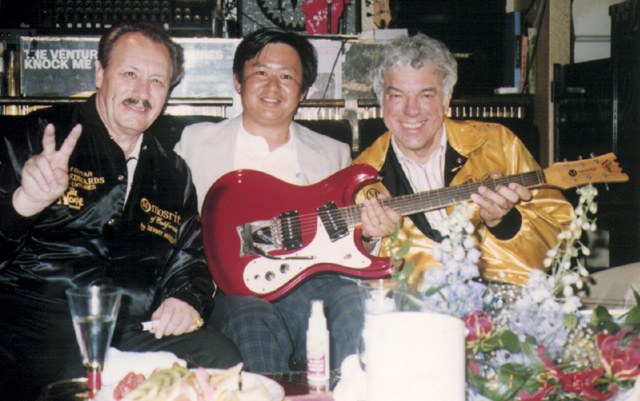
Six months after moving to Arkansas it was discovered that he was ill with bone cancer. Just six weeks later, in August 1992, he died. Had his health remained intact, I am certain that Mosrite would have risen from the ashes.

Andy moved to Nashville and ran a recording studio.

All the Mosrite guitars that sold for up to $300 to $500 in the 1960’s are now being sought after by collectors and bring in tens of thousands of dollars. There are now over 30 companies making copies of Mosrite style guitars.
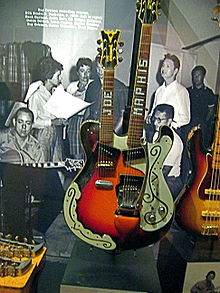

Joe Maphis Guitar at 1967 NAMM

When I was only 15, I was able to go to the NAMM convention and show, which was held in Chicago. I count myself fortunate that I was able to play an original Joe Maphis double neck Mosrite.  That was an experience I remember to this day.

Those of you  around in the 1960's may recall a popular band called The Strawberry Alarm Clock .

For the uninitiated it was in the late 1960’s, that Psychedelic music became popular. This also was an era of drugs, sexual freedom and youth that tuned in and turned on. Music was written to provide a background for this lifestyle. Bands with bizarre sounding names made extremely loud noise through massive and powerful refrigerator sized amplifiers and sang songs that often featured really bad lyrics.

The Strawberry Alarm Clock was one group that was actually very good.  Their song “Incense and Peppermints” is still one of those classic songs no matter how hard you try, you can’t get out of your head because you've heard it since 1967 and still occasionally find yourself hearing  48 years later.

Another view
Somehow Moseley hooked up with the Alarm Clock and was commissioned to design as set of two guitars and a bass for the group. These guitars all had Mosrite style parts, pickups, vibrato and bridges, but also had the bizarre feature of being surrounded by a wooden frame.

After finishing the bodies, Moseley shipped them to famed California artist VonDutch. He was known for unusual auto pin striping and painted body designs as well as painted designs on surfboards. Due to his involvement the guitar became known also as The Surfboard Guitars.

Pictured here are the Strawberry Alarm Clock Guitars. One of these is housed at the Lemelson Center of American History in the Smithsonian Museum.

The Moseley Family 1957
I would be remiss to end this story without mentioning Semie's daughter, Dana Moseley has taken up the Mosrite banner and is making and selling guitars that would make her Dad proud.

If you are in the market to buy a hand built electric guitar check out Dana Moseley's site first. She builds Mosrite guitars using the same methods her father taught her. Her guitars are amazing. 

However the Mosrite name now belongs to a Japanese company called Fillmore Guitars of Japan. Dana was receiving guitars from Japan and installing her own custom pickups. 

I believe that Semie was married more than once although I cannot confirm it. I do know that he had  one more daughter, that at this time was just a twinkle in her Mom's eyes and that is Michelle Moseley. She shares her father's faith.  

Semie was a legend in the guitar business, and an incredible craftsman.  At this writing his guitars are selling at prices in the thousands of dollars.


Tuesday, January 29, 2013

Joni Mitchell's Guitars and Tunings


Joni Mitchell is coming to my home town next month. Out of the three great lady folk singers of the early 1960’s, Joan,Joni and Judy, Joni Mitchell was by far the most interesting guitarist. Plus, she used many very interesting guitars and many more interesting tunings.

The first professional instrument she owned was acquired back in 1966 when she received a 1956 Martin D-28 from a Marine captain. The captain was in Vietnam when his tent was hit with shrapnel, injuring him. 


The captain had two guitars inside his tent at the time. Joni claimed this Martin to be her best guitar ever. She wondered if the explosion did something to the modules in the wood, since the guitars sound was incredible. 

She used this guitar on all of her early albums. But by the time she recorded Court and Spark; the guitar had been damaged by an airline carrier and soon after was stolen from a luggage carousel.

It was in the latter 1970’s when she turned to electric guitars. She preferred George Benson model Ibanez guitars which she usually played through a Roland Jazz Chorus amplifier. To keep up with her unique tunings, Joni traveled with five similar Ibanez guitars. 
Each guitar was strung with differing sized strings which were matched to the tuning she used. She states that the guitar has to sound crystal clear when playing harmonics. Therefore the more slack the tuning was, the heavier the strings needed to be.

During that same decade Steve Klein built her a wonderful handmade guitar in Klein’s own interesting and decorative style. This instrument was visually and technically a masterpiece. The sound hole’s rosette ring could be removed to provide a larger bass voice that can be tuned by affecting the air resonance of the body. The inlays are I-Ching hexagram number 56. The Wanderer graces the face and upper bout of the instrument and Don Juan’s crow flies on the head stock.

The acoustics she now owns and uses include two Martin’s; a D-45 and a D-28 and a Collings D2H and a Collings ¾ size guitar. All guitars are equipped with Highlander pickups, although she makes use of an external microphone on stage.

In 1995 Fred Walecki, the owner of Westwood Music in Los Angeles, built a unique Stratocaster style guitar for her.  The body was made of lightweight German spruce and the neck was made of maple. This instrument contained a hex-pickup that could be used in conjunction with a Roland VG-8 synthesizer. 

This instrument opened new options for Mitchell. Though the guitars strings maintained original tuning, the synth could alter each strings timbre and pitch. Instead of carrying around five instruments, she could now pack one guitar for her concerts, programming the Roland guitar synthesizer to match her variety of tunings. 

Not only was it useful for her variety of tunings, but also for the unique sounds she could coax from the Roland synth.

More recently I have seen videos of Joni wielding a 2008 Parker Fly Mojo Flame guitar. She uses this guitar as a synth controller in combination with a Roland VG-8 guitar synthesizer.  

This guitar alos contains the built in Hex pickup and a piezo pickup that allows her Parker guitar unique sounds to match her music.

For the unfamiliar, it was during the early part of 1960’s that folk music briefly became the rage. This music grew out of the clubs around Washington Square Park and New York City’s Greenwich Village.  

Many famous players started due to their love of acoustic blues music. The clubs attracted a hotbed of musical talent. Name a well known folk artist and you can be sure he or she got their start by playing at one of these club.  

Joni states she purchased Pete Seeger’s How to Play Folk-Style Guitar. She was so proficient that she skipped ahead of the book’s lessons and learned to fingerpick the way Elizabeth Cotton picked on her famous song “Freight Train.” And though she may not have mastered that alternating 1 – 5 bass line, Mitchell did come up with her own style.

I recently learned part of Joni's reason to use alternate tunings was due to having polio as a child, which affected her left hand. The altered tunings allowed her to play chord shapes that she could not get her weakened hand to play.

Like many guitar greats, the way she strokes and picks the strings with her right hand is the heart of her guitar sound.  Her style went beyond finger picking as she concentrated more and more on song writing.

Early on she caught on the some of the open tunings of blues players. From there she built up a bevy of tunings for her songs.


For instance she says the simplest tuning in her opinion is D modal (DADGBD). She also utilizes other simple tuning in open G (DGDGBD) and open D (DADF#AD).


Both Sides Now
For her two most well known songs, Both Sides, Now and Big Yellow Taxi she uses a capo on the second fret and tunes to open E (EBEG#BE). She makes use of the capo along with the diverse tunings. For Marcie she tunes to CBDFCE.

Mitchell claims she experiments by attempting to play her songs with different tunings to get a larger sound. She visualizes sounds as colours and shapes. To date, Mitchell said that she has used 51 tunings. Some tunings recur at several pitches. Generally speaking, her tunings started at a base of open E and dropped to D and then to C, and these days some even plummet to B or A in the bass. This evolution reflects the steady lowering of her voice since the ’60s, which occurs in all of us as we get older.


Mitchell has come up with a way to categorize her tunings that reminds me of Nashville Notation.  Since the guitar is tuned in fourths which occur on the fifth fret, standard tuning is 5 5 5 4 5 with E as the bottom string. 


Her tunings include 7 5 or 7 7 for the bottom strings. As an example, Free Man in Paris utilizes D A D G B D (the 7 5 tuning).

For those who are interested, the only published documentation of her 30-year guitar odyssey is four single-album songbooks transcribed by Joel Bernstein, her longtime guitar tech and musical/photographic archivist, which show the real tunings and chord shapes.


Joni Mitchell frequently turns to the dulcimer in her on stage performance. During a back packing trip Mitchell did not take a guitar, but did bring the dulcimer and a flute, learning to play both instruments.


Joni and Jaco Pastorius

I may add that Mitchell is also an accomplished pianist. And I cannot leave out the fact that in the 1970’s Joni was very dissatisfied with the standard bass style of the era. 

She came across a bass player from Florida named Jaco Pastorius, who gave a very interesting flavor to her songs. 

And of course Pastorius became on of the most recognized and sought after bass players of his era.


Here it is 2013 and Joni Mitchell is still singing and playing her songs to the delight of her fans and admirers.

2015 Update: Joni has recently suffered an aneurysm which has affected her speech. Let's all wish her the best and a speedy recovery.


 Check out her fingerings in this 1970 video.
©UniqueGuitar Publications (text only)


Wednesday, January 16, 2013

Acoustic Travel Guitars Part 2

(I apologize that this review took so long to publish. I had some issues come up in December that delayed  finishing the article. Thank you for understanding.)

Upon doing some further research I discovered there are many companies that offer acoustic travel guitars as part of their line up.

Part One of Acoustic Travel Guitars was based on instruments which I am familiar. Part Two is Acoustic Travel Guitars that I have run across on the web or in reading material.


Blackbird Nylon strung
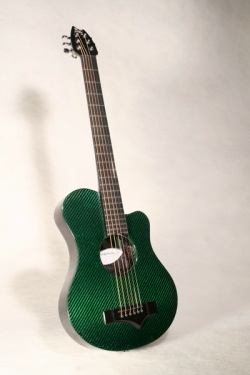
The first highly unusual and highly expensive acoustic travel guitar is made by a company named Blackbird. The Blackbird Rider Nylon guitar is made of carbon fiber, in the manner of Rainsong Guitars. This is considered a green guitar, although the finish is actually black. No trees were harvested by its manufacturer. So it is CITES approved.

The Rider is indestructible according to the literature. It weighs in at right around 3 pounds. The body on this guitar is somewhat trapezoidal.

There is no sound hole. Instead it has been replaced by a “sound scoop” on the upper bout facing the player. The Rider also comes in a steel string version.

Perhaps the downside is the price. The nylon string version sells for $1900 USD and the steel string Rider sells for $1800.

The Composite Acoustics Cargo travel guitar is another instrument made of carbon fiber, which the manufacturer refers to as composite. As with all carbon guitars, including this one, you get durability and strength in a lightweight package. This guitar holds up well in extreme temperatures and if the airline handles this guitar in a rough manner, it is not going to break.

The instrument’s unique design might be mistaken for an Ovation guitar. It has a fairly deep cutaway which slants downward at the end of the guitars neck, making those high notes very accessible. The sound hole is traditional on this short scale guitar. The fingerboard is also made of composite material, as are the top, back, sides, bridge, saddle and nut.

This instrument comes with an active L.R, Baggs Element, under-saddle transducer with a volume control.

The scale is 22-3/4 inches. Like the Blackbird Rider, this guitar is much too expensive. Its suggested retail price is $1800, but you could probably get one for around $1478 if you are so inclined.

Composite Acoustics: (337) 233-4119; compositeacoustics.com.

The Hawaiian Backpacker Acoustic Travel Guitars, looks much like a Martin Backpacker. The Asian manufacturer refers to it as a Hawaiin/Dulcimer Acoustic Camping/ Backpack guitar.

The guitar is 35 inches from the top of the neck toward the distal end of the guitar. It is only a mere 7-3/4 inches at its widest point.

This is a steel string instrument. The bridge is a traditional style (probably movable) wooden bridge. A mandolin style tailpiece anchors the strings. The Hawaiian Backpacker Acoustic comes with its own gig bag and is a steal for under $40 USD. It comes in natural, black and burnt-red finishes.

The Enorez Travel Guitar is made by a Chinese manufacture and imported by an east coast USA company called Zero One. If you spell zero one backwards, it is loosely Enorez.

Their travel guitar is quite unique. The thin and small body is reminiscent of the shape of an old mandolin. The strings are anchored on the head of the neck and are strung to the tuners at the bottom of the instrument. It looks backwards. This guitar comes with a hardshell tweed case and will set you back $170 to $180 USD.

Yamaha comes in with a sort of acoustic travel instrument they call The Guitalele  GL-1. This is actually a small nylon strung acoustic guitar.

Back in the 1920’s stringed instrument manufacturers were coming out with variations on the banjo such as the banjo-uke, the banjo-mandolin and banjo-guitar. The Guitalele seems to be the current decades version.

Yamaha suggests you tune this instrument to ADGCEA, to compensate for the short scale. This allows you to play guitar chords on the instrument and stay in tune.

The price is around $100 USD. Yamaha considers it to be a fusion of the guitar and the ukulele.


The price is not much more than what mid-priced ukes are currently selling for. The benefit of the Guitalele for a guitarist is not having to learn ukulele chords.  I could be a great at instrument for a guitarist looking for a new way to play, or a ukulele player who wants to produce a fuller sound. The scale is 17", so tuning up a fourth is a must. This is another travel guitar that is sized small enough to fit in an airline overhead compartment.

Tanglewood TB Baby
The TB Baby and Baby Deluxe were offered by the Tanglewood Guitar Company of the U.K as part of their Evolution series. The TB Baby has a similar appearance to the Baby Taylor. The guitar was an all laminate model. The TB Baby Deluxe came with a solid top and sold for around $129 USD. They also made a TB Big Baby. You might check eBay for used models.

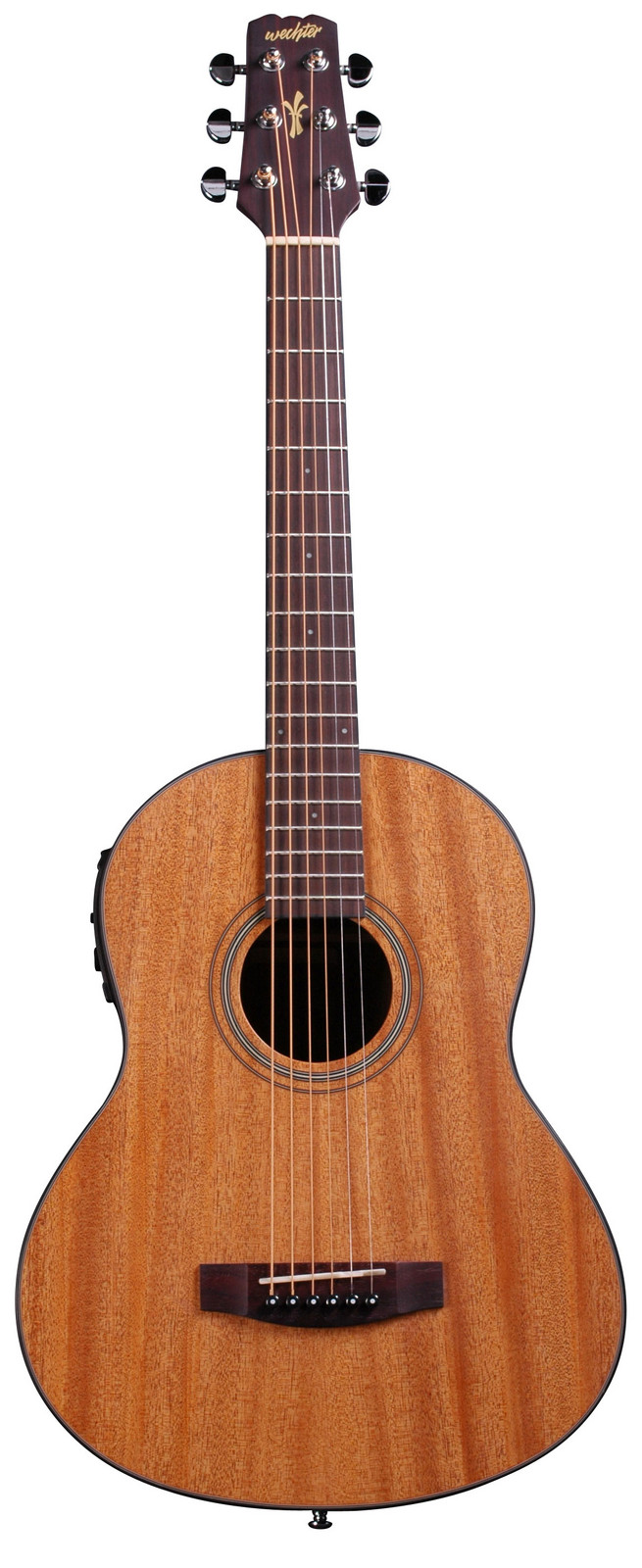
Wechter guitar offers a small travel guitar, model 1720 Elite. This comes with a solid mahogany top, sides and back. The neck is contructed of nato wood. The fingerboard is made of rosewood. All Wechter guitars use the Plek Pro Setup system which gives each instrument a personalized factory set up for accurate intonation and is guarenteed to prevent fret buzz. This is done through a computed aided machine with the ability to level frets within .001 mm of accuracy. This enables the 1720 Elite model to maintain a low action for enhanced playability.


The furniture grade mahogany gives this guitar added strength in the event it gets knocked around on a vacation or camping trip. The guitar has a satin finish and a 23.3" scale.


Ovation AA13
Ovation also offers some travel guitars under it's Applause line. These are the Mini-Applause AN13 nylon string guitar and the AA13 steel string acoustic guitar. Both come with spruce tops and Ovation's parabolic back and suggested selling price is $249. The AE13 is an acoustic electric model of the AA13 and sells for $50 more. Gig bags are extra for these instruments

I've mentioned Voyage Air guitars in the past. This company manufacturers full sized guitars with an unique hinged neck. This allows the player to fold the guitar in half an place in a backpacker style case that is included with the instrument. This design meets requirements for airline carry-on luggage.

To pack the guitar away, one simply unscrews a nut at the neck heel.


Surprisingly the hinged neck design is reported not to effect tonality.  Most models sell from $600 to $1000 USD.

This instrument features an East Indian rosewood fretboard and chrome plated tuning heads that top off the neck. The African mahogany bodies with solid spruce tops are manufactured offshore in Korea. The necks are manufactured in the USA and the instrument is assembled in the USA.

Some additional features of the Voyage Air VAOM-04 Songwriter include and hand inlaid 2-ring rosette and 6 ply binding. The saddle is compensated and Voyage Air comes with a proprietary nut design the manufacture refers to as the Captured Nut. The scale is 25.5".

The Amigo Travel guitar can be found on any number of musical instrument web sites including Amazon.com. 

This small guitar has an elongated mandolin shape. The top is solid spruce. The back and sides are mahogany. The Amigo AMT10 comes with a padded nylon carry bag. It is priced from $90 to $120 USD.

The Breedlove Guitar Company offers the C250/CM travel guitar. It is manufactured in Korea. The top is solid western red ceadar. The back and sides are laminated mahogany. It has a short scale of 19.1" and has a street price of aproximately $450 USD.

Breedlove suggests you tune this instrument up 5 frets to A on the first and sixth string to compensate for the short scale. 

The C250 comes with an undersaddle piezo pickup with a built in preamp powered by a nine volt battery. Included is a chromatic tuner that is built in the guitar as well as a tone control.

Emerald X5
The Emerald X5 Life Woody is/was made in Donegal, Ireland. This guitar is the creation of Alistair Hay or Emerald Guitars.It features a one piece carbon composite body and neck. The instrument is enhanced by a redwood burl veneer over the composite fiber. The fiber construction allows the neck heel to have an extreme tapered design allowing easy access to the higher frets. The instrument scale is 25.5" or full scale.

It comes with a B-Band pickup system with a built in tuner and is/was priced at 995 EURO's. It is a beautiful instrument.

Great Divide
For those of you that are short of funds, which would include many of us these days, you may want to look into The Great Divide Campfire SST-N Travel Guitar. $99 USD buys you a small guitar with a solid spruce top, a dove tailed, glued-in mahogany neck topped with a 19 fret rosewood finger board, a bone nut and saddle. The back and sides are laminated sapele wood. The scale is small at only 22.7" and it comes with a gig bag.

Sierra Compass


The Sierra Compass Series ST10 Travel Acoustic Guitar is an excellent travel instrument. It features a solid spruce top and laminated mahogany back and sides. Die-cast chrome tuners and a satin finish.

This instrument includes a high quality padded gig bag. Suggested price is $300 USD.


Alvarez RT16
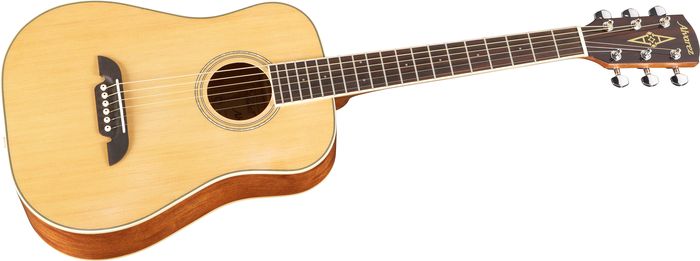
The Alvarez RT16 Regent Series 7/8 Travel Size Acoustic Guitar is a perfectly formed travel sized dreadnought. Compact, yet plays just like a full size acoustic.

The RT16 comes with an Alvarez padded gig bag and has a spruce top and mahogany back and sides. As a 7/8th sized guitar, the neck profile is easier to play. The guitar is constructed using a dovetail neck joint. The bridge is the patented Alvarez bi-level model, designed to enhance vibration. The scale is short at 22.5". The neck radius is 10". The neck is mahogany topped with a rosewood fretboard.

Newporter Mini
Fender guitars offers the Newporter Traveler Mini Acoustic model. This is named after Fender's well known 1965 Newporter guitar.

The new model is a mini-dreadnought with a short scale at only 22.6 inches.

The guitars top is made of spruce with mahogany back and sides. Fender has used a satin finish for the Newporter. The neck is made of mahogany topped with a 20 fret rosewood board. The bridge is also made of rosewood. Like the '65 model, the mini Newporter comes with a Stratocaster style headstock.

Unfortunately one of the best travel acoustic guitars is no longer in production. You might find one on eBay or another auction site. The Tacoma Papoose, by the Tacoma Guitar Company, was made in Washington state.

This wonderful instrument came with a solid cedar top, solid mahogany back, sides and neck. The fretboard was rosewood, as was the bridge.

Since the scale is 19.1", it was suggested by the manufacturer to tune it to A. It was sold with its own gigbag. Uniquely, the "paisley" soundhole was on the upper top bout.

The bracing on these guitars was proprietary and know as the Voiced Bracing Support System.

Tacoma Guitars were designed by Terry Atkins and George Gruhn, the well known collector/appraiser.

Back when these were being marketed, the list price on the P1 model was around $800. Though most Papoose guitar manufactured were six string models, Tacoma also offered a 12 string model.


Breedlove Passport. This is an excellent arrangement - Chet meets Queen.