Elias Otha Bates aka Bo Diddley played an unusual and unique guitar that he had a big hand in designing.
He also had a huge influence in transforming Blues music into Rock music, though he never set out to accomplish anything other than playing his own style of music. His “shave and a haircut-two bits” also known as “the Hambone” was the driving pattern that caught the eyes and ears of so many British Invasion bands and American bands of the 1960’s and became a part of their style.
Born in Mississippi and raised by his mother’s cousin, Elias Bates took on her surname, “McDaniel” and used that throughout his life.
Bo Diddley and Dean Cameron
The McDaniel family moved to Chicago and young Elias McDaniel was raised in the Ebenezer Baptist Church. He learned to play the violin and trombone in the church’s orchestra, but he was much more fascinated by the driving music being played at a nearby Pentecostal Church. It was there that he took up the guitar.
Early photo John Lee Hooker
He later saw John Lee Hooker play and McDaniel was awestruck. He was working as a carpenter and mechanic, but on weekends and at night he played in a band called The Hipsters along with his friend Jerome Green. It was during this era that they would trade joking insults at each other.
The band began to play at some Chicago Blues clubs and started making a name for themselves.
By 1954 he teamed up with harmonica player Billy Boy Arnold, Roosevelt Jackson on bass and drummer Clifton James and recorded some demos at Chess studios including I’m A Man and Bo Diddley. The songs were later re-done with Otis Span on piano and Lester Davenport playing harmonica, Frank Kirkland on drums and his friend Jerome Green playing maracas.
Within a year “Bo Diddley was released and not only went on to become a hit record, but a classic. It was then that McDaniel adopted the stage name Bo Diddley.
The origin of the name is somewhat unclear, as several differing stories and claims exist. Diddley claims that his peers gave him the nickname, which he first suspected to be an insult.
The phrase "bo diddley" was at once Black slang for “absolutely nothing.” But McDaniel states that the name belonged to his adopted mother. And yet another story states the Bo Diddley was the name of a prize fighter.
The song Bo Diddley became so popular that in 1955 McDaniel and his band were asked to appear on the Ed Sullivan Show. This perhaps made him the first Black performer on the show. Sullivan requested that he sing the popular hit song “Sixteen Tons”, but McDaniel sang Bo Diddley instead.
This infuriated Sullivan and McDaniel was banned from further appearances.
Ironically the Merle Travis song, Sixteen Tons, was one of the featured tunes on the 1960 Album, “Bo Diddley is a Gunslinger. (This was an era when Western TV shows were really big on television.)
He had a string of minor hits through the late 1950’s and ‘60’s In 1963, he starred in a UK concert tour with the Everly Brothers and Little Richard.
The Rolling Stones, still barely known outside London at that time, appeared as a supporting act on the same bill. This helped to further his fame.
Diddley/McDaniel co-wrote another hit song along with his guitarist Jody Williams called “Love Is Strange”which became a chart topper and a classic from Mickey and Sylvia.
Diddley liked to include women in his band. He knew this would be a great visual effect and he gave them nicknames. Norma-Jean Wofford was The Dutchess. Peggy Jones was called Lady Bo and became his lead guitarist.
Debbie Hastings Bo's bass player
Cornelia Hasings aka Cookie and Debbie Hastings lead his band for over a quarter of a century.
Diddley wore an ever-present Stetson hat, sometimes bedecked with badges. He also seemed to have a great attire of fancy stage clothes and shoes that enhanced his act.
Diddley continued to perform into the 1970’s era, He even did a concert with the Grateful Dead.
Bo Diddley's Hat and Badge
During these years Diddley was living in Los Lunas New Mexico and served for nearly three years as a deputy sheriff. He purchased and donated Highway Patrol pursuit cars to the force.
He also lived in Archer Florida, a community near Gainesville. Diddley/McDaniels continued to play music throughout his lifetime until 2007 when he suffered a stroke during a concert.
Bo Diddley fashioned homemade guitars from cigar boxes. This was an old folk tradition that gave his signature instrument its distinctive rectangular shape.
Diddley with some of his gutiar collection
Bo Diddley playing one of his handmade guitars
Before Gretsch began producing Diddley's guitars, he built two dozen or more of this own, famously giving one to Dick Clark after a career-making appearance on American Bandstand.
During his early years Diddley/McDaniel was seen playing a Stewart/Orpheum guitar. This brand was made by a New Jersey factory called Unitedcode. They sourced guitar bodies, necks and parts to a number of manufacturers. The pickups were made by another New Jersey company called Franz. These are exceptional pickups and were used by John D'Angelico on his high-end electric guitars.
He says he made these using a Victrola record player. This device had a magnetic device designed to pick up the sound from the needle. McDaniel would use this to amplify his homemade instrument.
He convinced Gretsch to build his guitar which included DeArmond pickups. In his own words he states that he approached a luthier from White Plains, New York named Guilliano who was a production manager at Gretsch.
He constructed three custom made guitars for McDaniel. These included his square guitar and two Jupiter Thunderbird guitars. As these were custom made instruments, McDaniel says he only authorized one guitar, but believes Gretsch built more. Apparently McDaniel thought the design was copywritten, however that was not the case.
Gretsch designated the square guitar as the G6138, though I have also seen this guitar listed under different serial numbers. Early promo pictures of Diddley carrying the guitar on a motor scooter show it with a red finish and a blue finish, both instruments with twin DeArmond pickups. A 1977 auction site shows, Bo Diddley's own Gretsch square guitar with a somewhat larger body and three DeArmond pickups. The Hard Rock Cafe in St. Louis has a gold finished twin pickup model Gretsch square guitar that belonged to Diddley on display.
He also designed a Gretsch guitar that we best know as The Caddilac Guitar, since it resembled the fins from a late 1950’s Caddilac. However Diddley called it The Jupiter Thunderbird. Gretsch made a couple of these for Diddley. He gave one to ZZ Topps Billy Gibbons. Gibbons has an incredible collection of custom made instruments and decided it would be wrong to tinker with the original, but he had his luthiers redesign the guitar and Gretsch took up the banner. It was released for sale in 2006 as the Gretsch Billy Bo Jupiter Thunderbird, model G6199.
So what was the secret of Bo Diddley’s sound? Listening to his guitar you hear a wildly pulsating tremolo.
His guitar was percussive and usually played in an open tuning. With Diddley, it was all about rhythm. His lead lines were usually just open chords played one octave above what he was playing. And he tastefully punctuated his songs with those "lead" lines.
Diddley recalls his tone stemmed largely from his attempts to imitate the sound of a bow on a violin. He also states that he constructed his first tremolo unit out of a clock spring and automobile parts. Of course a good portion of his band’s sound came from the maracas and drums, but his guitar sound was something special.
I’ve heard speculation that it came from the tube driven tremolo in brownfaced Fender amplifiers. And for the most part Diddley did use Fender amplifiers.
I’ve even heard that he used Magnatone amplifiers. However I can find any indication that he utilized Magnatone amps. In my opinion his sound is not similar to that warbling Magnatone vibrato.
However one of the first tremolo units; possibly the first standalone guitar effect was the DeArmond Model 601 Tremolo unit. This was developed in 1946 and available by 1948. And it is documented that one of the first guitarists to use the DeArmond Tremolo was Bo Diddley. In fact he used this on his early Chess recordings.
This unit looks very simplistic with its two knob layout, but in fact its design is somewhat complex.
The unit works by reducing the signal from the guitar several times a second and then building it back up. To achieve this the guitars signal is grounded through a water-based electrolytic hydro-fluid that is located in a canister inside the unit.
Within the canister and insulated from the units body is a pin that is connected to the incoming signal. When the unit is activated, a small motor shakes the canister causing the hydro-fluid to stir and splash against the pin which momentarily grounds out the guitars signal. This produces a liquid watery tone.
Later in his career, Diddley played custom made guitars which had built in effects. One story I have read is from a player in a North Carolina Rock-a-Billy band that had the good fortune to back up Bo Diddley. He states that Bo plugged directly into a rented Fender Twin Reverb amplifer, but his guitar had six or seven knobs on it with LED's to indicated what effect was on.
Listening carefully to Diddley/McDaniel I can also hear some tube distortion and definitely some echo.
Beatles' guitar sold for £294,000
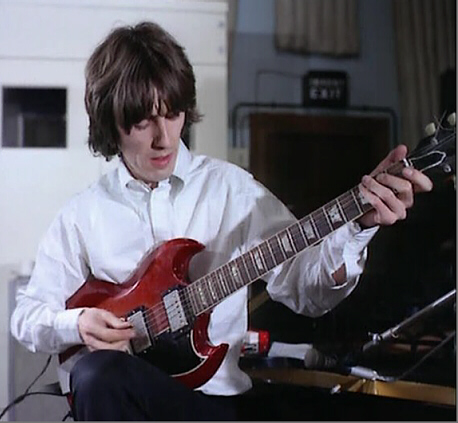
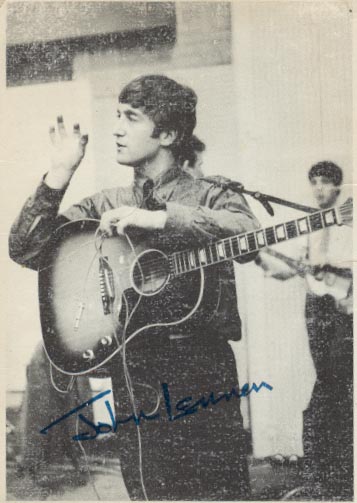
A guitar played by George Harrison and John Lennon has fetched £294,000 ($570,000) at auction in New York.
The Gibson SG guitar was used by Harrison from 1966 to 1969, including during the recording of Revolver, and by Lennon during White Album sessions.
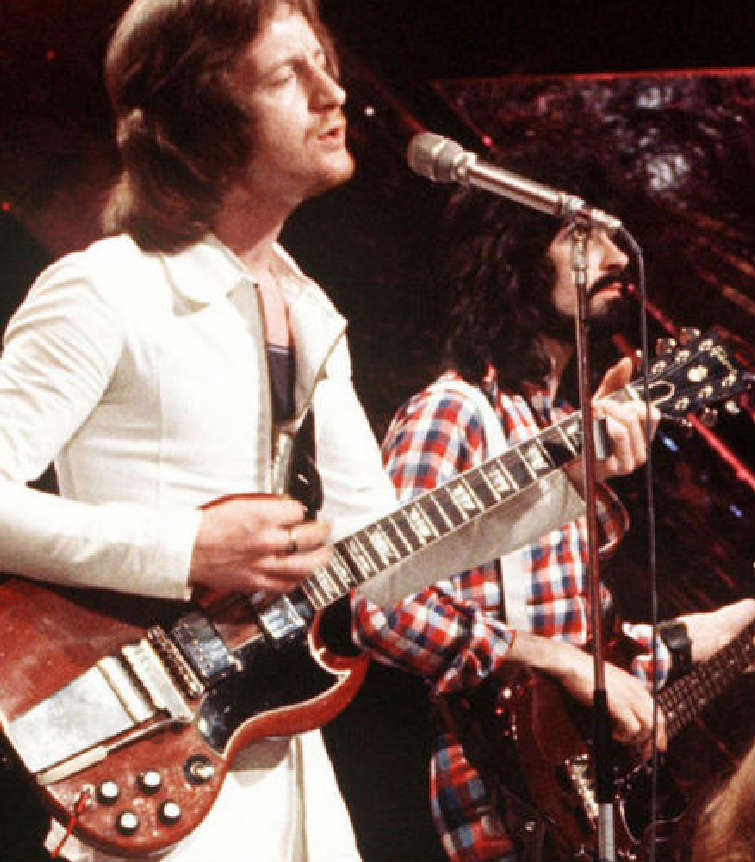
Pete Ham with SG
George Harrison had given the Gibson guitar to Peter Ham - of the rock band Badfinger in 1969.
When Ham died in 1974, it was stored away by his brother and not rediscovered until the US Rock and Roll Hall of Fame contacted him in preparation for a Badfinger retrospective in 2002.
It sold to an anonymous bidder on Friday.
Among 70 items of Beatles memorabilia on auction, there were also never-before-heard original tapes of an interview of Lennon by a reporter for the Washington Star newspaper from 1975.
These sold for £27,900 ($54,100).
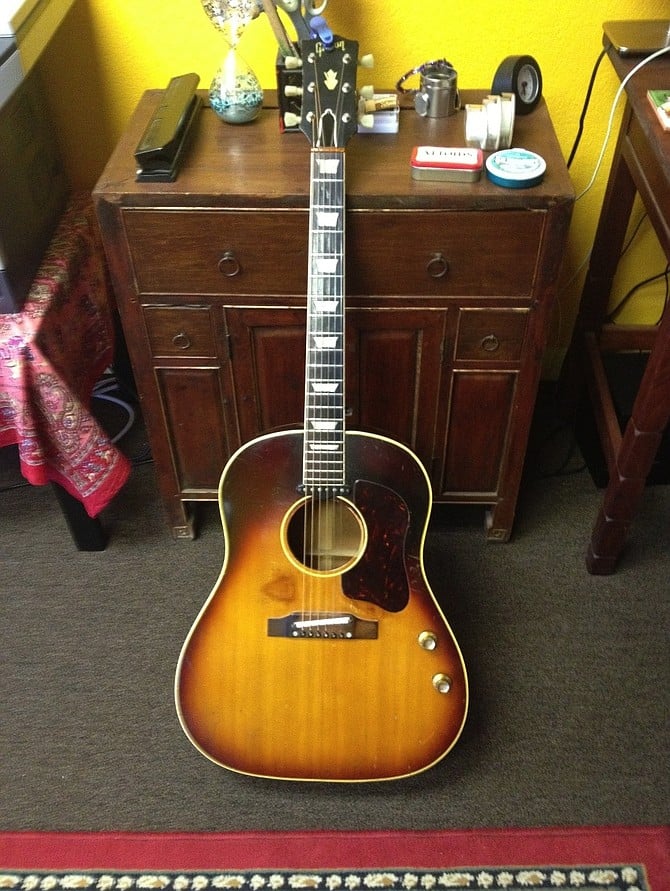
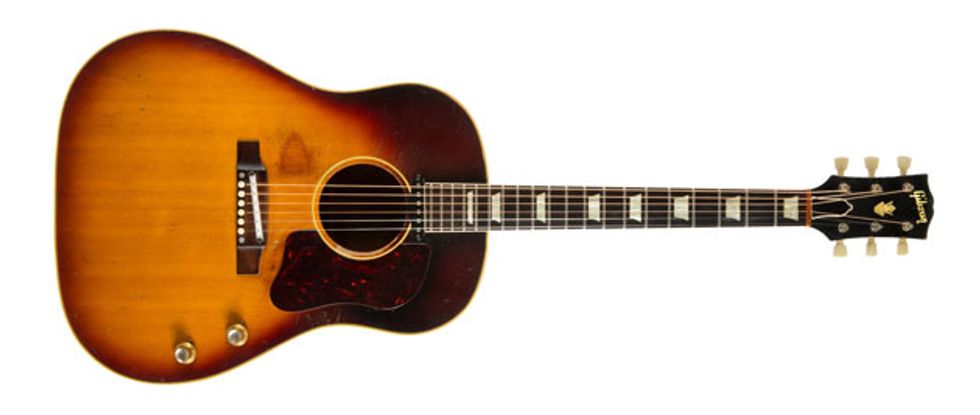
John Lennon’s 1962 Gibson J160e guitar, once thought lost, has been discovered in San Diego at Marc Intravaia’s Sanctuary Art and Music Studio in Sorrento Valley and is about to go up for one of the most publicized auctions in Beatles history. However, “Once the story broke on Reuters, there was quite a few awful comments about my friend [John McCaw, the guitar’s owner] from people not knowing the whole story,” Mr. Intravaia tells the San Diego Reader.
“He bought it in 1969 from a friend and never knew what he had until he brought it to me last August.” John McCaw, who bought the guitar from a friend in 1969 for $175, never knew what he had. McCaw bought the mildly beat-up Gibson acoustic from a friend for $175, in a transaction at Blue Guitar shop, then located in Old Town.
After spotting a magazine article in 2014 with a photo of George Harrison holding a similar guitar, McCaw noted Harrison’s guitar was only four serial numbers away from his Gibson, and concluded they were probably made on the same day in 1962. Further research revealed that John and George bought identical Gibsons on September 9, 1962 at a Liverpool music store called Rushworth’s.
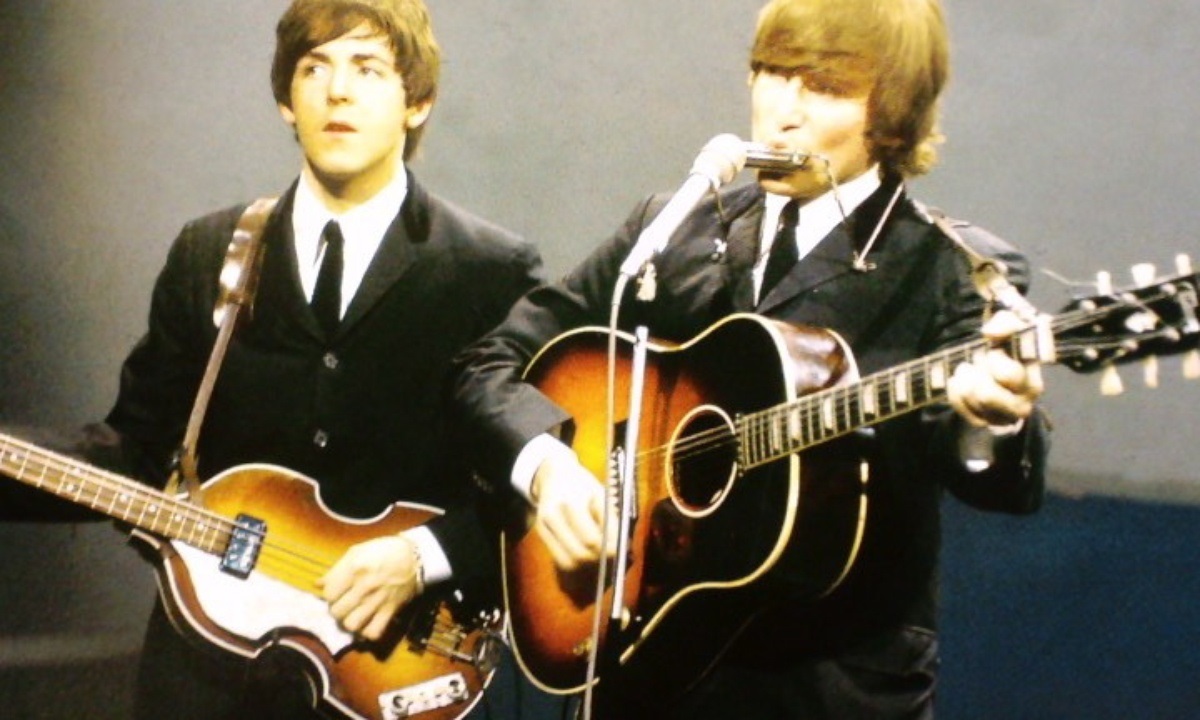
“He had read that at some point between September 1962 and December 1963, they swapped instruments for reasons unknown,” says Intravaia, “and that John’s guitar went missing after a series of December 1963 Christmas shows in London at the Astoria Cinema in Finsbury Park.”
Marc Intravaia and McCaw found video of Lennon playing the guitar and noted several remarkable similarities to McCaw’s guitar, too numerous and detailed to list here but including specific scratches, wear marks, and – most telling – wood grain patterns.
Local video archive licensors Reelin’ in the Years provided a high-def tape with freeze-frame close-ups of Lennon’s guitar, and pairing it with footage of McCaw’s (as seen in a new YouTube video) led to Intravaia contacting the official Beatles gear expert Andy Babiuk.
“He made it very clear that this might be a forgery and that he needed better pictures of the wood grain, because, in his words, ‘the wood grain is the DNA of the guitar.’
” With Babiuk holding all the original records and receipts for Lennon and Harrison’s Rushworth’s guitar purchases, Intravaia was delighted when “I received a call from Andy confirming that it was John Lennon’s guitar.”
Julien’s Auction House in Beverly Hills is auctioning the Gibson over the first weekend of November. The company’s owner, Darren Julien, calls it “one of biggest finds in music history,” stating in the press release that its sale may exceed the $965,000 earned in 2013 for an electric guitar owned by Bob Dylan.
Korean based Samick Musical Instruments Co, Ltd. is one of the world’s largest producers of musical instruments.
1960's Samick bass
You may be playing an instrument made by the Samick factory and do not know it. With a manufacturing capability of more than one million guitars per year in factories in Korea, Indonesia, China, and the United States, Samick also ranks as the world's leading stringed instrument producer.
The company sells its guitars under its own brand names, including Samick, Abilene, Silvertone, and the Greg Bennett Signature Series.
Samick has manufactured guitars for many other companies, including Fender and Gibson.
Additionally, this manufacturer produces a full range of pianos, electric and acoustic guitars, basses, banjos, autoharps, harmonicas, and other instruments. It also operates a dedicated Upright Piano and Piano Action plant, as well as its own sawmill and woodworking facility in Korea, a smaller factory in California, and a plant in Harbin, China that produces wooden guitar and piano parts.
Samick was started in 1958 with the goal of enriching human life through music, the universal language. Hyo Ick Lee founded the company as an importer of Baldwin pianos to Korea. Within two years Samick began building their own upright pianos, using imported parts.
In 1965, during the Folk Music years and the British Invasion years, when every kid wanted a guitar, Samick began production of acoustic guitars for the Korean market as well as for export to fulfill the demand for cheap Asian-made guitars that overwhelmed the market during this decade.
Samicks goal was toward a higher quality market. The company continued to improve its piano manufacturing techniques, and in 1970 its production abilities had developed sufficiently for it to launch its first grand pianos.
Hondo Guitars
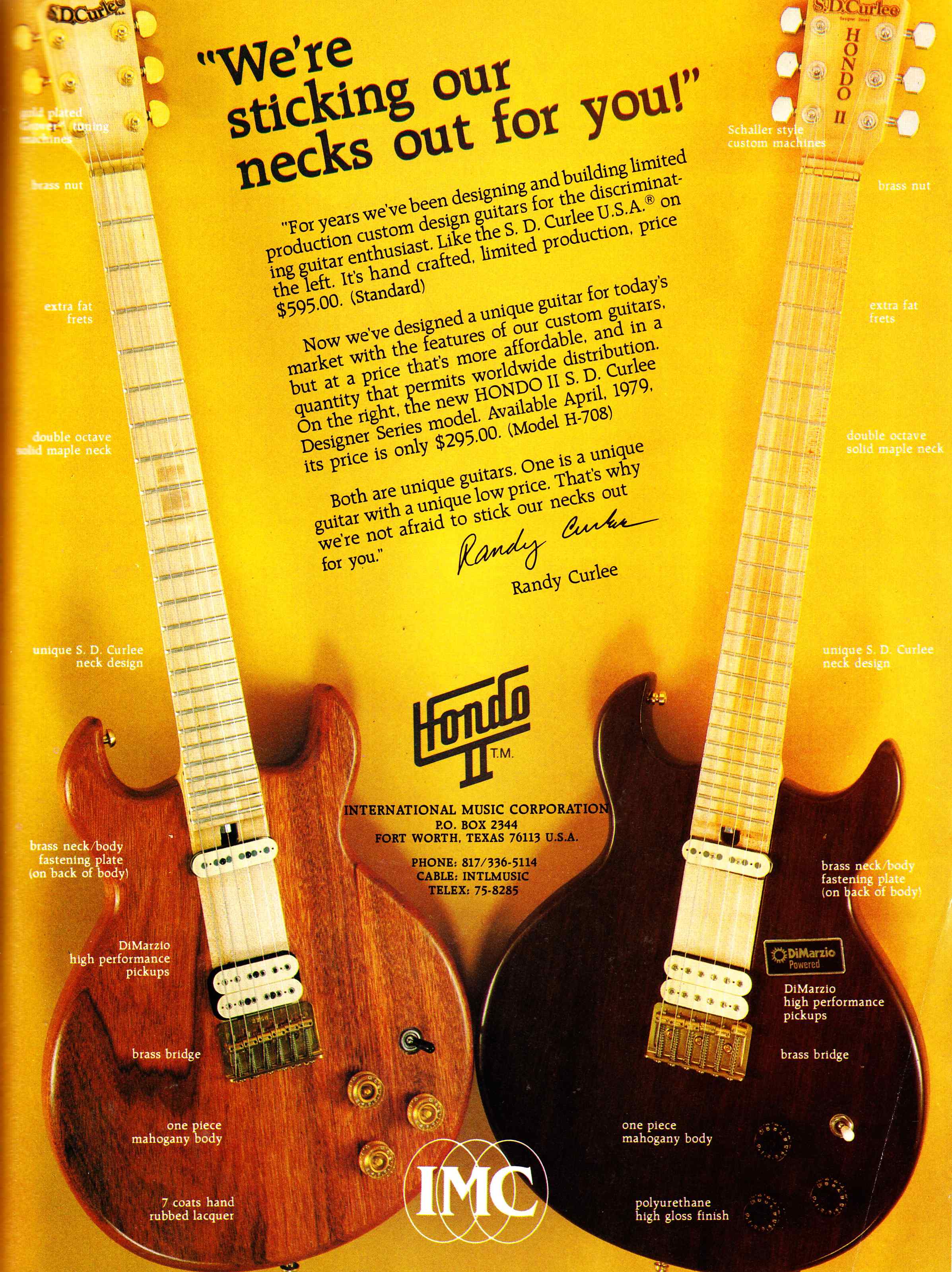
During this same period, the company began to step up the quality of its guitar production. Samick formed a joint venture with Texas-based International Music Company (also known as the Hondo Guitar Company).
Hondo II SD Curlee
The new company introduced modern U.S. production methods to the Korean market, while taking advantage of the low-wage level in Korea to offer inexpensive, entry-level guitars. Hondo initially produced a line of classical and folk guitars. By 1974 the company’s electric guitars had gained a level of quality and became one of the largest selling entry level brands. Hondo added banjos and autoharps to their product line up. By the end of this decade Hondo was selling nearly 800,000 instruments per year.
In 1971 Samick introduced a line of harmonicas.
And in 1973 Samick was diversified in its production and changed its name to the Samick Musical Instruments Mfg. Co. Samick’s thrust was the export market, especially the United States. To facilitate this, a branch office was opened in 1978 in Los Angeles California.
The lower production costs of Korean-manufactured instrument made them attractive to entry level buyers. This was especially true in the piano market since costs of US made pianos had escalated. In fact in 1979, Samick was building the Schumann piano brand for US households. During these years, the Korean musical instrument industry had caught up to its primary competition, Japan, and due to lower construction cost had surpassed them.
In 1979 Samick had developed new automated production facilities that reduced the need for skilled employees and increased production with the benefit of maintaining quality standards.
By 1982 Samick opened a branch office in Germany to introduce their brand to the European market. That same year they established a full U.S. subsidiary known as Samick Music Corporation.
In 1988 Samick went public, listing shares on the Seoul stock exchange.
That same year they purchased the Kohler and Campbell piano brand. The company had claimed the number one spot for grand piano sales by the end of 1995.
Faced with economic issues in Korea and most of Asia, in 1996 the company filed for bankruptcy protection.
The company had become too diversified with investments in furniture, computers, industrial equipment and the fishing industry; they were unable to make a profit and had a debt of nearly $10 million.
Samick’s prominence as a musical instrument manufacturer was a key factor that saved the company from going under. The company was able to rid themselves of non-profitable business ventures and most of its debt to the point they were able to begin reporting profits. In 2000 the company had a contract with OEM (original equipment manufacturers) for $50 million to supply grand pianos to Baldwin pianos. They gained another plus when the acquired Knabe pianos that same year.
In 2002 a consortium of Korean businessmen acquired Samick and retired all of its debt. Kim Jong-sup became president and announced the goal of becoming the Worlds Top Piano Brand. By April 2003, Samick with a revenue growth of nearly 30 percent, it pushed past the $200 million mark.
With the launch of a new line of high-end Knabe-branded pianos, Samick was prepared to claim a place among the world's leading quality piano makers in the new century.
Since the days of “lawsuit” guitars, Gibson and Fender both made the decision, if you can beat ‘em, join ‘em. Both companies have outsourced manufacturing of their “shadow” brands; Epiphone and Squier, to Asian manufacturers. It is difficult to determine where these brands originated. But it is a good guess that many of the superior, high-end guitars from were made by Samick in accordance with Gibson or Fender standards of quality.
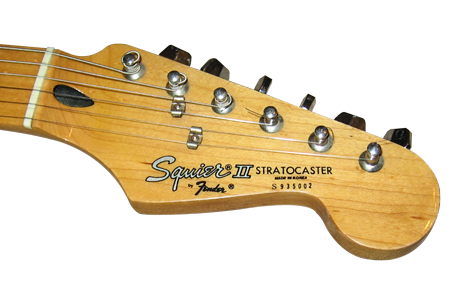
The Squier brand was developed in 1982 and early on all production was based in Japan. The first Squier guitars to emerge from Korea started as early as 1986. You can determine if your Squier was made by Samick was through its serial number that began with an “S” or “S9” followed by six digits. Samick began production of Squiers in 1989.
M-72
In the 1990’s Fender had acquired the DeArmond brand name. Initially this brand was introduced in Europe. In the late 1990’s, Fender offered DeArmond guitars for sale in the United States.
DeArmond Starfire
DeArmond guitars were based on Guild electric guitars that were no longer in production. The DeArmonds made in Korea were produced by Samick and perhaps Cort.
They are excellent quality instruments that come with reproductions of DeArmond 2K or Goldtone pickups.
Your DeArmond will have a sticker on the back of the head stock noting if it was made in Korea or Indonesia. In 1983 Epiphones were mainly manufactured in Korea.
By 1986 Gibson Guitars was acquired by Harvard MBAs, Henry Juszkiewicz, David Berryman and Gary Zebrowski, bought Gibson/Epiphone from ECL/Norlin. The new owners recognized the importance of the Epiphone brand and how the company could be pushed to match the success of other Asian guitar brands.
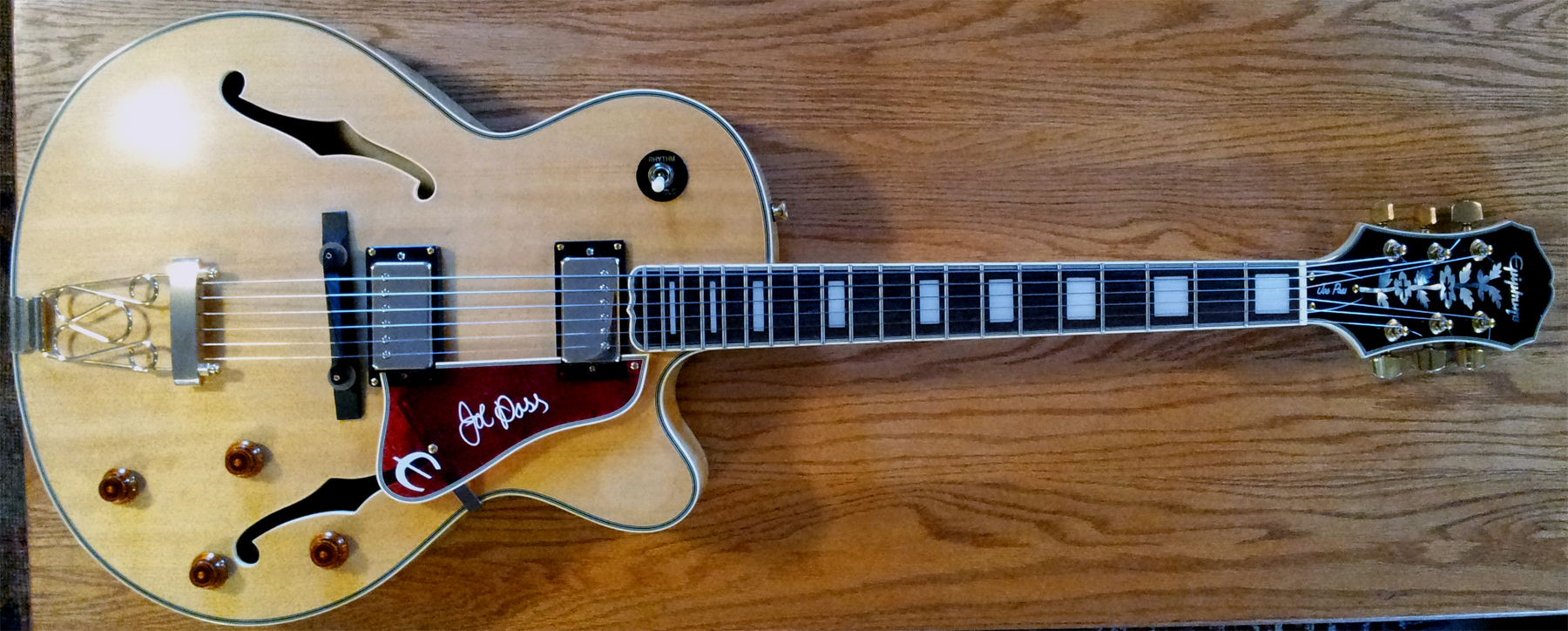
Samick built Epiphone Joe Pass
During this era, the new owners of Gibson opened up an office in Seoul to watch over manufacturing of their products. Not all Epiphones were manufactured by Samick. Factory processes were assessed and refined and Epiphones own engineers took a hands-on role in the development of pickups, bridges, toggle switches, and fret inlays, as well as unique features like the metal E logo and frequensator tailpiece.
These Epiphone guitars were constructed using different woods, for example Nato instead of Mahogany. Bodies were fastened with epoxies instead of wood-glue. Finishes tended to be polyester resin instead of nitro-cellulose lacquer. Some parts are made of plastic, such as nuts and bridge saddles instead of bone. Cheaper hardware and pickups were sometime used.
In 2002 Gibson moved all of its Epiphone production to Qingdoa, China.
One method of determining if your Epiphone guitar was made by Samick is its serial number. There may or may not be a factory code. There may be no factory designator for some models made in 1993 and earlier years.
Like Epiphones, Samick instruments generally start with an “S”. For example S3021234 is indicative of Samick-S-1993-3-February-02-unit 1234. If it begins with SI, that means it was made by Samick in there Indonesian plant.