Saturday, May 11, 2019

Vintage Hagstrom Guitars - 1958 to 1967

Dodds Music Store


I started playing guitar when I was 13 years old, and took lessons at Dodd’s Music Store in Covington, Kentucky. That is where I fell in love with the guitar. I would hang out at that place before, and after my guitar lesson, and even go there after school, just to check out the guitars.


Vintage Hagstrom Guitars

On a section of one wall was a display of six unusual guitars made by Hagstrom. Some of them looked like guitars made by Fender.


The six-on-a-side headstock, had the brand “Hagstrom” written in script similar to Fender’s spaghetti-style font. In smaller letters you could read Albin Hagstrom.

Aside from the lesser price, the big difference between Hagstrom and Fender was that Hagstrom guitars had thinner bodies, and a lot of slider switches. At that age, I did not know that the vibrato was a much different system than the one on a Fender Stratocaster, or even a Jazzmaster. But all those switches were mighty impressive to someone learning basic guitar chords.

Hagstrom King Neck Decal

One of the selling features, which was printed on a metallic decal on the back of the Hagstrom guitar headstock, was their “King Neck”.


Hagstrom Expander-Stretcher H-Rod
This feature refers to the unique “H Expander-Stretcher” truss rod. Hagstrom advertised that they were the "Fastest necks in the World". I don’t know about fast, but the necks on those old Hagstrom guitars were certainly among the thinnest.

Albin Hagstrom


Mr. Albin Hagström began importing accordions from Germany and Italy to Sweden in 1925 and founded Firma Albin Hagström. Albin expanded his business with shops in Sweden, Norway, and Denmark.

Hagstrom Store Drottninggatan Stockholm
In fact most of his business was devoted to music stores, that sold his accordions.


An Early Hagstrom Accordion

In 1932 he started manufacturing accordions himself in Älvdalen, Sweden. By 1936, Hagström hired two Italian accordion builders who helped to update and streamline the manufacturing process.


Then in 1939 Hagström started to establish themselves in USA by opening Hagstrom Music Company Inc in Rockefeller Center in New York as well as Albin Hagstrom Inc in Jamestown, New York.
Late 1940's and Early 1950's Guitars
The company had offered guitars as early as the late 1940's, but primarily was known as an accordion manufacturer, and distributor.

However, in 1940 the launch in Jamestown was canceled due to World War II and the people hired to run the company disappeared with the company's funds.

After the war ended,  Sven Hillring was sent over from Sweden to oversee a new launch of the new accordion factory in Jamestown,  New York. This was in 1946. Men serving in WWII were coming home with accordions, and in a few years the "stomach Steinway" would become a brief fad. The Hagstrom U.S branch stayed in business until 1949. To take advantage of America's  accordion craze, Hagstrom was there to provide the instruments.

But in 1958 Albin Hagström's oldest son Karl Erik Hagström came back to Sweden stating that the accordion era was coming towards an end and that the future was rock´n´roll . Rock music demanded electric guitars instead of accordions!

A 1958 Pre-production
P46 Deluxe - #P007
After some research, that included taking a Gibson Les Paul "Goldtop" apart (Hagstrom was the Scandinavian Gibson distributor at that time), the head designer Holger Berglund and his right hand man Arne Hårdén started to design the first Hagstrom electric guitar. A pre-production batch of guitars were built towards the end of 1958.

Those instruments have their serial numbers stamped in their perloid covered bodies starting from P-001. The first "official" batch of Hagstrom electric guitars is batch 449.

The first part of this batch is called the Hagstrom De Luxe "small model" and the last part is the "large model" witch later became the Hagstrom De Luxe 90.

1959 P-24 Smal Model Deluxe


The first batch included 200 guitars that were built from 1958 to 1959.


1959 Standard Sweetone Models


The last batch of these Sparkle & Pearloid guitars included 540 guitars that were built in 1963.


1960 & 61 Goya 80 Hagstrom Guitars

Many of these guitars were sold under the Goya brand name in the United States. This was because importer Jerome Hershman, who had been the sole importer of Levin guitars from Sweden, under the Goya brand, inked a deal to import and distribute Hagstrom guitars in the United States.

The original models were known as the De Luxe “Smal Model” (that is not a typo, It is called Smal) ,which was the first guitar and manufactured from 1958-59.

1959 Hagstrom
4 pickup P-46 Sweetone
These original guitars were covered with perloid plastic on the front and back of the body, the sides, the body, the neck, the fretboard, and the front and back of the headstock. While the guitar’s front was generally done in a sparkle colour, the rest of the body used the pearloid material.

This guitar had two single coil pickup that are surrounded by a metal frame. On the top of the frame were four push button tone controls, as well as two rotary potentionmeters.

In the center of the metal frame, between the two pickups, was a piece of gold or silver foil with diamond shaped patterns.

1959 Goya 90 - P-46
When I was young, I was told the feature was to enhance the sound, if the instrument was played un-amplified. I doubt if this explanation is credible. It was just further adornment.

Below the metal frame that housed the pickups and electronics, was a clear plastic pickguard.

A stamped chrome metal Hagstrom logo was adhered to the upper bout. There was no logo on the headstock.

The tuning machines were of the open backed variety and had ivoroid buttons. The side of the instrument featured a strip of binding in the center. The bridge/saddle was in-distinctive, and not tunable.  The strings attached to a small metal tailpiece. The input jack is on the instruments lower side.

'59 Hagstrom
Sweetone
The updated model known as the Standard “Sweetone”, was introduced in 1959. The features were similar, but the bridge was now made of metal, and on most models it was compensated. This model also was available with a mahogany top.

Next came the Standard 80 and Standard 90 were developed in 1959 and sold through 1962. These mostly came in sparkle models, But the Standard 90 was also available with the Mahogany front. These included similar electronics, but some models included the Hagstrom Tremar system.


1960 Hagstrom Batman P-90
Another very unique, and very rare guitar is the Hagstrom De Luxe Batman guitar. It is also known as the Hagstrom Ducks Foot guitar. This guitar had two pointed cutaway horns, a set neck, and a headstock with points on either end. The electronics were similar to the Standard models, The Batman was available with twin single coil pickups, or with four single coil pickups, It was also offered with a stop tailpiece, or the Hagstrom Tremar system.

This is the only guitar that Karl Erik Hagstrom designed. It was available in varying sparkle finishes, or in a mahogany finish.

1959 Goya 90 - P-24 Deluxe


There were two imported versions of the the Hagstrom Standard 80 and 90 guitars that were called the Goya 80, and Goya 90. These instruments were offered from 1960 to 1962.


1960 Goya 80
The Goya 80 had the same features as the Hagstrom Standard 80, as did the Goya 90. However this is a unique instrument. It had four pickups, instead of two.

Importer/distributor Jerry Hershman considered this instrument to be hard to sell in the United States under the Hagstrom name, so he insisted it be sold with the Goya logo, which, in his opinion, was more familiar to U.S. buyers.

Goya 80 without electronics

Also, because the custom fees were less expensive on acoustic guitars, the Goya 80, and Goya 90 were sold without the electronics, although they were said to have an acoustic pickup. The guitar did have an eighth inch plug running from the input jack to a routed area on the guitar, but since it had no electronics it was considered to be an acoustic instrument.


Goya 80 - P-24 Pickup Unit
Once in the USA, the electronic units were assembled on the instruments. There were four different electronic units available. Some had two pickups, while others had four pickups. The units included the roller knobs for pickup volume, and either four or six tone switches.

From 1962 to 1966 Hagstrom offered some guitars branded under the Kent logo, known as the Kent model PB-24G.

1962 Kent PB-24G and 1963 Kent PG-24G

The reason the guitar was not sold under the Hagstrom brand was that Karl Hagstrom was worried that the acrylic top - pickguard/electronic assembly may crack, and he did not want the Hagstrom name on this product.


This guitars body was shaped like a Fender Stratocaster. Kent guitars were meant for distribution throughout Europe, and the U.K. at a time when guitars imported from the USA had high tariffs.

Hagstrom Kent PB-24G
The top was made of an acrylic material that was dyed either light blue or red so no paint was necessary on the body. The sparkles, and pearl were not to be seen again.

I am told this guitar also came in purple/lavender and orange/brown, but I have never seen this model in those colours.

The center portion of this instrument was raised and was cream coloured. It generally held two single coil pickups with an indented area for the gold or silver foil insert. Though it looked like a scratch plate, it was actually a molded part of the top.

On the bottom were four slider switches which turned the pickups off or on, and changed the tone. The guitar included one master volume knob. Below the volume control is a raised section for the input jack. It resembles an inverted Stratocaster jack.

Hagstrom Kent PB-24 G back


The back of this guitars body was a vinyl covered shell which allowed the body to line up with it, and six bolts and washers around the top's perimeter secured the top in place.


This guitar came with a wooden bridge, that is embedded with eight sections of fretwire as saddles. The strings attach the a Hagstrom Tremar unit. The neck was painted glossy black, as was the six-on-a-side "dolphin" shaped head stork.
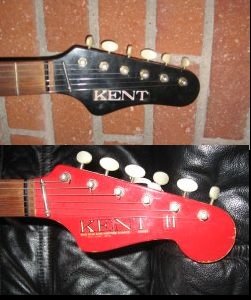
Kent Head Stocks


More often the headstocks were painted black if the bodies were blue or red for the guitars with red bodies. They all bore the KENT logo. It was meant to be a budget guitar, but it was not a bad guitar at all. I have seen a few of these guitars with three pickups, and six slider switches.


Kent III New Model
Some of the later models were known as Kent II or Kent New Model. These were labeled as Hagstrom guitars.

By 1963 Hagstrom introduced their "new" models, which were like nothing else on the market, but for the Fender style six-in-line headstock. These were the Impala, the Corvette/Condor, and the Automatic. The twin horns were offset, and there was a slight edge to the bottom of the body.

1964 Hagstrom Impala


The Impala came in red-burst, while the Corvette/Condor, and the Automatic came in brow-burst.  The Corvette had two names. In Europe or the UK, it was the Corvette. Due to trademark infringement, in the USA, it was called The Condor. No one knows why there was not a problem with the Impala, since General Motors also made a car with that trade name,


1964 Hagstrom Corvette

The Impala, and the Condor/Corvette had the same controls, including a three pickup selector knob. Since the Impala only had two pickups, the first position was off, the second position activated the neck pickup, while the third position activated the bridge pickup.


1966 Hagstrom Condor

For the Corvette/Condor, the switch turned each pickup on.  The volume was controlled by a slider switched that was mounted on the side of the pickguard.  The guitar featured eight tonal switches. Both guitars featured an unusual body shape. The input jack was side mounted on both the Impala, and Condor/Corvette. Both guitars featured the Hagstrom Tremar unit.


Condor 4 bass
A bass version of the of the Condor, called The Condor 4 was available. It had a slightly different body shape. This bass model came with a slider switch mounted in the pickguard, and four tonal switches.

Hagstrom had two other models. One was called The Automatic, and was sold under the Hagstrom brand, while the other was called The Futurama Coronado Automatic brand. Both instruments were vary different. Both instruments came with three pickups.


1965 Hagstrom Automatic

The controls for the Automatic were mounted on the pickguard. These featured a single tone, and volume potentiometer. A set of three slider switches that controlled which pickups were active, and two additional switches that I assume are tone controls. The jack was side mounted The body shape of both the Automatic, and the Futurama Coronado were similar to a Fender Jazzmaster.


Hagstrom Futurama Coronado
The Futurama Coronado version was wired totally different. on a raised wood grain scratch plate were three volume controls for each pickup. On the lower bout of the guitar were twelve tonal switches in two rows. The upper row had seven switches, while the lower row had four switches. The jack was side mounted. This was a unique guitar sold only for the European, UK market.


'65 Hagstrom I
The Hagstrom I, II, and III, started out with strat-style bodies in 1963 to 1965. The Hagstrom I was much like the acrylic body Kent Pb-24G, but with the Hagstrom logo.

The Hagstrom II and III retained the same "strat-shape" as the PB-24G but had solid wooden bodies.

The pickups on the II, and III were mounted on an acrylic plate, with four switches, volume knob, and a raised input jack.  The Hagstrom II came with two pickups and the gold/silver foil insert between them. The switches were on/off, for each pickup, a tone switch that activated some capacitors for low or high sounds, and a mute switch.

Selmer "Futurama
Hagstrom-made III and II


The Hagstrom III, also known as the Futurama on the UK market, and distributed there by the French company Selmer, had three single coil pickups, six switches, a volume knob, and the raised input jack. The switches controlled which pickups were active, tone, and one switch muted the guitar. All the instruments came with the Hagstrom Tremar vibrato system.


Hagstrom I with wooden bridge
The Hagstrom I had a wooden bridge saddle, while the Hagstrom II, and III came with a height adjustable compensated metal bridge. There were two types of bridge saddles available; the compensated model, and an adjustable model.

By 1966, the Hagstrom line up added some new guitars, which were distributed in the European, and US market.

1966 Hagstrom F-11


The Hagstrom I with the acrylic body was renamed the F-11. It was a two pickup guitar, available in red, white, light blue, and black.


1966 F-B

A similar bass known as the F-B was offered. It came with a bass neck, and a metal bass that held the strings, with a slanted wooden bridge. However the body was much the same as on the F-11 guitars. The twin single coil pickups had four pole pieces.

The newest models for 1966 were the Hagstrom F-200, the F-
300, F-400 and F-12. The bodies on these guitar had offset cutaways, like a Stratocaster, but the horns were pointed, much like an SG. The thin lacquered wooden bodies on these guitars were beveled on the edges. The bodies were made of birch. These guitars had improved square pickups, with tone rings around each pickup.

1966 F-200

The controls for the F-200 were similar to the older models; an on/off switch for each pickup, a tone switch that changed capacitors for lo-hi sounds, and a switch labeled mute. Another switch was added to the upper bout that was a standby or kill switch that shut off the electronics.

The right handed versions were available in red, white, blue, black, and sunburst, and all came equipped with the Hagstrom Tremar unit.


1966 F-300
The F-300 had an additional pickup, and six switches on the bottom side of the guitar, plus the standby switch on the upper portion of the pickguard.

All of these guitars had black pickguards with the controls mounted on them. Each instrument had only one potentiometer for the volume. The input jack was similar to the one on a Stratocaster, but not as deep. It was mounted on the instruments body.


1966 F-400
This same type of instrument was offered as the F-400 bass, which had two square pickups and metal surrounds, four switches on the pickguard, a volume pot, and a standby switch. The F-400 bass had a flat chrome base that served as a string attachment, and had a wooden slanted bridge.

One thing that is interesting about all of the Hagstrom instruments is the narrow neck, which Hagstrom marketed as the World's Fastest Neck. I don't know about that, but I once owned an F-400 bass, and it was an extremely narrow neck, which in my opinion, was great for a guitar player doubling on bass.

If you are used to playing with a P-bass neck, this would not be your instrument,  Instead of string trees, all Hagstrom necks had a metal bar just above the nut to lower, and direct the strings.

F-300 Neck
The necks on all the guitars and basses were made of maple, with a rosewood fret board, and dot inlays. The headstocks were Fender-like, six-on-a-side style, and the tuners were great. The tuners on the F-400 were enclosed, and comparable to those on any Fender bass.  The literature states that left handed versions of the F-300, and F-400 were only available in red, black, or sunburst.

Joe Long with a Hagstrom F-400

However I have seen a video of the Four Seasons bass player, Joe Long, playing a white Hagstrom F-400. In 1966 my two favorite Hagstrom guitars were the F-12-S, and the Hagstrom Eight String bass.


1966 Hagstrom F-12S
The Hagstrom F-12-S was a 12 string version of the F-200. All the controls were the same as the F-200, but this guitar was set up for 12 strings. The strings went over a metal compensated bridge that was height adjustable, and attached to a stop tail piece. The headstock on this guitar was a flat six-on-each-side style. A badge that said Hagstrom was centered between the strings.


A friend of mine owned this guitar, and I borrowed it many times from him. The neck had a very flat radius, and was not at all thick. The only drawback from this guitar was due to the enclosed tuners, I found it to be top heavy. But it had a great sound.

Hagstrom H-33


Hagstrom offered an acoustic 12 string model called the H-33, that suspiciously looks like a Levin guitar. Hagstrom offered some other acoustics as well. Due to Jerry Herschman's connection with Levin guitars, I believe they were most like made by Levin, and badged as Hagstrom models. In later years this model came with a trapeze tailpiece.


1966 Impala, Condor, and Condor IV
During this same year, 1966, Hagstrom offered the Impala and the Condor in the United States. This included a bass model known as the Condor IV. The Impala was a twin pickup guitar, and advertised as producing 18 tonal effects, while the Condor came with three pickups, and is said to produce 27 tonal effects.


1966 Viking V1 & V2
In 1966 Hagstrom offered some acoustic electric models they called the Viking guitars, and Concord basses.  The Viking models, the V-1, and V-2, were similar instruments. Both had semi-acoustic bodies with twin F holes,  twin single coil pickups, with a tone, and volume control for each pickup. The edges of the ES-335 shaped bodies were bound, and offered in red, or sunburst. The V-1 was priced at $250, while the V-2 cost $425. A Bigsby tailpiece was an option.


Red Viking V1

The pickguard, with the Hagstom logo on it, was black. The necks were once again thin, and had a six-on-a-side headstock. The back of the neck was painted to match the guitars body. If the body was red, the back of the neck and headstock was red.


Sunburst Viking V-1
If the body was sunburst the back of the neck was sunburst. The front of the headstock was usually black, but could be red on that color guitar.

The instruments had a stock harp style tail piece, however were available with an optional Bigsby unit.

The difference between the V-1, and V-2 was the adornment.

The maple neck on the V-1 had a bound rosewood fretboard with dot inlays.

1968 Hagstrom V-2
On the V-2 instrument, the F holes were bound, the neck, and headstock were also bound.  The neck on the V-2 had a bound ebony fretboard, with block inlays. The headstock on the V-2 instrument was glossy black and bound. The hardware and pickup surround were gold-plated.

The necks on both instruments were bolted on units. The V-2 had a fancier harp tailpiece.

1968 Elvis with a Hagstrom V-2

You may have seen a picture of Elvis with a V-2 guitar. He borrowed this guitar from session player, Al Casey, just for the pictures.


Hagstrom C-1 and C-2

Hagstrom offered bass versions they called the Concord C-1, and C-2. Once again, these bass guitar were very similar. The C-1 had twin single coil pickups, a bound neck, and chrome hardware. The C-2 came with the same twin pickups, but the f-holes, neck and headstock were bound, and all the hardware, including pickup surrounds were gold plated. The necks on both basses were quite thin.

We will take a further look at Hagstrom guitars from 1968 to 1984 at another time.

Click on the links under the pictures for sources. Click on the links in the text for further information.
©UniqueGuitar Publications (text only)




Sunday, April 28, 2019

Relish Guitars

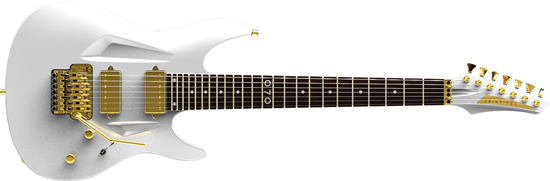
Aristides model 070
There are some very interesting and innovative guitars coming out of Northern Europe. Last year I wrote about Aristides Guitars that are built in the Netherlands.


Versoul Raya 6


I also did an article on Versoul guitars that are manufactured in Finland.


Relish Guitars
Now I have encountered some exquisite and unique guitars being built in Lucerne, Switzerland with the unusual name of Relish Guitars.


Relish Guitars - Jane and Mary


There are two versions of these unique instruments; Jane and Mary. Both are manufactured with a similar body shape, but out of different materials.


Relish Guitar Founders
Relish Guitars are a venture that was started by partners Pirmin Giger and Silvan Kung who are living their dream of designing and building an exceptional and unusual guitar, by taking a similar approach that artisans took with historical Swiss watchmaking technology.

The Jane Model
Jane’s body (the guitar) is based on a milled aluminum frame which serves several functions. The strings attach directly to this frame which enhances their sustain.


The maple neck is bolted directly to the aluminum frame and center bar. The bridge is also attached to the bar. This further adds to the guitars sustain. So although the guitar body is essentially hollow the way the frame and neck are engineered, it provides the resonating factor of a solid body instrument.

The frame also acts has a stable housing for the components, which allows easy access to the guitars inner-workings including swapping out the pickups and changing the battery.

The pickups are connect to a circuit board by means of gold plated connectors that simply unscrew in the event you want to change pickups. Relish Guitars will add the connectors and cables to any aftermarket pickup you send to them.

Magnetic LED touch switch 
The circuit board operates the unique LED switching system, which is powered by the battery. Instead of the usual Switchcraft style toggle switch, this guitar comes with two LED’s on the front of the body. By merely touching one or both the pickups go off or on.

The guitars interior work is pristine.

The Jane guitar comes with standard and passive volume and tone potentiometers and twin passive Relish Bucker XV pickups, which are designed and made in-house.

Jane's aluminum frame
Sandwiched above and below the frame are two sheets of 7 layer wood veneer, that are available in walnut, ash, or cherry. The front and sides attach directly to the aluminum frame.


Back cover with guitar pick wedged in


The veneer cover on the back is routed out and has a second “door” that has a parallel shape to the body.


Magnets 

This door is held in place by magnets and is easily removed with a guitar pick.


The neck is made of solid maple and the headstock comes with Schaller machine heads.


Woven Bamboo fretboard
The fretboard is constructed of woven dark bamboo. This material is harder than most fretboard woods and is a sustainable product. It is topped with stainless steel fretwire and has 24 frets. There are no fret markers.


Schaller tuners - resin nut

This guitar is slightly over the 25 1/2” for its scale (650mm) and has a 10” radius. The nut is made of resin. The neck has a two-way adjustable truss rod.


A Hipshot adjustable bridge/saddle assembly that allows the strings to attach directly to the guitars frame.

I have to hand it to Relish Guitars for coming up with such a unique body shape. This double cutaway guitar is not a copy of anything else on the market. The Jane model comes in walnut, ash, cherry, blond flamed, white, gray/black and Bordeaux.

Mary
Mary is much different from Jane, as Mary comes with a solid alder frame that is milled on a CNC machine.

The top and back are made of milled plywood that attaches to the alder frame by use of bolts that utilize large o-rings to prevent any vibration.


Mary's frame


Unlike the Jane model, the entire back side of the Mary guitar is removable to access the pickup connectors if there is a need to change them out and also to attach the strings to the tone block on the underside of the Hipshot bridge/saddle.


The maple neck is bolted to the alder or ash frame by means of 4 bolts and a metal plate and is hidden away beneath the instruments back veneer.


This guitars neck is topped with a fretboard made of dark woven bamboo  with stainless steel frets. There are no position markers on the fretboard.

The Relish Mary guitar
Mary comes with twin Relish Bucker XV pickups that are made by the company. The pickups are controlled with a 3-way blade switch.  There is a single volume and a single tone potentiomers with chromed and knurled knobs. The headstock has a veneer that matches the colour of the body.
©UniqueGuitar Publications (text only)


Friday, April 5, 2019

The Gibson Byrdland - A Most Unique Guitar

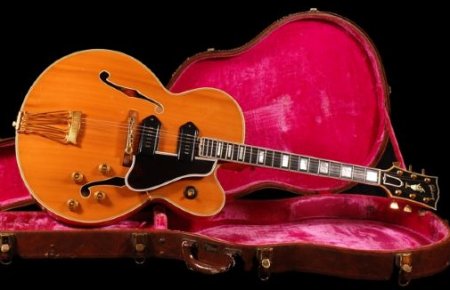
1955 Gibson Byrdland
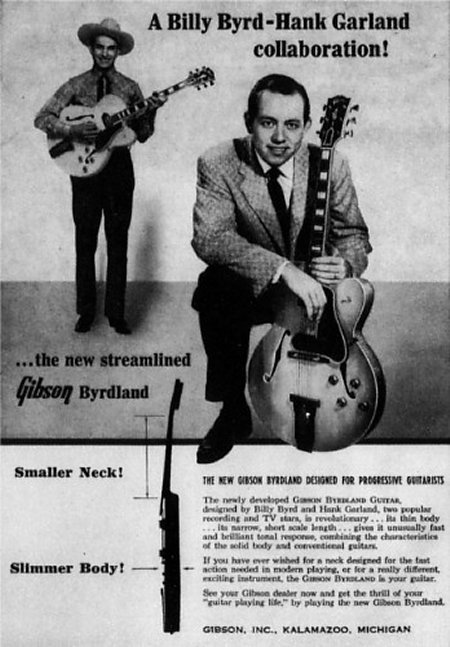
The Byrdland is a stunning looking electric guitar that is made by Gibson. Its name derives from the names of guitarists Billy Byrd and Hank Garland for whom Gibson originally custom built the guitar.

At the time Gibson's president, Ted McCarty, sought opinions and ideas about new products. So in 1955, in collaboration with two of the best Nashville guitars on the scene, Billy Byrd and Hank Garland, Gibson developed the Byrdland guitar.


The Byrdland was the first of Gibson's Thinline series. Many guitarists did not desire the bulk of a traditional archtop guitar such as Gibson's L-5 CES, one of Gibson’s top models. The Byrdland was built with its overall depth of 2¼ inches which,was over one inch shallower the Gibson's L-5 CES model.


It was later during the design process, Byrd and Garland specified a shorter scale neck.which would help facilitate intricate single-note patterns and unusual stretched chord voicings.


Billy Byrd
Only three were produced in 1955.. Billy got number one and Hank got number two and then he ordered and purchased a third that had a custom cherry finish. At this time the two prototypes both had natural finishes and Venetian cutaways.

The original instruments were to come with twin Gibson P90 single coil pickups. Although Hank ordered his with a single P90 and a Charlie Christian pickup in the neck position.


1957 Byrdland


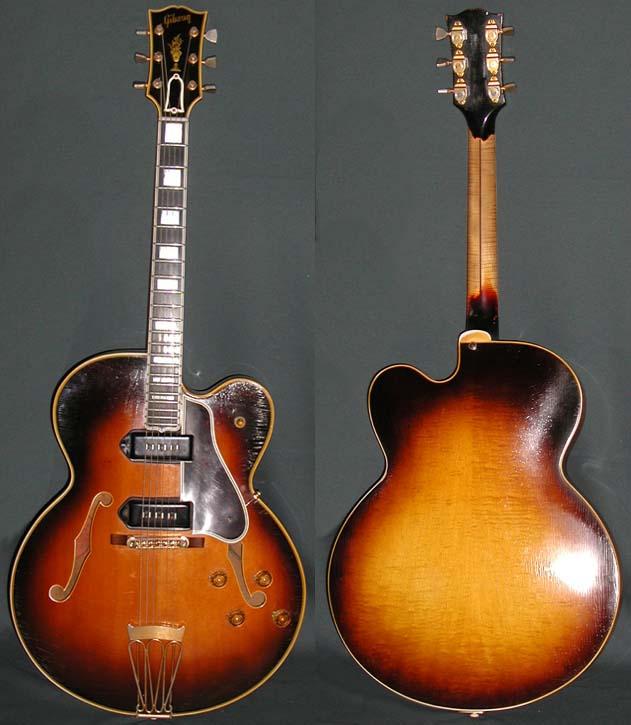
This guitar was designed with jazz players in mind. It featured the same 17” wide, 21” long spruce top and body as was on the single cutaway L-5 CES, but the body was shallow. In comparison, the Byrdlands body was only 2 1/4” deep as opposed to the full 3 3/8” body of an L-5.


1957 Byrdland Gary's Guitars
The headstock was also similar, but narrower to correspond with this guitars short scale neck. The Byrdlands neck was a two full inches shorter than the L-5 CES, based on the Byrdlands scale of 23 1/2 inches.

The production models were equipped with Alnico V pickups. One interesting feature of this guitar is the fact that the two pickups are spaced closer together, because of the shorter scale and the 22 fret neck.

This gives the the Byrdland it’s distinctive sound. In later years the Alnicos were replaced with humbucking pickups.

The headstock and the neck were both bound. The ebony fretboard came with block mother-of-pearl position markers which started at the first fret. The headstock featured the traditional Gibson flower pot inlay.


The Byrdland came with a fancy gold-plated trapeze tail piece that was engraved with Byrdland and the rosewood bridge with topped with a Gibson tune-o-matic saddle. The body was bound as were the guitars F holes.

Hank's #2
Hank Garland’s number two and number three Byrdlands both had fancy three loop trapeze tailpieces that were gold plated. Number two had the Charile Christian pickup with a white top plate, which matched the guitars while pearloid pickguard, while number 3 had a black top plate on the pickup. In the following year,

By 1956, Gibson sold 60 units, which was more than the combined sales of L-5’s and Super 400’s. Electric guitarists seemed to appreciate the feel of the narrow body.


The number 3 Byrdland was the guitar that Hank played at the famous Elvis concert in Tuepelo Mississippi in 1957. This was during a period when Scotty Moore and Bill Black had quit the band.


Hank's number 3


Hanks number three was given back to Gibson in 1957 and was supposed to be archived, however someone mistakenly sold it to a music store in Chattanooga Tennessee. A music teacher there purchased it and had it autographed by Hank Garland.


1956 Gibson ES-350T
The Byrdland then became a regular production instrument. Later Gibson developed the ES-350T from the Byrdland using less-costly hardware and detailing, and offered it as a less expensive model.

From 1955 to 1960, Gibson made the Byrdland with a Venetian, or rounded, cutaway.


1961 Byrdland


From 1961 to 1968, it used the sharp, pointed, Florentine cutaway.

It returned to the Venetian in 1969. The model was in production from 1955 through 1969.


1978 Byrdland


Gibson reintroduced it as a limited run in 1977, 1978 and 1992.


In the late 1960s, guitarist Ted Nugent began using a Byrdland, which was unusual considering Nugent's style of music.However, in an interview Nugent states that he first saw Detroit guitarist Jimmy McCarty playing a Byrdland back in the early 1960's.

Nugent was amazed at McCarty's ability as a player. At the time Nugent was in a rock band and was the opening act for McCarty's band. McCarty was playing a Byrdland through a Fender Twin amp. Nugent finally saw a Byrdland for sale at a local music store he frequented and was able to trade his Epiphone Casino and a few hundred bucks for that guitar. He has been collecting and playing Byrdlands ever since then.


Nugent's Great White Buffalo Model
The hollow-bodied nature of the guitar created feedback issues at higher levels of gain and volume, making it impractical for hard rock and similar styles. Nugent incorporated the controlled feedback of the Byrdland into his playing and continues to use it today. Nugent gives his Byrdlands, and other Gibsons, a custom touch by removing the stock selector switch knobs, and installing Gretsch strap-lock knobs.

2015 Gibson Custom Byrdland
The guitar is currently available as part of Gibson's Custom series and is made with the Florentine cutaway. In 1976 only, Gibson offered a twelve-string version, but made fewer than 20.


When the instrument was first introduced in the Gibson Guitar catalog, the famous jazz club, Birdland, filed a lawsuit against Gibson over the name. The court dismissed the suit when Gibson showed that the name was made up from the names of two people.

Click on the links for further information.
©UniqueGuitar Publications (text only)