Sunday, November 23, 2025

The Harmony Guitar Company - One Of The Oldest And Largest US Guitar Manufacturers


1949 Harmony Patrician 
At age 13 I wanted to learn how to play the guitar. I already played clarinet in the school band, and had taken some piano lessons. For my birthday my Dad took me to a pawn shop located on the West Side of Cincinnati. For $20 he purchased a guitar. For an extra $5 the salesman threw in a set of Black Diamond Strings and a tuning pitch pipe.

That first guitar I owned was a late 1940's archtop Harmony Patrician. Though the neck said "Steel Reinforce", but those heavy Black Diamond strings caused the neck to bow about a half an inch above the neck at the 12th fret. So the steel reinforcement really did not do much good.

And though it was a challenge to play, I learned the basic chord patterns and got a start with that instrument. Old Harmony Guitars will always have a warm place in my heart.

I later learned that The Harmony Company, at one time was the one of the largest and most successful musical instrument builders in the United State. "Harmony" was the trade name of given to the company that was established in 1892 by Wilhelm Schultz.

1920 Harmony Uke

During the early part of the 20th Century the ukulele craze hit college campuses. Young men with bulky raccoon coats and ukuleles could be seen serenading girls. It was during this era, 1916 to be exact, that Sears, Roebuck and Company purchased Harmony so that they could corner the ukulele market.


1920's Sears Catalog
Sears was the nation’s largest retail merchandise store. They were the Amazon of their day. This was especially true do to their catalog sales and they sold many musical instruments through their catalog; especially guitars. It was opportune that both the Harmony Company and Sears Roebuck were based in Chicago.


The man leading Harmony in those early days was Joseph Kraus.
Sears retained him as chairman of the company through 1940.

Harmony Factory
By 1915 Harmony was indeed the largest producer of ukuleles and banjos in the United States. During these early years Harmony produced violins and other folk instruments. In fact Harmony became the largest manufacturer of violins in the United States. They had quit making them for a long time and then started building violins again in the late 1930’s.


Harmony was possibly the first company to build a long neck Pete Seeger style banjo, even before Pete's Vega version was made.


By 1923 Sears was selling over a quarter of a million instruments a year. Seven years later this figure doubled.

'29 Harmony Smeck Vita Uke


In 1928 the company introduced Roy Smeck models of ukuleles and guitars. This multi-instrumental string player was very popular at the time. His name was also added to a line of lap steels and electric guitars.

Though Harmony was manufacturing guitars, banjos violins, and mandolins, Sears, Roebuck and Company sold those instruments under their own Silvertone brand name.  Harmony also produced musical instruments under at least 57 brand names for other wholesale and retail organizations.

Some of the brands that are actually Harmony instruments include the brand names Holiday, Vogue, Valencia, Johnny Marvin, Nobility, Monterey, Stella among others.

1950's Harmony
H-1311 Cremona


All of the "arched top" guitars that Harmony produced did not have an actual carved top, like the ones expertly carved on high end guitars. Instead the wood for the top, usually spruce, was dampened and placed in a heated form, then pressed into an arched shape.
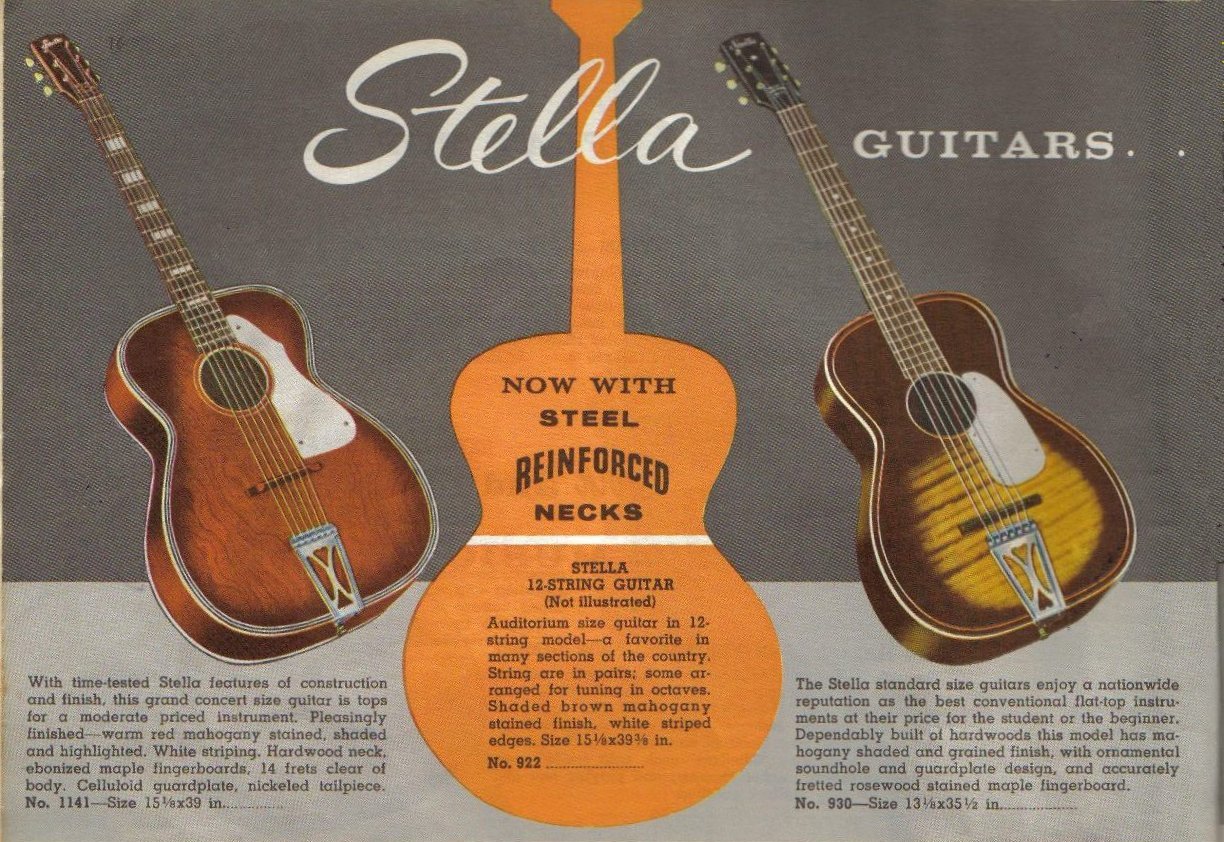


During the early 1930's Sears bought brand names owned by the bankrupt Oscar Schmidt Company, which included La Scala, Stella and Sovereign. Stella guitars were a popular guitar for Blues players.


Harmony Exhibit - Lillibridge Gallery
In 1940, Harmony Chairman  Joseph Kraus had a conflict with company management and left. However he had acquired enough stock to have controlling interest and he restarted the Harmony Company independently.

Very Early photo of the Harmony Factory


Like many other guitar companies, Harmony sales peaked in 1964 to 1965 selling 350,000 instruments annually. As foreign competition crept in, and domestic sales declined.


H-54 '63 Rocket & 60 H-75

Harmony electrics took their queue from Gretsch and Gibson. Most of the guitars pickups were manufactured by Rowe Industries Inc. also known as Rowe DeArmond, which was based in Toledo, Ohio.

Vintage guitar magazine price guide puts the current value of a Harmony H76 at between $1100 and $1200 USD. It sold for $200 to $300 new.


1939 Harmony H-1248
The very first Harmony electric was the Spanish Electric model H-1248. It was manufactured during 1939 and 1940 and sold through Sears. The pickup on this guitar was similar to the one on their lapsteel model. A similar guitar was sold as early as 1936 under the Supertone brand name.


Many of the Harmony/Silvertone amplifiers were made by Sound Projects of Cicero, Illinois.


1947 Harmony 200 aka 1300 amp


While other Harmony Amplifiers was made by the Valco Company.


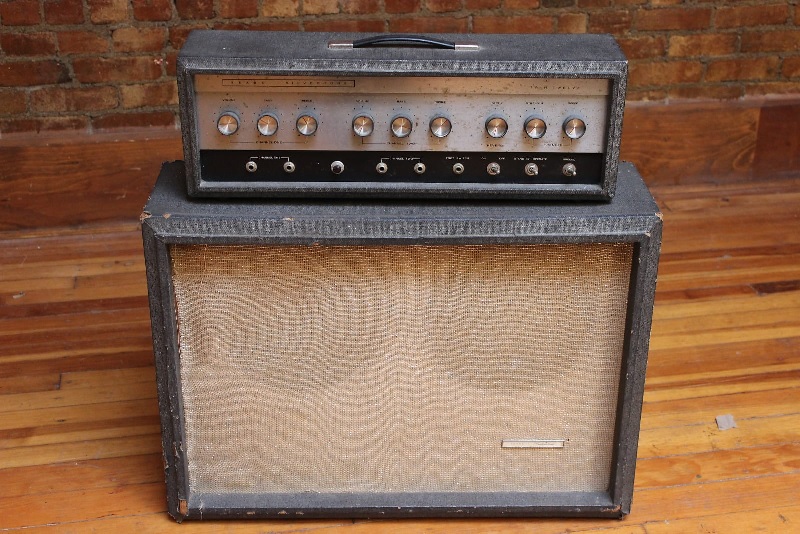
Harmony H-400 student amp


The Harmony H-400 series were updated tube amps made during the 1960's.


Silvertone Twin Twelve model 1484
The more popular amps such as the "Silvertone  Twin Twelve" produced in the 1960's were made by the Danelectro Company of Neptune, New Jersey, which was owned by Nate Daniels. Though they were not sold under the Harmony brand name, they were sold by Sears, under their Silvertone brand..

These Silvertone amplifiers are perhaps the ones that most of us remember.

Harmony H1213


During the 1940’s through the 1960’s Harmony produced a line of archtop guitars  These guitars were more popular with Big Band players of the 40's and 50's.


1960's Harmony Sovereign
By the mid-1950's flat top guitars had gained in popularity. Perhaps Harmony's best flat top guitar was The Sovereign model H-1260. It was a full bodied instrument with a solid top, mahogany back and sides, ladder bracing, and it had a big booming sound. It was the company's top of the line acoustic model from 1958 through 1971. The Harmony Sovereign is a fine instrument.


Harmony Headstocks


From the photo you can see “Steel Reinforced Neck. Most Harmony guitar necks were not adjustable.


Harmony Stella H-930


On many of the less expensive instruments, such as the Harmony made Stella. The fret markers were merely painted in the appropriate places. On some instruments the pickguards were painted directly on the soundboard. The tailpieces on the lower end models were made of cheap pressed metal. Some even had the tailpieces, bridges, and pick guards screwed into the wood.


Harmony Patrician

Harmony guitars that survived from the 1940’s, although made of pressed tops, they were very nice instruments and made of solid spruce or mahogany. Even lower end models were usually made of solid birch. The tops were never laminate.


Catalina H-1220 and H-1221

Perhaps the more unusual Harmony arched top guitars were the two tone Catalina Series guitars. These were manufactured between 1955 through 1958.


1931 H-1502 and 1971 H-930T


Harmony was one of the few manufacturers to include a tenor guitar in their offerings. In fact there were 34 different models offered from 1931 through 1971.


1944 Harmony H-165

Harmony also offered a solid wood, all mahogany alternate to those all mahogany Martins sold in the 1940's. The H-165, made from 1944 to 1958 featured a 'figure 8' shaped body with rounded edges. The body shape changed in 1958, and this guitar was offered through 1971.


Harmony Stratotone H-44

One of the more unique electric Harmony guitars that was offered beginning in 1952, was the Stratone H-44. This guitar featured a neck-thru body construction, with "wings" added to form the cutaway shape. It came in a one or two single coil pickup version.


H-45 and H-46 Stratone Mars
The H-45 and H-46 Stratone Mars were instruments I remember. These were produced from 1958 to 1965, and resembled a 'poor man's' Les Paul. The H-45 had one single coil pickup, while the H-46 came with twin single coils. Both instruments had bolt on necks. Mars was an important selling feature, as this was the era of all-things-outer space.


1963 H-14 and 1963 H-15
Around 1963, coinciding with the beginning of "The British Invasion" and guitar guitar boom, Harmony offered the Bobcat. This guitar came in several versions. Based on its shape, it appears it was to compete against the inexpensive Kay Vanguard.  The H-14 Bobcat came with a single pickup and a "W" vibrato, while the H-15, and H-15V featured twin single coil pickups. These guitars were offered through 1972.


1967 Harmony
 H-60 Meteor

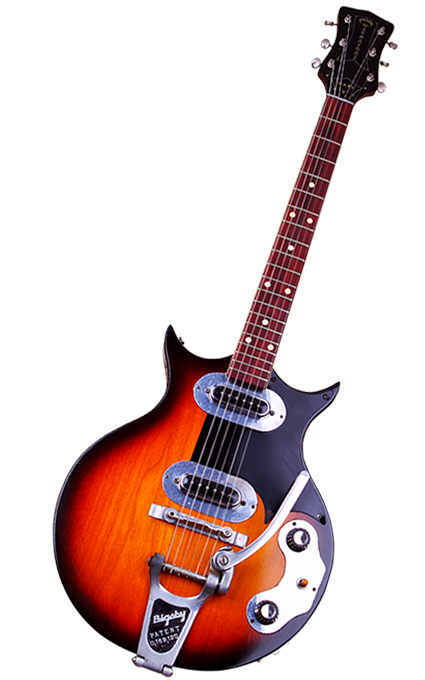
The Harmony H-60 Meteor was the company's answer to Gibson's ES-330 and Epiphone's Casino, in appearance only. While this guitar came with the 330's double cutaway hollow body, which was made of laminated maple and arched. But the Harmony guitars neck was bolted on to the body The twin pickups were enlarged DeArmond  Gold Foil single coils pickups. The H-60 Meteor came with or without a Bigsby vibrato. This guitar was offered until 1970.


1972 H-682 Rebel
In 1972 Harmony offered the H-682 Rebel, which perhaps was meant for those who could not afford a Rickenbacker. Though the hollow body shape may have been reminiscent of a Ric, everything else was much different. It came with a single oddly shaped "F" hole. The body was bound. It had two single coil pickups, which were controlled with two on/off slider switches, and four slider potentiometers. These adjusted the volume and tone of each pickup. The bolt-on neck was topped with a six-on-a-side headstock. The guitar was available in sunburst or avacado.

This same guitar was available in 1968-1971 under the designation H-82 Rebel. The main difference was the older variation had a roller bridge.

1967 H-19 Silhouette


From 1963 to 1967 Harmony's offered the H-19 "The Silhouette", which resembled Fender's Jazzmaster/Jaguar's body shape. It came with a Hagstrom vibrato and twin DeArmond Gold Foil single coil pickups that were mounted on top of the pickguard.

From as early as 1947, Harmony made some impressive Jazz style guitars.


1951 Harmony H-60

Perhaps one of the company's best offerings for Jazz player was the model H-60. It was produced from 1951 to 1955. It feature a single pickup guitar, and a 3 and a half inch single cutaway body of solid wood. 

The single coil pickup was a P-13 pickup made by Gibson.

This was a gorgeous instrument and featured a set-in neck, which was not adjustable.  In later years, Harmony used to H-60 designation for it's Meteor series.

Harmony H-62
The double pickup version of Harmony's Jazz guitar was known as the H-62. It was offered from 1953 through 1964. The original versions came in blonde or sunburst and had a three and a half inch depth body, topped with two Gibson made P-13 single coil pickups. The Harmony logo is inlaid. The solid arched top is made of spruce, and the back and sides are mahogany. This guitar originally came with an extended faux tortoise shell pickguard. This was Harmony's top of the line Jazz guitar. In 1960 the body depth was changed to two and three quarter inches.

H-63 Espanada
One other Jazz style guitar made by Harmony was The H-63 Espanada. This guitar was made from 1955 through 1964. Like the prior Jazz boxes, The Espanada originally had a body with a depth of three and a half inches. the entire guitar was done with a glossy jet black finish. It too had twin Gibson made P-13 pickups. An aluminum badge that said Espanada in script was glued on the upper bout, and on the headstock. In fact it did not mention Harmony. What was also very unique was that from 1955 through 1957 the guitar's body was bound in aluminum trim.

Beginning in 1968 this changed to white/black/white binding. In 1960, the bodies depth was diminished to two and three quarter inches. 

Harmony H75 & H59

Harmony's line
 resembled Gretsch and Gibson guitars, but did not have the complicated switching of a Gretsch, nor did the Harmony versions have the quality of Gretsch and Gibson. But for the money these were quite nice instruments.

Harmony - Fender


Ironically when Fender was trying to break into the acoustic guitar market, the first guitar line they offered in their catalog was made by Harmony guitars with the Fender brand on the head stock.


Baldwin 801 by
Harmony


When Baldwin purchased Burns of London and Gretsch guitars, they did not have a classical model.  So they turned to Harmony manufacture “Baldwin” classical guitars.


Harmony H-173

The Harmony H-173 Classic nylon string model is the same guitar as the Baldwin 801C, but the H-173 did not come with the Prismatone piezo pickup, nor did it have a rosette. It was a very plain student style instrument. Both Jerry Reed and Willie Nelson were given 801C guitars and matching amplifiers by Baldwin Guitars.


Baldwin Prismatone Piezo Pickup

Guitarist Jerry Reed loved it, because it came with a Prismatone Pickup. Reed purchased three of these instruments and took them to a Nashville music store to have a luthier install cutaways on each of them. 


As mentioned, to promote Baldwin (Harmony) guitars, Jerry Reed and Willie Nelson were given Baldwin 801c guitars and Baldwin C1 amplifiers. Jerry owned several of these guitars and had a luthier put in a sharp cutaway in some of them. 


Trigger

Willie Nelson's Baldwin guitar was left on a stage and a drunk put his foot through it, smashing the top. Willie took the instrument to Shot Jackson's Guitar Shop for repair. Mr. Jackson could not fix it, so he sold Willie a Martin N-20 classical guitar and installed the Baldwin's Prismatone pickup on it. This guitar has become associated with Willie, the one he calls Trigger. 

Harmony Guitar Company shuttered its doors in 1975. By these years the manufacturing had ceased and the company was mainly importing and relabeling Asian manufactured instruments.


In the early 2000's the Harmony trade name was sold to the Westheimer Corporation which briefly continued to market imported “reissue” Harmony guitars. 

Bandlab Technologies
In 2018 the rights to Harmony's tradename were acquired by Bandlab Technologies, the Singapore based company that created Cakewalk software for recording. Bandlab was started in Boston, then acquired by Gibson until 2017, and then sold to Bandlab.

2017 Harmony Guitar Line Up

Around that same time Bandlab reintroduced Harmony guitars.  The guitars are now made in China. Though the names are similar to some of the older Harmony electric models, but the shapes, and pickups have changed.


2019 Harmony 8418 Amp
Harmony recently introduced a five watt tube amplifier that appears to be a winner. The Harmony model 8418 features a 6" Jensen speaker, and a single volume control. It was designed using the original blueprints.

©UniqueGuitar Publications (text only) 2025
Click on the links below the pictures for sources.
Click on the links in the text for further information.
Please click on the advertisements to help support this page. Thanks!




Saturday, November 22, 2025

Paul Bigsby - Inventor, Designer, Electric Guitar Pioneer

Paul Bigsby
In the history of the electric guitar Paul Bigsby stands out as a one of a kind builder. He was the designer of the famous Bigsby guitar vibrato tailpiece, but he is also remembered as one of the pioneers of the electric guitar. The guitar designs that he created back in the late 1940’s have influenced Fender, Gibson, Epiphone and many other well-known guitar manufacturers. And Bigsby had quite an influence on the steel guitar industry. 


Bigsby $400,000

Today I ran across an advertisement on the Reverb page for a Bigsby guitar. It was made for a musician and studio owner named Larry. It may be the last standard Bigsby Spanish guitar ever built as it is dated September 15th, 1958. (The price must have dropped as I ran across a Guitar World article for this same instrument in February of 2022 with an asking price of $750,000.)


P.A. Bigsby for the most part worked alone, hand building one piece per month in his garage. Each of his creations is handcrafted and unique and so authentic Bigsby Spanish style guitars extremely rare. 

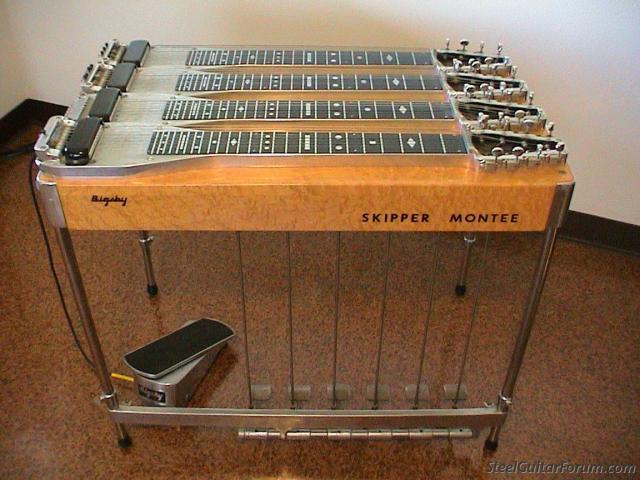
1950 Bigsby Pedal Steel
The great bulk of his output was pedal steel guitars, which he essentially invented (or at least perfected). In fact for some years Bigsby remained the only real source of the best professional-grade steels. The Standard guitars, mandolins and custom conversions account for only a small part of his output, which was by most accounts set at 12 instruments per year.

Paul Bigsby was born and spent his childhood in Illinois, but his family moved to Los Angeles in search of work. Bigsby acquired a job as a pattern maker and was carving wood patterns that were used to make metal molds for manufacturing. This skill gave him a useful start in his career building musical instruments.

He also developed a keen interest in motorcycles and motorcycle racing and won his first race at the age of 20. This hobby turned into a career and he went on to open his own motorcycle dealership and became well-respected in the cycling community as racer

PA Bigsby - Crocker Motorcyle 
As Paul Bigsby got older, he joined the Crocker Motorcycle Company and assisted in designing the Crocker V-Twin engine.

When World War II rocked the world, Bigby enlisted in the U.S. Navy. World War II brought about many changes to the world and to the United States. 

California became a bastion of manufacturing and many families from the southern United States migrated there in search of work and the American dream.

Suffice to say, these men and women brought their passion for Country Music with them and movies, radio stations, clubs and eventually television would capitalize on Country Music.

Cliffie Stone's Hometown
Jamboree

By 1946 Paul Bigsby was married and divorced. He had a daughter by his first wife. He remarried a year later and Bigsby, his wife and daughter would attend Cliffie Stone’s radio show called Hometown Jamboree which featured Western Swing music.

Bigsby had learned to play guitar and bass and this show became a way for him to meet some of the stars, musicians and sidemen. Bigsby used this contact as an opportunity to capitalize on his skills.

Cliffie Stone's Band

The electric steel guitar was prominently featured in Western Swing. There were some prominent companies building electric steel instruments. Though Bigsby did not invent the steel guitar, he certainly  improved on it.


Joaquin Murphy and Bigbsy
In 1947 he built a double 8-string steel console guitar for Earl “Joaquin” Murphey, the steel player in Spade Cooley’s Orchestra. The instrument combined two guitars on one console which enabled the necks to be tuned to different pitches. The player could quickly switch between tunings. This is a standard feature today for most pedal steel players. The instrument was made of solid birds-eye maple with one neck elevated higher than the other.

Bigsby Tapered Headstock

Bigsby was the first to use a tapered metal headstock design, which is featured on most professional steel guitars today.

As Bigsby learned more about the needs of guitarists he took the steel guitar a step further by creating a pedal steel guitar. Once again, there were manufacturers, such as Gibson, that already created a system of using pedals to change tuning on the steel guitar,

But Gibson’s early version utilized a system of pedals arranged on the left rear leg of their Electraharp. Bigsby was the first to arrange the pedals on a rack across the floor in front of the player, which is the configuration utilized to this day.

Speedy West's 1948 Bigsby

He presented his Bigsby pedal steel guitar to Speedy West, He was the steel guitarist that replaced Murphey in Spade Cooley’s group. Again Bigsby utilized a polished birds-eye maple chassis for this guitar, which became his trademark on all of his future instruments. 

The instrument was replete with a birds-eye maple front cover for the front of West’s instrument.

Speedy West's Bigsby

This also included inlay with Bigsby’s logo, which helped his name recognition wherever the band played. Instead of a wooden neck this guitar came with twin cast aluminum necks which gave this guitar incredible sustain.


Bigsby's pickup winder
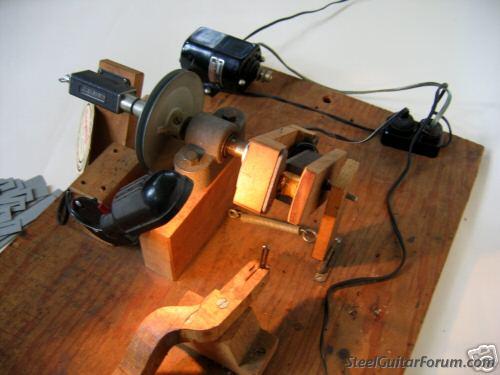
It would not be long before other prominent steel players would seek out Paul Bigsby. Bigsby built his own pickups and experimented with them. His winding machine was made from sewing machine parts. He came up with a design that was similar to Gibson’s Charlie Christian pickup.

Bigsby Pickup
This used a blade magnet wrapped with a wide flat coil and an aluminum housing. The housing was a great way to shield the 60 cycle hum that is found in many single coil pickups.

There was a time when Paul Bigsby, Les Paul and Leo Fender would get together to discuss electric guitar and pickup design. 

In fact Les Paul installed one of Bigsby pickups in the bridge position of the Epiphone hollow-body guitar that he used to record “How High the Moon.” 

Chet Atkins D'Angelico

Chet Atkins must have loved the sound, because he installed a Bigsby pickup on his original D’Angelico guitar. Hank Garland and Merle Travis also used Bigsby pickups on his guitars.

Paul Bigsby's 3rd Guitar


Bigsby had tinkered around with the idea of building a solid-body electric guitar as far back as 1944. In an attempt to interest Gibson, he even built one for Les Paul.


Merle Travis' Bigsby

However it was Merle Travis who was perhaps the first to observe the sustain quality found in Bigsby’s guitars. Travis sketched out a design for a solid-body guitar and brought it to Bigsby.


Evolution of Fender Headstock

Merle wanted his guitar to have six-on-a-side tuners on a headstock similar to that of a Martin Stauffer. This later became the design Leo Fender used on the Stratocaster.

Merle 1st Version

Travis also wanted playing card symbols inlaid on the fretboard; a heart, a diamond, a spade, and a club. He also wanted an armrest and a violin style tailpiece. On the first version there is no cutaway, there are only two knobs and an extended headstock that scrolled in the opposite direction. 


2nd Version
Later on this headstock was cut off and a new one added. The first version did not have the cutaway, but this feature was also added.

The six-on-a-side tuning system had been used in the past, notably on Stauffer and early Martin guitars, but it was Merle Travis who incorporated this feature on his Bigsby that first introduced this to the electric guitar. The advantage of this arrangement is that the strings are all wound in the same direction and the straight pull helps with tonality.

Travis’ Bigsby guitar utilized Kluson tuners. Today this would have been easy, but tuners manufactured at this time were set up for 3-on-a-side guitars. Bigsby had to machine the screws and remove the screw holes on one side of the tuners to make the 6-on-a-side arrangement work. Once Fender and other companies started using the 6-on-a-side arrangement Kluson used Bigsby’s idea for manufacturing their tuning keys.


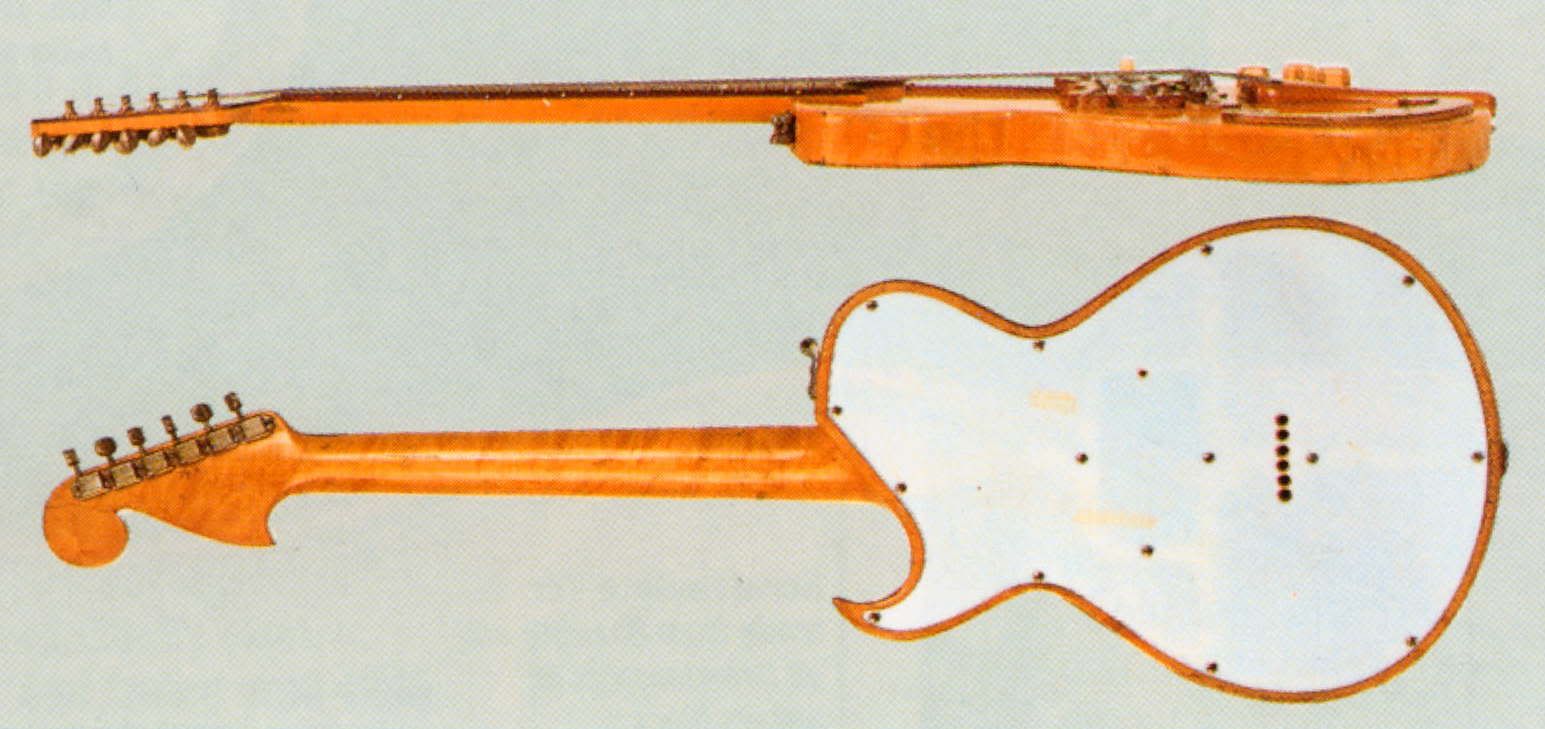
Bigsby built this guitar using a birds-eye maple body. As it was too heavy, the body was hollowed out to reduce weight. The guitar had a decorative violin tailpiece, but the strings were actually retained through the body by steel ferrules ala the Telecaster.

A metal bar across the back reinforced the body and the back of the instrument was covered in plexiglass. Bigsby had built the guitars nut and compensated bridge from aluminum that he cast.

A single handmade pickup as already described was placed in the bridge position. It was controlled by volume and tone potentiometers and a 3-way switch which had differing capacitors for variations in tone which predated the Fender Esquire guitar.

The instrument was replete with a decorative walnut armrest on the guitars bout.

Merle Travis' Bigsby
All in all, Paul Bigsby made three versions of the Travis guitar. The first had the reverse scroll on the headstock, the second had a more traditional headstock and the third incorporated two pickups with adjustable pole pieces. Bigsby referred to this as his standard guitar.

We may wonder if Fender copied Bigsby's designs. In the book, The Story of Paul Bigsby references a letter written by Don Randall, one of the first founders of Fender Guitars. In the letter, Randall is talking about Merle Travis and says, “He is playing the granddaddy of our Spanish guitar, built by Paul Bigsby— the one Leo copied.”

Fender's Prototype Esquire

In fact it appears that Fender copied several features from Bigsby’s creation. The popular Telecaster and Esquire utilized the 6-on-a-side headstock. And though the prototype Telecaster did have 3-on-a-side, the production models did not.

Fender also copied the string-thru-body string arrangement and in the case of the Esquire, the 3-way switch with activated some capacitors that gave the guitars the tonal characteristics. Additionally the Telecaster/Esquire both featured a body depth of 1 ½”, which was the same size Paul Bigsby used on his first electric guitars. Bigsby also adopted the use of the blade switch before it became a Fender standard.

And though Fender had essentially copied some of Paul Bigsby’s designs, Bigsby persevered to build high quality instruments for individuals.

Bigsby went on to create his style of guitar for notable Nashville session player Grady Martin. This instrument had a neck-through-body design, Bigsby’s signature birds-eye maple body and a scroll on the top cutaway of its body that was a mirror-image of the scroll on the instruments headstock.

Later on he produced another guitar for Martin. This one had two necks. The top neck was for a 5 string high-strung guitar neck that was tuned an octave about usual tuning. This neck was slightly angled from the main guitar neck. The other neck was a traditional guitar neck. Both necks were topped with the scroll style headstock that had become Bigsby’s trademark. The upper neck came with a single adjustable pickup while the lower neck had 3 single coil Bigsby designed pickups.


The upper instrument had a cast violin style tailpiece, while the lower neck had the strings terminate on Paul Bigsby’s latest invention, The Bigsby Vibrato tailpiece. A three-way switch controlled the pickups on the lower neck. Each neck had individual tone and volume controls.


In 2012 sold for $266,500
Bigsby also made a guitar for guitarist Jimmy Bryant. However Bryant did not wait for the completed instrument and purchased Bigsby’s third guitar (pictured earlier which was owned by Ernest Tubb’s guitarist, Tommy "Butterball" Page.

Billy Bryd Bigsby
Ironically Tubb’s current guitarist was Billy Byrd and he purchased the Bigsby guitar that had been ordered for Jimmy Bryant. This model was possibly the first double cutaway guitar. This guitar sported two adjustable pole single coil pickups and a Bigsby vibrato tailpiece. 

It had some decorative indentations on the body's bottom.


Billy Boy Bigsby

Another instrument made for Byrd. Ironically Billy Byrd eventually signed with Fender. After that Paul Bigsby reconfigured this guitar as the Billy Boy guitar.

Tiny Moore Mandolin


Paul Bigsby designed and built a five string custom electric mandolin for Tiny Moore, who played guitar and mandolin in the group, Bob Wills and the Texas Playboys. 


Paul Bigsby also built a full size electric guitar that may have been meant for Merle Travis. It can be seen in a short film that Travis being played by Merle, but this guitar was acquired by of a guitarist known as Jack Parsons.


Too Much Sugar For A Dime

This instrument looked more like a traditional wide bodied arch topped instrument. However the top was flat and had no f-holes. 


This guitar was acquired by Jack Parsons. He eventually added a Bigsby vibrato and had his name engraved on the instrument.

Paul Bigsby helped a musician that he befriended build guitars out of myrtle wood. The Myrtle Tree only grows in two places on earth; the Holy Lands, and the coast between southern Oregon, and northern California. 

Dale Granstrom and Guitars
Dale Granstrom was a woodworker and a musician. He played Steel guitar.  He ordered a pedal steel from Bigsby. He told Paul that he admired the sound that Joaquin Murphy got from his Bigsby, and asked if he would help him build some instruments out of myrtle wood stock. 

Surprisingly Bigsby was very helpful. Though these are not actual Bigsby instruments, Paul Bigsby advised and walked Granstrom through the build.  Dale Granstrom and his brother built two guitars, and a bass guitar, using Bigsby's templates and instructions.


Professional guitars began to notice Paul Bigsby's Vibrato and wanted to add it to their instruments.


Guitarist Keith Holter was one of the first to own a Bigsby with a vibrato.


Bigsby's Patent Application

Paul Bigsby applied to patent "A Tailpiece Vibrato For A Stringed Instrument" in November of 1952. The patent was approved in March of the following year. Units sold prior to 1953 are embossed Bigsby Patent Pending. Afterwards they just say Bigsby and the patent numbers.

Here is a link to Deke Dickerson's research into the beginning of The Bigsby Vibrato. Super Rare Early Bigsby Vibrato 


Merle and Chet Vibrato Arms
The Bigsby Vibrato revolutionized guitar playing. The standard units came with a flat arm. Merle Travis, and Eddie Pennington preferred a long arm, while Chet Atkins liked a shorter arm that he could move with his pm.


Grady Martin Bigsby
Merle Travis may have had a hand in insisting that Paul Bigsby to build a vibrato bar tailpiece that stayed in tune. At the time Travis was using a Kauffman vibrato. So Bigsby set out to build his vibrato which was made from cast aluminum and it worked by pulling the strings up and down. In fact it was designed to raise or lower the pitch a half step and was meant to be utilized with a bridge that rocked back and forth to prevent the sawing motion that it would have on a fixed bridge saddle.

The first units utilized a piece of rubber instead of the spring. Harking back to his days of building motorcycle engines, Bigsby eventually settled on using a type of spring found in motorcycle engines.

1956 Bigsby

Initially the bar on the units were fixed, so that the arm could not be pushed away. There are guitarists that liked this arrangement. Others modified the to fit their needs, although it was still fixed.


Some guitarists loved the feel of the Paul Bigsby guitar neck and had their acoustic instrument's necks replaced by Bigsby. This is what Merle Travis did with his Martin D-28 when he had Paul change the neck and pickguard.


Thom Bresh
Merle Travis' biological son, Thom Bresh, followed in his father's footstep and had a luthier, Harvey Leach, create 
the Leach Bresh Spirit is based on his father, Merle Travis’ famous Martin D-28 with a Bigsby neck. 

The Bresh Spirit features Brazilian rosewood back and sides, and a top carved from a one- thousand-year-old California redwood. The neck is 1 11/16" at the nut and has a zero fret.

Merle Travis, Joe Maphis, Hank Thompson and others had their Martin guitars retrofitted to accommodate the Bigsby neck.

1960 Bigsby Volume Tone Pedal
Paul Bigsby also was responsible for some other inventions. Pedal steel players had long used volume pedals to create those swells used in their music, Bigsby was the first to create a volume pedal that worked in the traditional up and down method to raise and lower the volume.

However his pedal also pivoted left and right which adjusted the bass and treble. During the 1960's Rowe DeArmond offered a similar pedal.


'61 Gibson ES-175 with Bigsby
Gibson Guitars president at the time, Ted McCarty was very impressed with this unit. His company was utilizing a design similar to Kauffman's that moved the strings from side to side instead of up and down. McCarty made a deal with Bigsby, with the provision that he build the vibrato unit with a bar that could be pushed away, when not in use.

Though Bigsby guitars were excellent high quality instruments, it was this vibrato unit that was to be Paul Bigsby’s biggest success. Up to this time he had been running a one-man shop.

Now he had to hire employees to keep up with the demand for Bigsby vibratos. This would eventually become a global business for Paul Bigsby.

Magnatone Mark V
Bigsby designed a line of guitars for the amplifier company Magnatone. For a brief period of time and he continued to build steel guitars for a while, but in 1956 once the vibrato became very successful Bigsby quit building guitars, to concentrate his efforts on his vibrato unit, which by now was offered in several forms to retrofit different style guitars.


Paul Bigsby in later years

By 1965 Paul Bigsby was tired of business and his health was failing. He sold “Bigsby” to his friend Ted McCarty who had given his company its biggest boost. This would allow Bigsby to retire, which he did in 1966. Paul Bigsby died two years later in the summer of 1968.

Ted McCarty continued building Bigsby vibrato units until 1999 when he sold the rights to manufacture to Gretsch Guitars.

Due to the scarcity of Bigsby guitar, if you are interested in buying one the price will be very steep, in the six figure range.

T.K. Smith "Bigsby"


There are other builders that have taken up Bigsby’s designs, such as T.K. Smith that build fine quality Bigsby style guitars.


Though some modern players may find the Bigsby vibrato to be antiquated, the unit was not meant for the wild pitch fluctuation that punctuate the music of Vai, Malmstrom, Satriani and others. The Bigsby vibrato was meant to give a tasteful little vibrato to each note. It has become an industry staple and has been and is still being imitated.

©UniqueGuitar Publications (text only) 2025
Click on the links beneath the pictures for sources.
Click on the links in the text for further information.
Please click on the advertisements to help support this page. Thank you!