Sunday, October 17, 2010

The Supro Thunderbolt


Imagine a Fender Pro Jr. with a 15" Jensen speaker.  But for the power tubes, that would describe the Supro Thunderbolt.

The Valco Cmpany in Chicago made Supro amplifiers. The Supro Thunderbolt model was introduced in late 1964 as a bass guitar amp. This amplifier was a very simple design having only a volume and tone control and a single 15-inch Jensen speaker.

The tube compliment included 2 RCA 6L6CG power tubes, 2 - 12AX7 preamp tubes with one possibly being used as a phase inverter and 1 5U4 rectifier tube.

The amplifier chasis was housed in the bottom of an open backed cabinet with the two control knobs mounted on the amplifiers faceplate.


For those not familiar with the Valco Company, a merger of the National Guitar Company and the Dobro Guitar Company formed it in 1942 by three company principals, Victor Smith, Al Frost and Louis Dopyera.


The company started manufacturing Hawaiian guitars and amplifiers under its own name and as a subcontractor for Oahu, Harmony, Airline, Kay, National, and Gretsch. Supro was their house brand name.

By the late 1960’s The Valco Company had become roughly the third-largest amplifier manufacturer in the United States. In 1964 Valco introduced the Thunderbolt Bass Amplifier (model S6420.

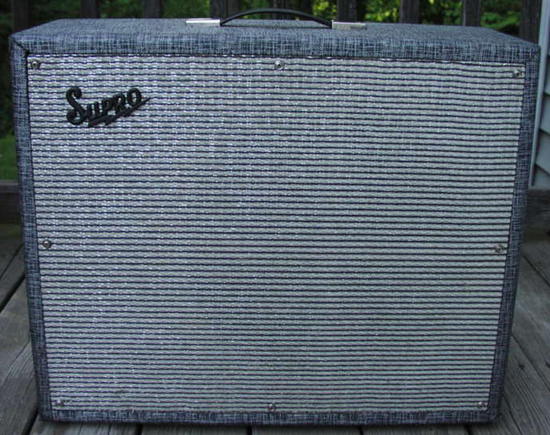
The Thunderbolt came covered in Supros traditional blue ‘rhino hide’ tolex with horizontally striped grey grill cloth. In 1967, black tolex replaced the blue rhino hide to keep more in line with Fender.

The amp was marketed as a bass amplifier, but guitarists noticed its great sound. My good friend Doug Abbott played his bass through a borrowed Thunderbolt one at a gig we did around 1967. As a bass amp, the Thunderbolt was not at all impressive. It distorted like crazy when turned up.

The amp just did not have enough power for those low frequency bass notes. Bass players of the day complained.

Not only did the speaker and tubes distort, the baffle board that held the massive speaker fluttered.

Valco/Supro attempted a quick fix by adding a wooden brace across the speaker hole and another brace on the baffle board’s backside. Next Valco also eliminated the rectifier tube in favor of a solid-state rectifier. These improved the amp’s performance as a bass amplifier somewhat.

But bass players were not at all satisfied with this Supro amp.


However, as a guitar amp, the Thunderbolt was a something else. That raw tube distortion combined with the heavy bottom of the Jensen 15 sounded huge.

Guitarists had earlier noticed the Thunderbolt. Jimi Hendrix used one early on with the Isley Brothers and Jimmy Page used one on early Led Zeppelin recordings.

Airline was Montgomery Wards brand name for musical instruments. Valco created a similar amplifier for them known as model 62-9020A, which is the same circuit as the famed Supro Thunderbolt.


Outside the amplifier was different in appearance, sporting dark brown grill cloth with a fancy logo. On the inside was the same Thunderbolt amplifier.


By 1967, Valco merged with Kay. However, this was end of the line for Valco. The merged company went out of business in 1968.

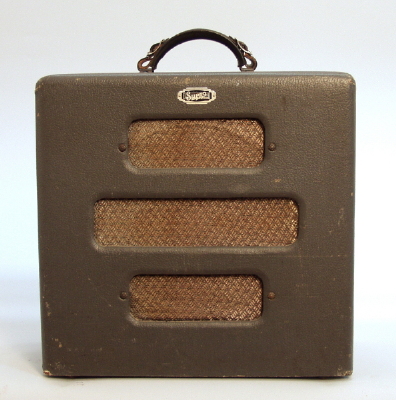
This is an older Zinky amp
But now the Supro brand name has been revived.

In the mid 2000’s former Fender amp designer, Bruce Zinky left that organization and started his own company.


His first hit was a small practice amp called The Smokey, which still is available with a plastic housing or housed in and empty cardboard cigarette pack with a tiny speaker poking out of the center.


Zinky went on to produce high quality boutique amplifiers under his name. Recently Zinky acquired the rights to the Supro name and is now producing high quality updated replicas of former Supro amplifiers


All of the new amps are made in the USA by Absara Audio. The project designer is David Koltai, with circuits curated by Bruce Zinky. 

The new amps were just exhibited at the Summer NAMM and feature not just an updated version of the original S6420 Thunderbolt, but a hotrod version that is designated the S6420+ Thunderbolt(+).

The other new Supro amp include the 1624T Dual­Tone with twin 12” Supro speakers rated at 24 watts, the 1690T Coronado with twin 10” Supro speakers and a pair of 6L6 power tubes pumpling out 35 watts and the S6450R Thunderstorm, which comes with twin parallel channels, a 3 way tone stack, twin 6L6 power tubes and 3 way rectifier switching options; 35 watt, 45 watts and 60 watts.


\

The Iceman Cometh

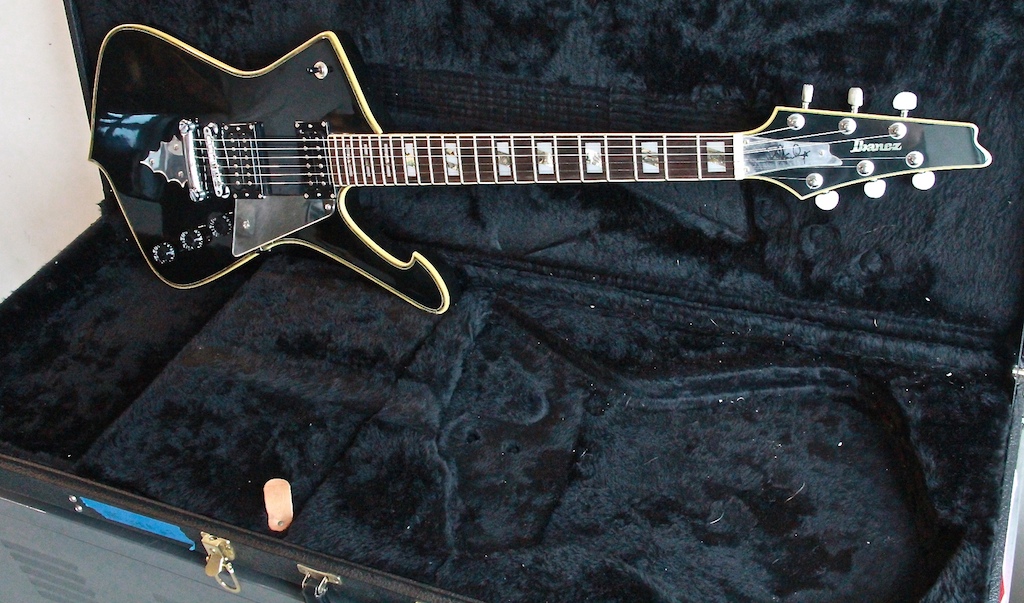
1975 Ibanez Iceman - Artists Model 2663
The Iceman is an Ibanez guitar produced by Hoshino Gakki. To understand the guitar, you need to know a little about the company.

102 years ago when Western music was just reaching Japan, Matsujiro Hoshino opened a music business. In 1908 he opened a facility to sell sheet music and organs.


In 1929 Hoshino opened a manufacturing facility called Hoshino Gakki Ten, to produce its own musical instruments.


By 1935, Hoshino began in the Spanish guitar business and sold guitars domestically under the brand name, Ibanez-Salvador. It seems that Asian and European companies like to put Spanish sounding names on guitars, with thoughts it would increase buying potential.

The Ibanez factory was destroyed during WWII.

Greco guitar
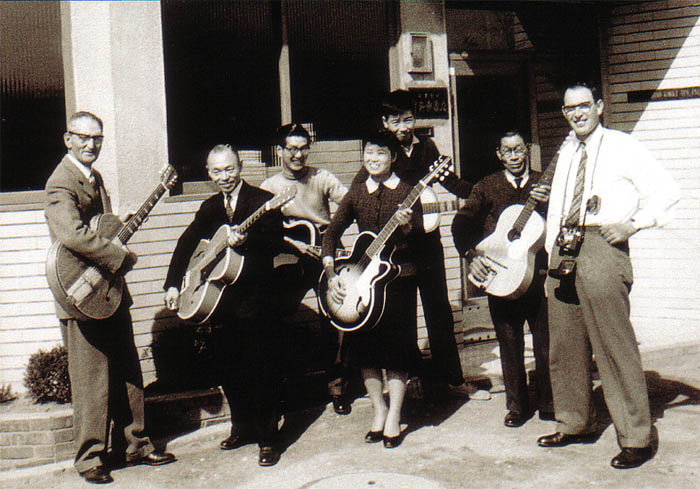
By 1955 the company opened as an export only business. 1962 was the start of the British Invasion and guitar craze and Hoshino began exporting guitars under the Greco brand that were manufactured by subcontractor. They also manufactured, exported and sold drums under the brand name Tama.

By 1971, Hoshino had established a U.S. distributorship through the Elger Company of Pennsylvania.


Around this time Hoshino started making copies of U.S. instruments and they were etremely excellent replicas of Gibson and Fender guitars that sold for less than half price of a U.S. made instrument, due to lower labor rates. The replicas were too good.


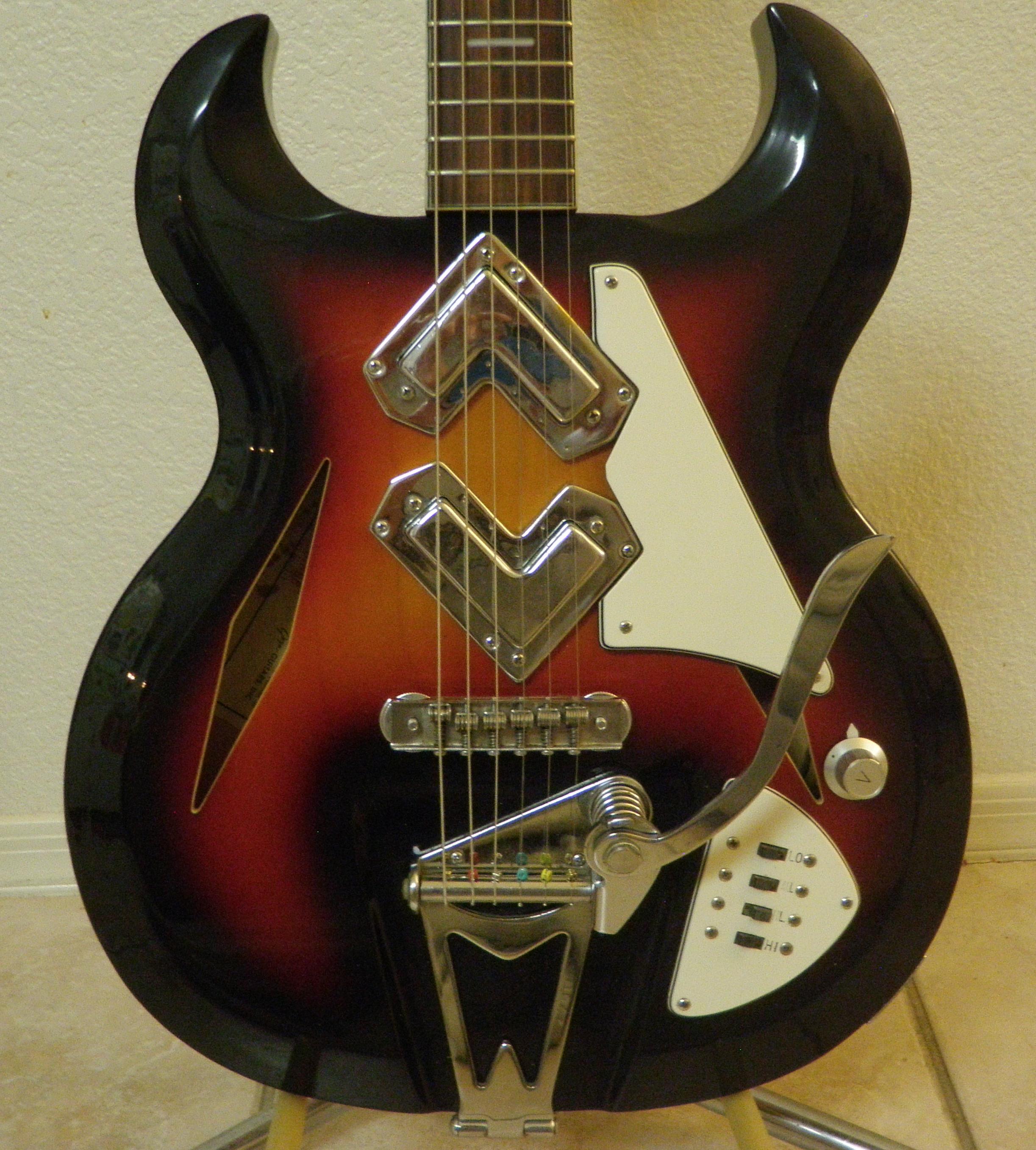
Ibanez copy


Gibson filed suit against Hoshino. Hoshino had to make some changes to their instruments. They also wanted to build an original Japanese guitar and get out of the replica business. The resulting guitar was called the Ibanez Iceman.


Fujigen and Ibanez

A meeting occurred between Hoshino, which made Ibanez guitars, and Kanda Shokai, which manufactured Greco instruments and FujiGen one of the largest guitar factories in Japan. Their goal was to come up with an original design, build the guitar and create a marketing plan. This meeting resulted in the Iceman/Mirage design. Each distribution company would have distribution rights to it in different global markets.


The Ibanez model would be named the Iceman and the Greco model would be named the Mirage.  They are essentially the same guitar except for the pickups and a few other factors.

The Ibanez Iceman sported Super 2000, Triple Coil and V2 pickups.

The Greco Mirage used their own version called Greco Dry picups and also DiMarzio Super II pickups on the Greco Mirage.


Greco Mirage Guitars
Wood, pickups and neck joint construction varied on each version, based on model numbers and quality.

The earliest Ibanez Iceman models from 1975 were called Ibanez Artist models. Not until 1978 did Ibanez use the designation became The Iceman guitar. The original model guitars have the elongated headstock with three on a side tuners.


In 1979 Ibanez produced several different models varying in price and quality. Some came with fixed necks and some had bolted on necks.


In 1982 to 1983 the headstock was changed to have 6 in line tuners.

 
In 1976 Paul Stanley of KISS was approached by Hoshino to endorse a guitar He chose the Artist 2663, which was the original designation of the Iceman. Stanley was allowed a lot of input in this guitars design.


The resulting signature guitar was dubbed the PS10. Stanley said, "First of all, the Iceman and the PS10 have about as much in common as a Chevy and a Rolls Royce..." "I came up with a guitar; construction, frets, inlays, wiring, the type of tail block that has the sustain block built into it, the half brass/half bone nut and so on..."

\Stanley used the PS10 as his primary guitar from the 1977 to 1980. He used it again from 1992 to 1997 before signing a contract with Washburn for a signature guitar at that time.

In 1995 the PS-10 was reissued as the PS10-II. The following year an updated model was offered called the PS10-LTD. The in 1997 the PS10-CL (classic edition) was offered.


These were the same guitar except the LTD was Japanese made and the CL was manufactured in Korea.

Stanley is quoted as saying, “The Iceman and the PS-10 have about as much in common as a Chevy and a Rolls Royce.” Needless to say, Stanley preferred the Artist Model over his own namesake instrument.

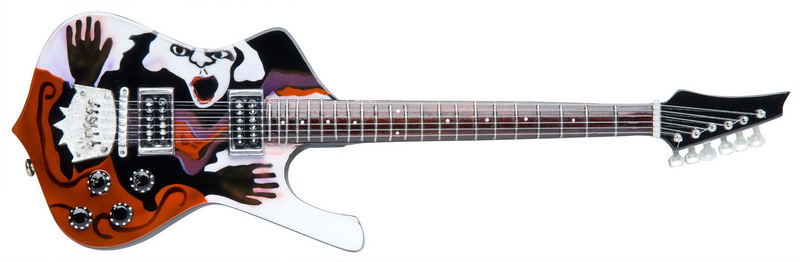
Daron Malakian of System of a Down favoured this guitar from the early days of System of A Down.. Daron had his own signature model, the Ibanez DMM1.


It was a limited edition run based on the Ibanez Iceman ICX shape and features a special graphic design painted by Daron’s father, Vartan Malakian. Only 300 were made.


The Iceman was also redesigned by Paul Gilbert, who is another Iceman endorser and has a signature model.

On this model the body of an Iceman was flipped upside down and given a cutaway in order to reach the higher frets. The 2 new designs had natural wood finishes, one mahogany with cherry top, and one with korina wood and three single coil pickups.

Paul Gilbert's newly designed model was introduced at the 2009 NAMM show as the "Ibanez Fireman" (PGM-FRM1). In 2009, the Iceman was redesigned by Paul Gilbert using Photoshop, which allowed him to flip the body over. Since the cutout was now on the other side, they added a smaller cutout.

There were two designs; both of a natural wood finish, one with mahogany with a cherry fret-board and another with korina wood.

In addition to the 3 pickups, this instrument features a 24-3/4" scale length (shorter than the others), a set 3-piece korina/bubinga neck, rosewood fingerboard with 12" radius, 22 frets (instead of 24) and a fixed Gibraltar II bridge.


The pickups on the Gilbert model are Dimarzio Area 67 single coil hum-cancelling models. The designation Fireman is due to the reverse body, since Fire is the opposite of Ice.

Another different model of the Iceman was known as The STM which is a special version of Iceman designed for Sam Totman of Dragonforce.

Essentially it is an Iceman with a 24-fret neck-through neck and Edge III tremolo instead of a hardtail bridge. This is the first production Iceman since the 1990s to have a whammy bar.


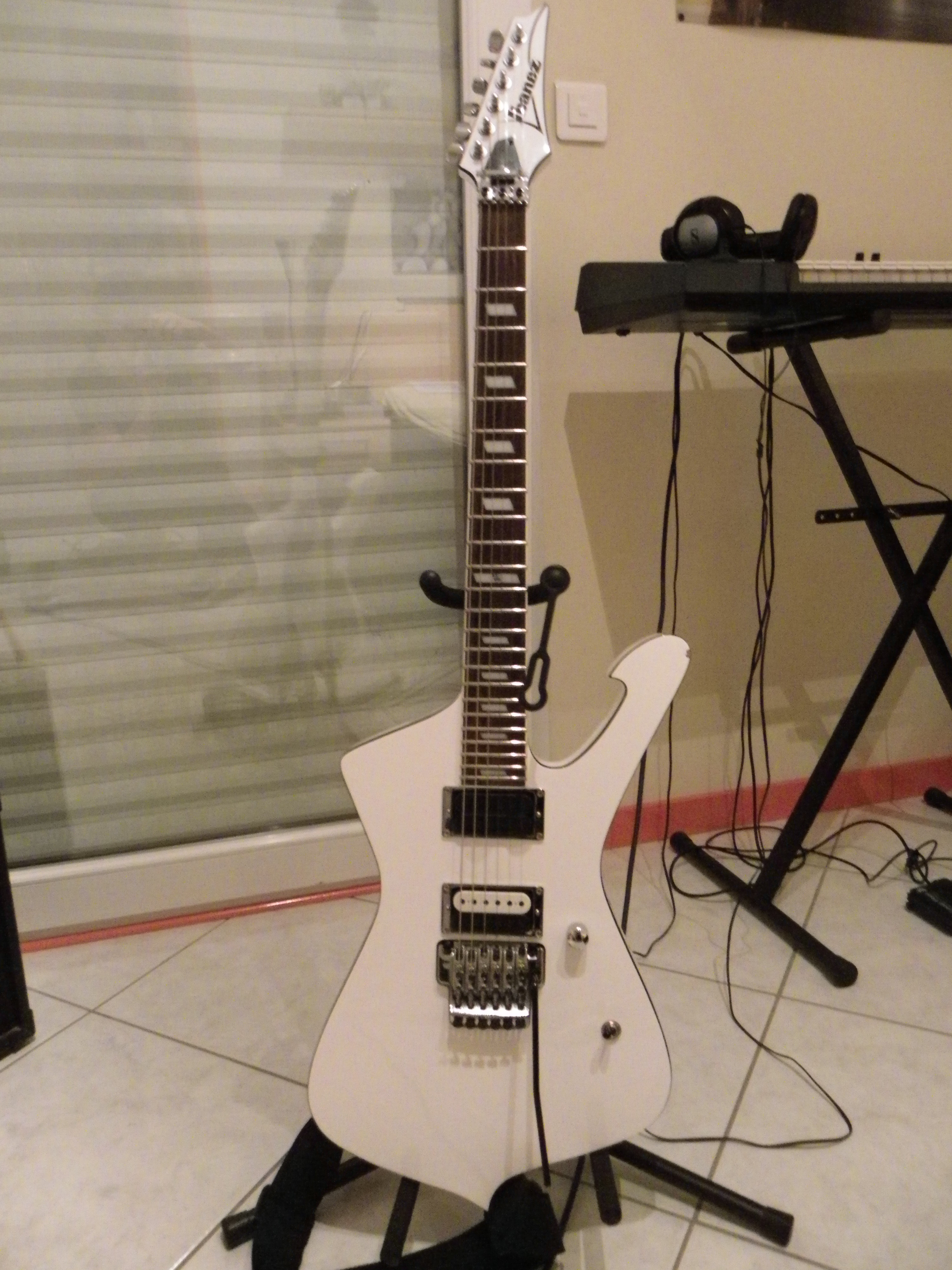
The majority of Ibanez Iceman guitars sport a 24 fret, two octave neck with a 25.5 inch scale and come with two pickups.

Many models use DiMarzio pickups D Activator pickups that deliver a powerful sound without active circuitry.


The X-Series guitars feature neck through body construction with the model DT700 being the first to utilize this feature.

The fixed bridge models feature the Gibraltar Custom bridge and thru-body stringing. Most tremolo models feature the Edge III trem system.

The necks are made of 5 piece maple and walnut laminate. The fretboard is made of bound rosewood with reversed sharktooth inlay and is topped with Jumbo frets. The body is made of mahogany. The controls are simple; one volume and one tone potentiometer and a 3-way toggle.

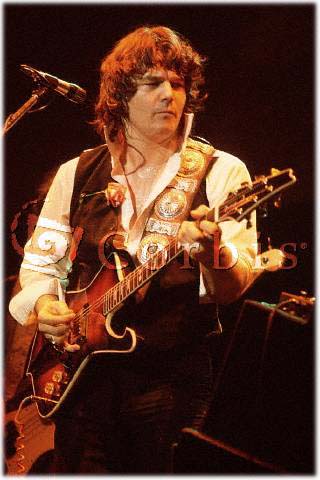
From 1975 to 1983 Ibanez and the other distributors built eight different models that ranged in price from $400 to $800. Steve Miller played an Iceman IC210 on Fly Like An Eagle.


IC210
Although some changes were made in the Iceman design, the public wanted super-strats in the 1980’s because that is what the Shredders were playing.


By 1983 as sales dried up, Ibanez only manufactured two models of Iceman. However serious guitar collectors realized The Iceman was a very well made and unique instrument that would eventually rise in value.

In 1994, the Ibanez Iceman guitar was re-introduced to U.S. markets. They are no longer manufactured in Japan. Now they are built in Korea.


I guess Karma works sometimes, since there are a couple of Iceman replica guitars floating around.


One manufacturer is producing Iceman copies using the Hondo II brand name. This instrument is an excellent copy of the real thing, while another is manufactured by a company using the brand name Odessa.


Finally, in rhe 1980's, a company named Antares also made Iceman replica guitars.


Wednesday, October 13, 2010

The Gibson J-160E - The Beatles Guitar


The Gibson J-160E is one of the first ever acoustic-electric guitar models. The first Gibson electric acoustic is attributed to Lloyd Loar although Gibson thought it was a bad idea at the time.

Loar had experimented with acoustic electric guitars back in the 1920’s when he worked at Gibson and later with his own company, Vivi-tone.

Most of us have probably played acoustic guitar into a microphone. This works great in a studio setting as it picks up the guitars natural sounds. However in live performance, it can be a problem.

The microphone may pick up other instrument sounds leaking into the mic. Your guitar may bump the mic stand resulting in a non-pleasing sound and the soundman being knocked off his stool.

Plus your movement is restricted. You have to stand directly in front of the microphone.

In 1951 Gibson was aware of these issues and to solve the problem created a guitar called the CF-100E. This guitar was a small bodied instrument with an ingenious single pickup at the base of the fretboard.

This instrument bore a resemblence to the J-160e, except for it’s smaller size and Florentine cutaway. The neck joined the body at the 14th fret on the bass side. It was also offered without a pickup as the CF-100.

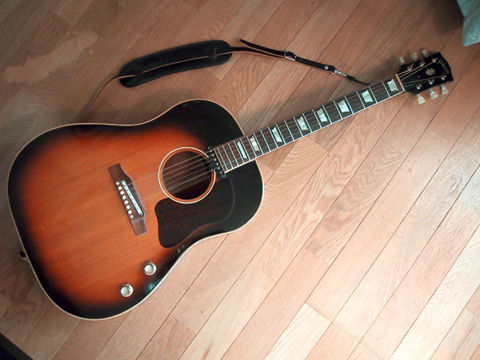
In 1954 Gibson came up with a second acoustic-electric model which was deemed the J-160E. This was a slope-shouldered Jumbo bodied instrument.
The constuction of this guitar was a departure from Gibsons typical process. First of all, plywood was used for most of the guitars body. Instead of using X-bracing which allows the sound board (guitars top) to vibrate more freely, Gibson utilized ladder-bracing.

Ladder bracing was used on some classical guitars and on budget guitars, such as Stella.

Perhaps this may have been to emphasise the pickup or to deaden the acoustic sound to prevent body vibration being picked up. Who knows? Even with the poor quality tone the vintage j-160e's are still quite collectible.


The guitar had an adjustable bridge allowing the saddle to be raised or lowered by screws on opposing sides of the rosewood bridge. The pickup was a single coil P-90 without a cover. The volume and tone controls were placed on the lower bout of the guitars top. Despite the cool looking outer appearance, there were many better sounding Gibson acoustics available.

It  chosen by mid 1960's artists for it ability to be amplified. Not only was this the guitar of choice for The Beatles, but also for Peter and Gordon and Chad and Jeremy.

The 1954 model had a 16-inch wide body. The rosewood fretboard came with trapezoid inlays. Only the top was solid and made of spruce. The back and sides were made of laminated mahogany.


The neck had 19 frets and joined the body at the 15th fret. This is interesting since most often dreadnaught style guitars join the body at the 14th fret. My thought is this was due to the pickup placement.

On the headstock overlay, there was a crown inlay. The guitars pickguard was fashioned in Gibson’s teardrop pre war style. Gibson only offered this model with a sunburst finish.

1955 J-160e
The following year another fret was added, but the guitars top was now made of laminated spruce.

In 1969, Gibson revamped the model to a square-shouldered dreadnaught style and the bridge saddle was fixed. Another change occurred in 1972 when the pickguard was altered to three-point style. The trapezoidal inlays were changed to small block inlays that same year.

In 1979, the J-160E was discontinued.


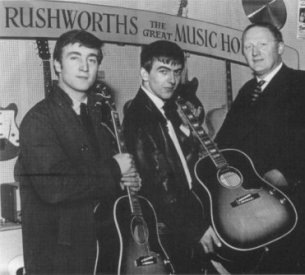
Sometime in 1962, George Harrison and John Lennon each purchased a J-160E’s at the same time at Rushworth’s Music Store in Whitechapel, Liverpool. Since John did not have enough money to afford his guitar, he asked Brian Epstein,the Beatles manager, to co-sign for the purchase.

In the end Epstein paid for both John and George's guitars. These guitars were often used early in The Beatles career both on stage, in the studio and in the Beatles movies.

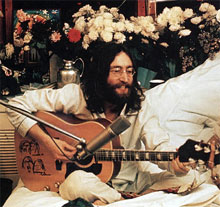
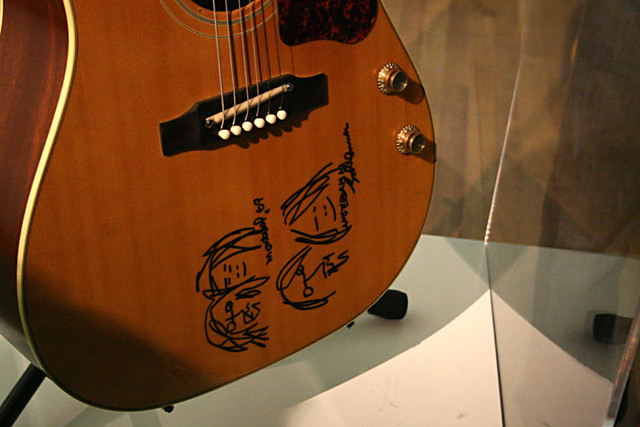
In 1967, Lennon decided to have an artist paint his J-160E with a psychedelic scene. Then in 1969 for whatever reason, he decided to strip the paint on the guitar and give it a natural finish.


Prior to being in the Beatles, Lennon attended art school in Liverpool. If you did not know it, he was a compulsive doodler. (Pick up a copy of his books, In His Own Right and Spaniard in the Works to see some of his doodles.)


Lennon decided he would doodle caricatures of him and Yoko on the guitar during the time he and his wife were protesting the Viet Nam War by holding a Bed-In. So Lennon was recognized for the sunburst J-160E and the natural finished model.


In 1991, Gibson reintroduced the 160E. Major changes were made to the instruments design. It now had a solid spruce top and solid mahogany back and sides. The single coil P-100 pickup was replaced with a P-100 stacked coil humbucking pickup. The bridge saddle was fixed. Once again, Gibson only offered a sunburst finish. These instruments were produced through 1997.


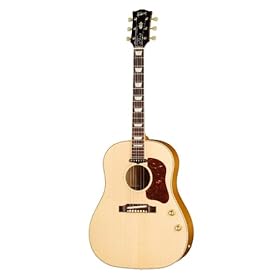
Gibson reintroduced the J-160E offering it in a standard model and a John Lennon Peace model, based on the stripped finish he used during the Bed-In days of 1969. These were made in Gibson's Montana facility.

Gibson also design a non-domestically manufactured Epiphone model which is known as the EJ-160E John Lennon Signature model. This guitar is currently manufactured in Indonesia.

There are some minor changes in this model. The scale is 25.5 inches opposed to the original 24.75 inch original and the knob placement is slightly different. Prior to this Epiphone replica, the Epiphone EJ-160E was manufactured in Korea.


I don't know about the bracing on this instrument. The top, back and sides are made of laminate wood and the P-100 pickup is a single coil model.

I have already stated, Gibson currently manufactures the J-160E standard model. The standard sunburst sells for $2700. These instruments are similar to the 1990's run, being entirely made of solid wood having X-bracing and a stacked P-100 humbuckers. The Lennon Peace standard model is supposedly offered in a natural finish and sells for $3250. However I have not run across any stores stocking this model.

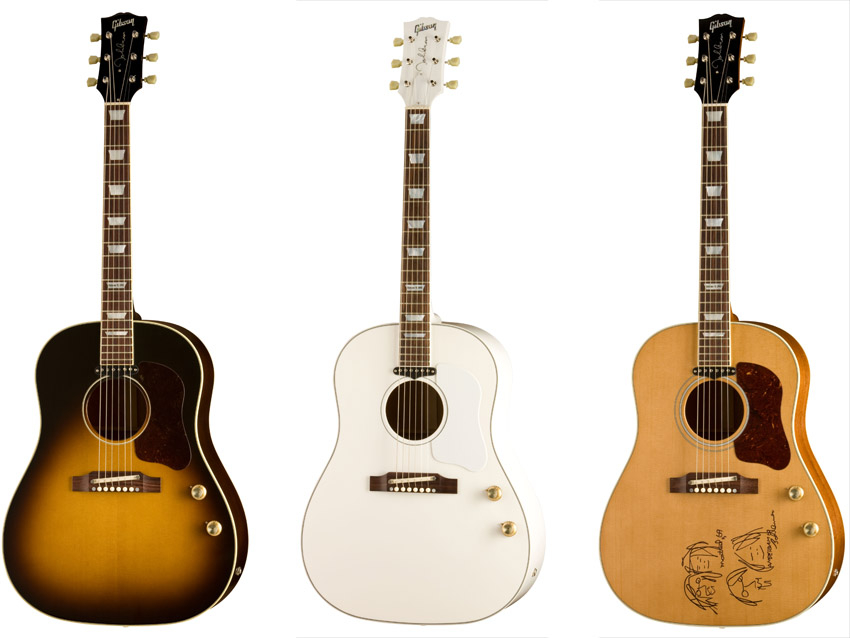
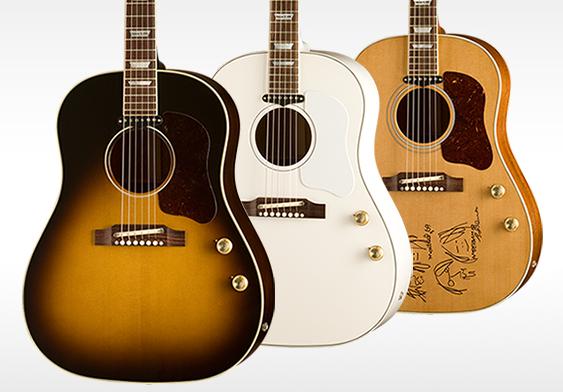
This year a special run of the Peace models are offered to celebrate the 70th anniversary of John’s birth date. In addition to the Sunburst model, there is an all white model, which was commissioned by Yoko Ono and The Peace model with one of John’s famous doodle on the lower bout.

These reproductions are limited to 70 guitars of each model with the exception of the sunburst model J-160E VS (vintage sunburst) of which 500 units will be produced.

The Lennon 70th birthday J-160E are based on the 1960's design and feature laminated Sitka Spruce Top, historically correct Gibson ladder bracing patterns and a Gibson Authentic single coil P-90 Pickup.

John Lennon signature is transcribed in Mother of Pearl on headstock. Lennons date of birth is engraved on the 12th fret trapezoidal inlay. The 70th guitar of the Imagine series will come with Lennon’s signature in Abalone.

The 70 Imagine guitars and the 70 Museum guitars (named because the Bed-In guitar is in the Rock and Roll Hall of Fame) both come with 70th anniversary certificates personally signed by Yoko Ono.

Anyone interested in this special run of guitars might want to dig deep into their wallet. The 70th Anniversay J-160E VS retails for $4728.00 US dollars. However the Imagine will set you back $10,748 and the Museum retails for $15,048