Merle Haggard started his life in California. His father died at a young age which had a bad affect on young Merle. His mother had to find work and became a bookkeeper to support her family. Merle’s older brother gave him a guitar when he was 12 years old and Merle was able to pickup up songs by Bob Wills, Lefty Frizzell and Hank Williams by listening to phonograph records.
As Merle grew older he became rebellious, perhaps because his mother had to work, perhaps because life was hard. His mother eventually decided she could not handle him and had Merle placed in a juvenile detention center. This really only made matters worse, and Merle got into more trouble after being released. He committed a series of minor crimes which landed him back in a juvenile center.
His first “gig” was at a bar where he played guitar for $5 and free beer.
After a series of run-ins with some bad company in prison, Merle Haggard straightened out his life, and earned a high school diploma.
While in prison he was able to play in the prison country music band. He stated that he took inspiration from a 1958 performance by Johnny Cash at San Quentin.
Haggard was released in 1960. Within a year he began recording music for a small label called Tally Records. He had a few minor hits. His fear was that his history of being a prisoner would ruin his career. But what happened was just the opposite.
In 1966 his album Branded Man, which contained his autobiographical song, was a commercial success. He had a new band, began touring and continued to record hit songs throughout his career.
In 1968 Haggard did a tribute album called Same Train, Different Time: A Tribute to one of his heroes, Jimmie Rodgers. This LP brought Merle many accolades.
By the end of the 1970’s Haggard had composed a number of hit songs, based on his past; such as Mama Tried, The Legend of Bonnie and Clyde, Sing Me Back Home, Okie From Muskogee and The Fightin’ Side of Me.
In 1972, after Haggard had become an established country music star, then-California governor Ronald Reagan granted Haggard a full and unconditional pardon for his past crimes.
Young Merle with a Martin 00-18
Merle Haggard's choice of guitars have been Martin acoustics or Fender Telecasters. The first decent guitar that I can determine Merle played was a 1940's Martin 00-18 as we can see in this picture of a very young Haggard with guitar on a farm.
Merle Haggard with a Martin 000-18
One of Haggard's heroes was Jimmie Rodgers. Throughout his early career Merle seemed to have an affinity for small bodied 12 fret Martin 00-18 guitar that Rodgers played early in his career and we see Haggard on the cover of the Mama Tried album holding a Martin 00-18.
Young Merle Haggard's most photographed guitar with his Martin 00-45. It is on his album covers and in publicity photos.
It is a beautiful instrument.
Haggard played other Martin guitars throughout his career. These appear to be Martin D-28 models. In the mid 1960's
Country musician Billy Grammer and two partners put together a company to build Grammer guitars. For a few brief years these were played by many Country artists and Merle Travis was one of them. In 1968 the Grammer Company was purchased by the Ampeg Music company and around this time a Merle Travis model was offered.
Washburn Parlor guitar
Haggard's album Strangers shows him with a beautiful Washburn parlor guitar. Jimmie Rodgers played one of these guitars too.
Merle Haggard is also seen in publicity photos play an unidentified nylon string guitar, This was during the 1970's when other Country players were picking up nylon string guitars, possibly due to Jerry Reed, Willie Nelson and Chet Atkins gravitating to this instrument.
Ovation Classical
We also see a photo of Merle Haggard playing an Ovation Classical Electric.
There was no pickguard on this guitar. The body had a single cutaway. The neck on this guitar joined the body at the 12 fret.
It featured a slotted head stock that features an elaborate logo that read Blue Yodel No. 13 (a tribute to Jimmie Rodgers) was inlaid on the Indian rosewood peghead. The C.F. Martin logo was displayed on the back of the headstock
The neck was topped with African ebony fretboard that had Martin elongated diamond inlays. The belly bridge was also constructed of African ebony with pearl inlaid bridge and end pins.
The guitar came with factory installed electronics. There was only a limited number of the Martin 000-28MH editions issued.
Martin Guitars made a donation for each one sold to charities that Merle Haggard chose.
Perhaps the guitar that Merle Haggard is most identified with was his butterscotch Fender Telecaster. In 1961 Haggard was at a show in Las Vegas to watch his friend Roy Nichols do his act. Nichols had walked off stage and handed Merle his Telecaster and told him to "go use this thing". Haggard walked out on stage and sang a few songs. He played a Telecaster ever since that day.
He once remarked, "A Telecaster is not for the timid; you had to be a bulldog to play a Telecaster because it is hard to play. It doesn't respond like a lot of guitars, so you have to play it with a different attitude, and that makes the results different."
Merle's Original Fender Telecaster at the Oklahoma Music Hall of Fame
The pickguard is ivoroid and modified from a normal Telecaster plckguard design.
Fender Custom Shop photo
The body is bound on top. The body if quite interesting as it is made from a center maple block and has two ash "wings" laminated to the block. The ash sections are chambered. With the neck-heel and maple block it appears to be a neck through body guitar, however that is not the case.
The headstock comes with an inlaid dogs head underneath announcing it to be a Tuff Dog Tele. Merle's signature is on the headstock. The gold-plated machine heads are Fender Deluxe models with pearl buttons.
The electronics are unique. The guitar has twin Texas Special single coil pickups, one with a gold-plated cover and a 4-way blade switch that is has a Strat-style cap. The first position is the bridge pickup, the second position is the bridge and neck in parallel, the third position is the neck pickup and the fourth position is the neck and bridge pickups in series.
Merle Haggard owned a few other guitars. He can be seen playing a Taylor 814ce.
He also owned a Framus 12 string guitar that he gave away to be auctioned off for a charity. The body was autographed by some of Haggard's friends.
Though he did not own this guitar, here is a rare photo of him playing his friend Lefty Frizzell's customized Gibson SJ-200 with a Bigbsy neck.
The last guitar he owned was a gift from his friend Randy Travis. He called it the Rose guitar. I cannot find any information on the luthier that made this fine instrument. I do not know it was named after Merle's song I Threw Away the Rose or if the makers name was Rose.
This was a small guitar that appears to have a spruce top and mahogany back and sides. The neck was topped with an ebony fretboard with no position markers. The word "Hag" is inlaid between the 9th and 11th fret. The neck joined the body at the 12th fret.
The guitars body is bound in white trim and is a dreadnaught shape. The headstock has a rosewood cap with "Rose"inlaid on it. Merle played this guitar later in his life and it is very well worn. From the looks of it, he must have taken it everywhere.
AKA "True Banjo Stories" ~ Uncle Dave Macon's Banjer ~
I thought I might change things up and start writing The Unique Banjo Blog. So I present you with installment Number 1.
I ran across a very interesting information from Phillip Steinmetz, who has befriended the likes of me on Facebook. I have to tell you that Phillip is an exceptional performer, banjo player and knows all these great old timey songs. I was directed to Phillip's story by from my other Facebook friend, Eddie Pennington. who is an extraordinary thumb-picking guitarist from Princeton Kentucky.
This story regards Phillip's Grandpa. (actually his great uncle, but Phillip and just about everyone called him Grandpa). If you think Phillip's grandpa looks familiar, it is because he was known to all of us Country Music aficionados as Grandpa Jones.
Phillip goes on to tell this story: "I think this (picture) is probably the first time that I had ever held a banjo and as you can see Grandpa didn't look too happy about it! Well, the next few pictures tell why he wasn't so enthused about a little whipper-Snapper holding that particular banjo.
The story behind us acquiring it began when my Dad wanted to learn how to play the banjo and had asked Grandpa to find him a good banjo for him, somehow the subject of what ever happened to Uncle Dave's banjos came up and Dad said to Grandpa, "wouldn't it be nice to have one of Uncle Dave's ".
Well, Grandpa called Dad some months later and said that Uncle Dave's son Doris, was at the Opry one night and was wanting to sell one if his Paps banjos, so Grandpa bought it and brought it to Dad on his next visit.
Doris and Uncle Dave Macon
Shortly afterwords, Doris told Grandpa that he should get the banjo back for him, as I think he realized the mistake that he made in selling it in the first place. Sad to say, but Doris had a problem with liquor and that lead to poor decisions I'm sure. Anyway, getting back to the history of this "little banjer", as Uncle Dave called it, this was one of two that were made special for him by Gibson and the only way to tell them apart is by looking at the last set if pearl dots on the fretboard.
On ours, the three dots are spaced close together, on the other banjo, they are spaced further apart.
Also instead of metal truss rods, both banjos were made with dowel sticks, so that Uncle Dave could twirl them around for his trick banjo playing.
Young Phillip Steinmetz and Grandpa
The other picture of me and Grandpa was taken at the same time, but probably before I grabbed up Uncle Dave's banjo!! Hah, see the difference in Paw's expression!!
Again, my Dad's love for the Old-Time Music and especially Grandpa's, is the reason we have so many treasures like this banjo. My Dad will never get enuf credit for what he has done for me! Love You Paw!" By the way, I don’t think I mentioned this is April Fools Day!
Betcha' never thought you would see Robert Johnson playing Eddie Van Halen's guitar.
We will resume the Unique Guitar Blog tomorrow. Enjoy the videos!
"Rooster hits the washboard and people just got to smile,Blinky, thumps the gut bass and solos for a while .Poorboy twangs the rhythm out on his Kalamazoo. Willy goes into a dance and doubles on kazoo."~ Down on the Corner by John Fogerty
1929 Brooklyn newspaper
The Great Depression hit the United States in 1929. Businesses failed, people were out of work and very few people had disposable income to spend on expensive musical instruments. It was sort of like today. (But I digress)
The Gibson Mandolin - Guitar Manufacturing Company realized that if they were to sell musical instruments they needed to drop their pricing. But the dilemma was to do so without cutting their standards. The solution was to create a new budget brand and align it with Gibson.
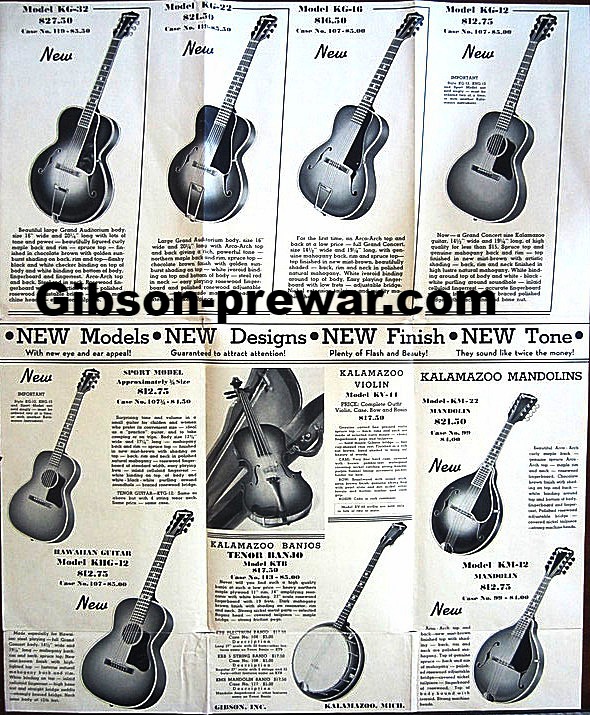
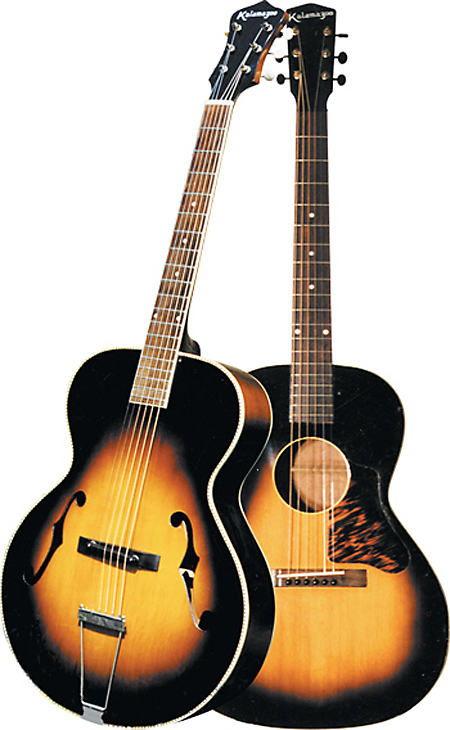
So in 1933 Gibson introduced the Kalamazoo brand of musical instruments which included guitars, Hawaiian guitars, banjos and mandolins. These instruments sold for less than half the price of similar Gibson branded instruments. To accomplish this, Gibson saved costs by eliminating the instruments adjustable truss rod and using less expensive hardware and materials. For instance, some of the Kalamazoo archtop guitars featured real carved tops and backs, but others featured what Gibson called the arco-arch, which was their term for a pressed top similar to the ones found on Kay and Harmony arched top guitars.
From 1933 to 1940 the guitars, both arched and flat top, were made of solid wood for the tops, backs and sides. However Kalamazoo guitars made from 1940 through 1943 featured plywood bodies. All of the flat top guitars featured ladder bracing the instead of X-bracing found on more expensive Gibson models.
The KG 3/4 was a 3/4 sized guitar that was similar in shape to the Gibson L-00. It came with a solid spruce top that was bound, mahogany back, sides and neck. This guitar was finished in two tone sunburst. The fretboard on this and other KG models was rosewood with dot inlays.
The headstock which had a flat shape had a Kalamazoo decal on its top and open gear tuners were on a metal strip of 3 per side and featured black plastic buttons on the back side. The case sold for $4.50 extra.
The most popular Kalamazoo model was the KG-11. This guitar featured all the accouterments of its 3/4 size KG version, but came with a standard 24.75” scale. This guitars shape was different than a Gibson L-00 in that the lower bout was wider. The original 1933 price for this guitar was $12.75 USD and the case would set you back $5.00. The Hawaiian version came with the same features except the body joined the neck at the 12th fret. It was known as the KHG-11.
During this era, many tenor banjo players were doubling on the guitar, so 4 string tenor guitars were popular. Kalamazoo offered the KTG-11. This instruments body and accouterments were similar to the LG-11, but the neck was narrower and the headstock only had 4 tuning pegs.
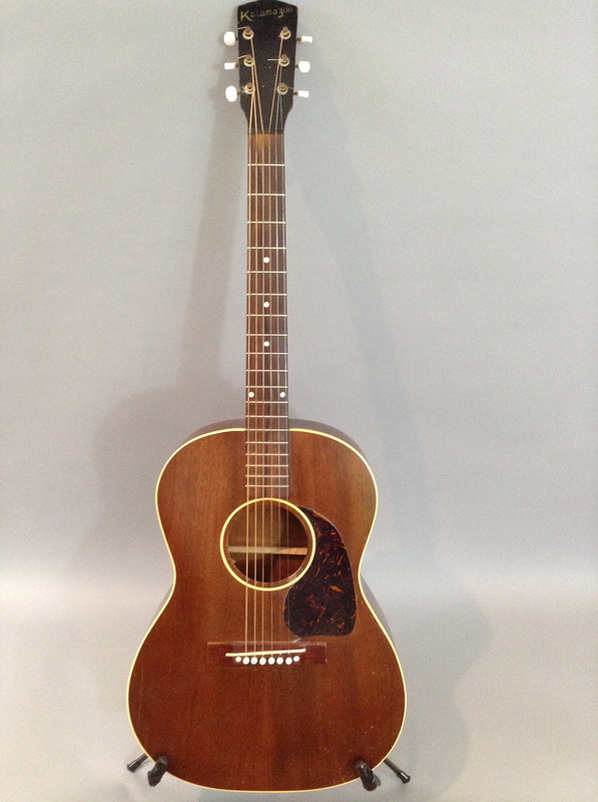
By 1939 Kalamazoo came out with the KG-12 Flat top guitar. It’s body shape was narrower and its proportions were similar to a Gibson L-00. It had a solid spruce top, solid mahogany back, sides and neck and the neck had a rosewood fretboard with dot inlays. This gutars headstock had a slight point on its top that is known by collectors as a pointed dome peghead. It came with a mist-brown finish and sold for $12.75 in 1939.
A similar guitar was the KGN-12 “Oriole.” What made this guitar different was the natural finish on its solid spruce top and the back and sides were made of flamed maple veneer.
There was an Oriole logo on the headstock below the Kalamazoo logo. Both were decals. The headstock on this guitar was different as it was more like Gibson’s open-book headstock.
For those that preferred a neck that joined at the 12th fret Kalamazoo offered the KHGN-12. This guitar was available as the Hawaiian option with a raised nut and called the KHG-12.
In 1936 Kalamazoo offered the KG-14. This guitar looked spot-on like a Gibson L-00 and had a sunburst spruce top and dark brown mahogany back and sides. The bridge saddle and fretboard were made of rosewood and the neck had dot inlays. The headstock on this guitar was done in Gibson's "roof peak" shape and topped with a Kalamazoo decal. Once again the tuners were open gear models on strips of three tuners per side.
The Hawaiian version of this guitar was the KHG-14 which came with a raised nut. The neck on this instrument was slightly wider and joined at the 12 fret.
The KTG-14 was the tenor version of this Kalamazoo flat top guitar. The appointments were similar, but for the 23" scale.
By 1935 Gibson was offering the first Kalamazoo archtop guitar. This wa the KG-21 and was very similar to a Gibson model L-30. This guitar had a solid spruce top that was pressed instead of carved. Gibson called the pressing process “arco-arch.” The back and sides were made of mahogany as was the neck. The rosewood fretboard had white position markers. The upper part of the headstock had the roof peak shape. The bridge was made of rosewood and the strings attached to a budget model trapeze tailpiece.
A tenor version of this guitar was also marketed and called the KTG-21. The body was the same, but the neck was narrower and only had four strings.
An upscale version of this same guitar was called the KG-22. It came with a bound neck that featured a non adjustable steel rod and a nicer trapeze tailpiece and in 1935 sold for $21.50 for the guitar and $5.50 for the case.
In 1935 Kalamazoo also offered a nicer archtop model called the KG-31. This guitar looked similar to a Gibson L-50. Once again the solid spruce top was pressed or arco-arched instead of carved. The back, sides and neck were made of mahogany. The fretboard and bridge were made of rosewood. The neck was bound with white position markers and the headstock had the roof peak on its top end.
Gibson also produced some models of the KG-31 that had maple back and sides.
The KG-31 was available with a tenor neck and called the KTG-31.
By 1939 Gibson set out to make a more affordable archtop and called it the KG-16. This came with the arco-arched solid spruce top and mahogany back and sides. The body shape was similar to the KG-21. It too had the roof peak headstock and sold for only $18.25.
That same year, 1939, Gibson offered the KG-32 archtop guitar. The body shape was similar to the KG-31. The key differences between this guitar an the KG-31 were the checkered binding on the top of the body instead of white binding and a non-adjustable steel rod in the neck.
In 1940 Gibson launched the KG-32 Kalamazoo Oriole Archtop guitar. This guitar came with flamed maple sides and flamed maple veneer on the back. The pressed top was laminated spruce and had a natural finish instead of the usual sunburst finish found on all the previous models.
Some KG-32 Oriole guitars were sold with the roof peak headstock design and others had the Gibson open book headstock design. The headstock was topped with the Kalamazoo logo decal and below it was an orange Oriole bird decal.
In 1939 Gibson modified their Kalamazoo KG-21 archtop with the addition of a single coil pickup above the bridge saddle, It was known as the model KES (Kalamazoo Electric Spanish.) A single volume control was added below the pickguard and a jack was put on the guitars lower side. This guitar sold for $100.
By 1940 Gibson modified their Kalamazoo KG-12 model with the addition of a single coil pickup that was mounted over the sound hole. A single volume control was added to the guitar and a jack on the lower side for the cord. This model was called the KES-R.
The amplifiers for these instruments were the KEA and the KEA-R. The KEA had 8" speakers and 5 tubes with an output of aproximately 10 watts. The KEA-R was similar, but had a 10" Rola speaker.
Gibson made Kalamazoo guitars through 1943 when WWII interrupted production.
By 1949 Gibson resumed prodution and offered one more Kalamazoo flat top guitar. This was the KG-1. It was a very similar instrument to the Gibson LG-0. but the Kalamazoo model had no truss rod in the neck. This was an all mahogany instrument and had a black finish. The interior bracing was ladder style. The tuners were Kluson budget models that were three on a strip. It had a tortoise shell celluloid pickguard. The headstock had the roof peak design. It was made until 1953.
1949 KES
During that same year Gibson made one more Kalamazoo electric archtop guitar. This was the model KES (Kalamazoo Electric Spanish) guitar. It was the same body style as the KG-22, but sported a single P-90 style pickup in the neck position, which had no exposed pole-pieces, as well as a volume and tone control on the lower bout. This was a slightly different version of the KES from 1939. The neck was unbound.
Gibson offered a 10 watt Kalamazoo amplifer with a 10 inch speaker to go along with the guitar. Sometime in 1953 Gibson shut down production of Kalamazoo instruments.
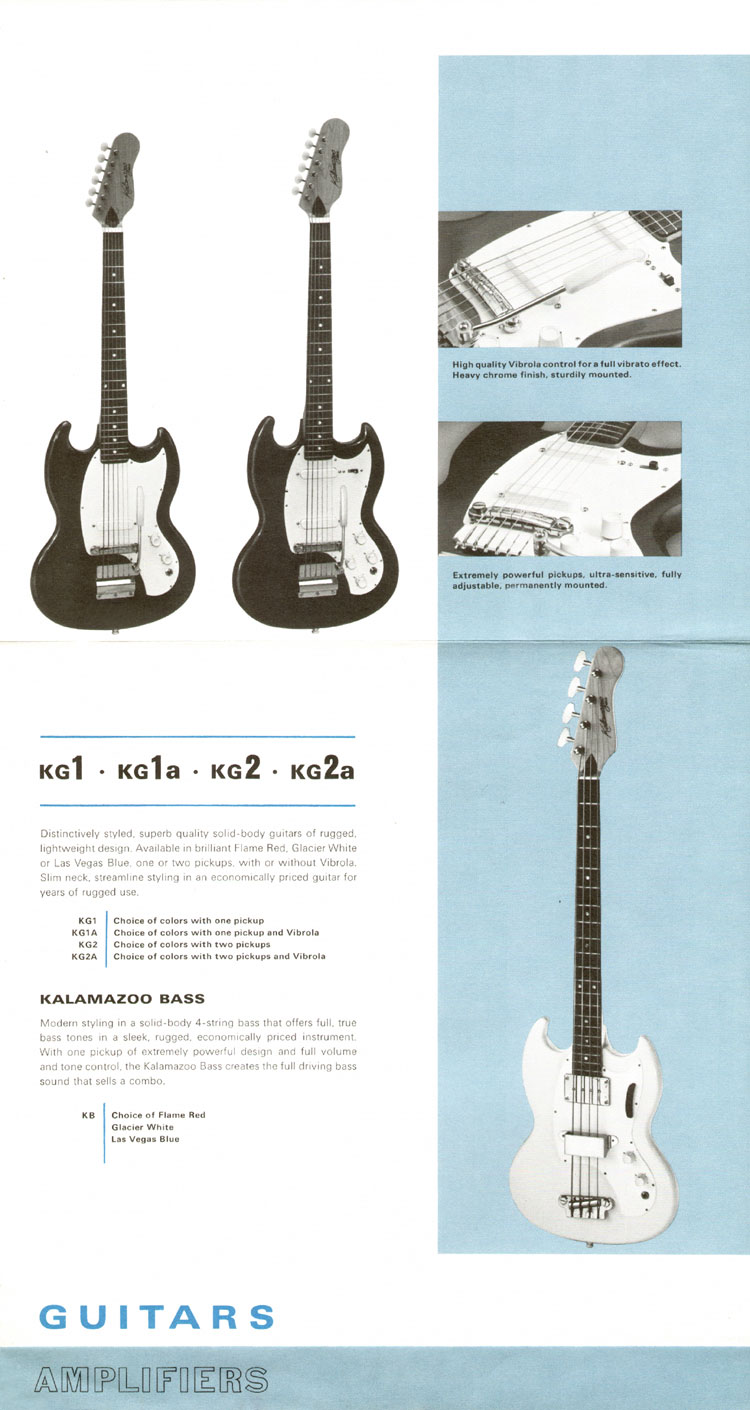
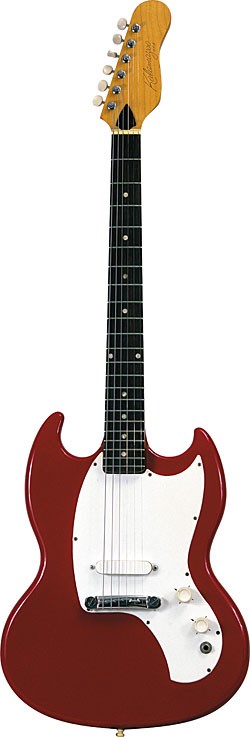
The bodies of the electric guitars and bass started out to be somewhat similar in appearance to a Gibson model SG, however the headstocks were Fender-like and had six budget tuners all in a row.
To reduce cost and perhaps to conserve on materials Gibson made the instruments bodies out of particle board; essentially sawdust, wood shavings and glue. Even more interesting is that the bodies supposedly were made by a toilet seat manufacturer in Wisconsin.
The Kalamazoo guitar line-up included the KG-1; one covered single coil pickup in the bridge position, the KG-1A; one single coil pickup and a Maestro vibrato.
The KG-2; two single coil pickups with a slider switch on the upper bout by the neck pickup, and the KG-2A, which came with two pickups and a Maestro vibrato.
All models came with a bolt-on neck topped with a rosewood fret board and dot position markers.
The Kalamazoo bass was known as the KB. The original body shape was similar. It came with one large single coil pickup in the neck position and a palm rest. The strings attached to a compensated metal bridge/saddle.
1967 KG-2A and KB
Around 1967 the body shape changed on Kalamazoo guitars and basse changed and now looked more like a Fender Mustang. All the other parts remained the same.
Despite the particle board construction, it was a pretty nice instrument that was much better than the Asian budget models that were flooding the market during that era.
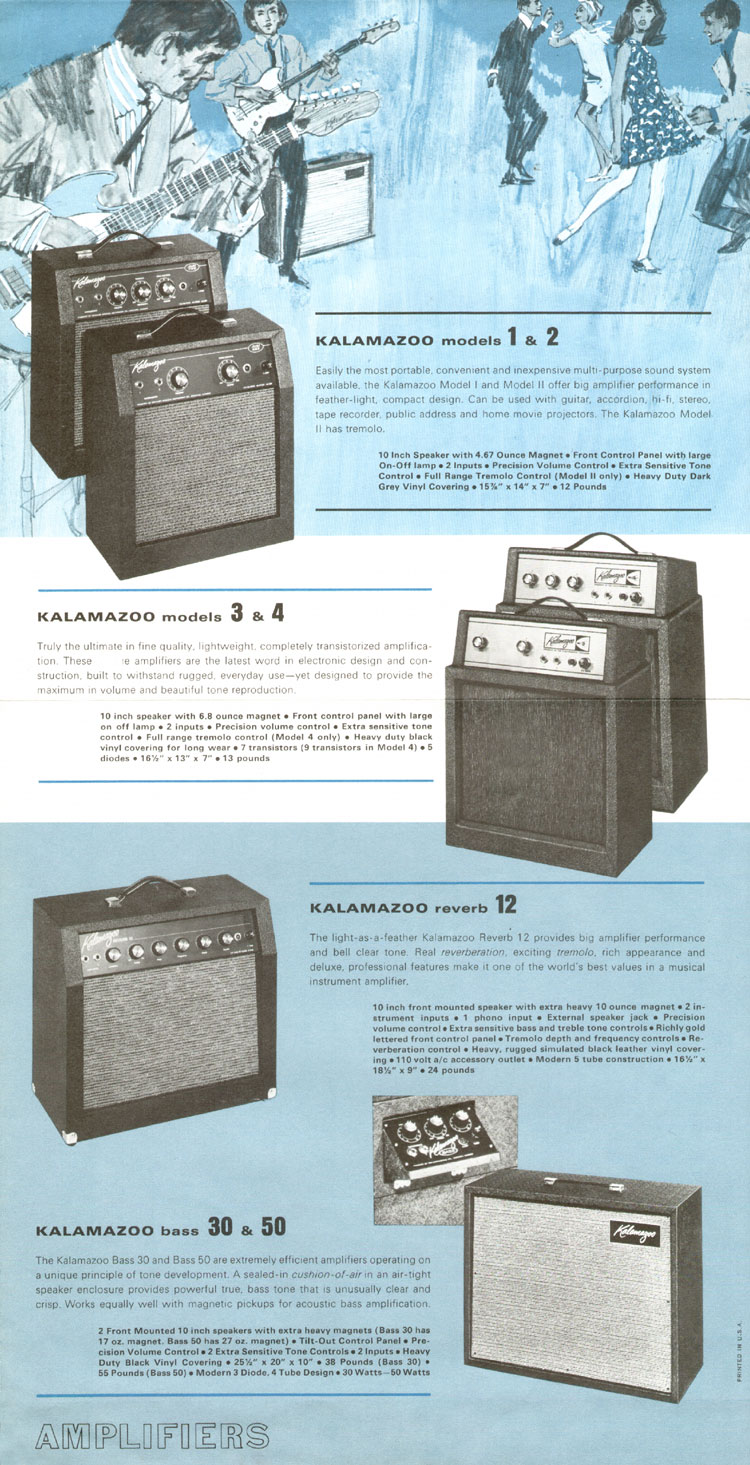
The model #1 came with an Alnico 10" speaker. It was a single-ended circuit with 6X4 rectifier, 6BQ5 output tube, 12AX7 input tube. It featured a single volume and tone control.
The Model #2 came with 2 12AX7 tubes, one was for the preamp and the other was used as a tremolo oscillator. The rectifier was a 6X4 and the power tube was a 6BQ5. It came with a 10” CTS alnico speaker and the output was 5-8 watts. The controls featured volume, tone and tremolo.
The Kalamazoo bass amp came in either 30 or 50 watt versions. The 30 watt version featured two 10” Jensen C10P speakers. The controls were for “loudness”, treble and bass and these were housed in a drawer at the rear of the amplifier that dropped down.
The player pushed the control panel back when the amp was not in use. The rectifier for the Bass 30 was solid state. Two 7591 tubes were utilized for the power section and the preamp sported 2 6EU7’s.
Although Kalamazoo made a 50 watt bass amp, I cannot find any information.
The Kalamazoo models 3 and 4 are both solid state amplifiers with 10” speakers. The model 3 controls featured tone/off/on and a volume control. The model 4 came with tremolo.
The look of these amps was interesting since the electronics were housed in the top section which was slightly smaller than the bottom section that housed the speaker, so it resembled a piggy-back amp and speaker cabinet, however it was a one piece unit.