One of the men that has done more than most to shape the world of modern rock guitar, and even the world of heavy metal music gets very little respect or recognition these days.
I am of an age where I can recall Surf Guitar being played on the radio. I am not certain how players learn songs anymore, but I grew up listening to The Ventures, The Surfaris and Dick Dale. I learned to play guitar by listening to those songs over and over until I could duplicate them.
In those days, Dick Dale was just a name of the guy playing lead guitar on some popular songs that I wanted to play with my garage band. I knew he was from California and his bands name was The Del-Tones, but had no idea that his persistence in seeking a better, bigger and louder sound from his guitar would eventually turn into the industry standard and change live guitar music and concerts.
Dick Dale was born Richard Anthony Monsour on May 4th, 1937 in Boston Massachusetts. His father was Lebanese and his mother’s family came from Poland. Due to his Lebanese heritage Dale developed an interest in Arabic music. I mention this because the song everyone associates him with is Miserlou. When he was very young his uncle taught him how to play the tarabaki, while the uncle played the oud. Because of this Dale developed his rapid and alternating picking technique. He states the music had a sense of pulsating.
One can certainly hear the Arabic influence in Misirlou. Much of this song is played on a single string, up and down the neck. In reading about the song, it was first popularized by a Greek recording in 1927 and called Misirli which roughly translates to The Egyptian. Dale would have learned this song as a kid.
In the late 1990’s, when I first got on the internet I used to visit The Fender Forum aka The Fender Discussion Page. Early on this site was not just a discussion page for fans of Fender guitars, but also received visits and comments from Fender employees, including Bill Schultz, the CEO at the time.
Fender had a newsletter back then and one issue featured an interview with Dick Dale. We thought it humorous that Dick Dale spoke in the third person throughout the interview and we poked fun of that.
I took the initiative of emailing Mr. Dale, hoping that he might join in the discussion. Boy was I mistaken. I received a terse reply. I wrote him again and apologized for remarks like,Dick Dale uses bridge cables to string his guitar. (Which is almost true. His choice of Ernie Ball strings at the time ran from .60 to .16 gauge.) (Note: After rereading an article I wrote about Jazz and Session player Howard Roberts, I discovered that Roberts choice of string sizes was similar; .58 to .16.)
Dale took the time to email me back and was very gracious. I have nothing but respect for this man. In his text he related some similar experiences that I could relate to. We both took care of our elderly parents. And we both loved animals, Dick Dale more-so than I, because he raised a menagerie of around 40 assorted lions, tigers, leopards, hawks, eagles, ravens, a baby elephant and other non-domestic critters that had been rescued from poachers.
He also elaborated to me about the nights that he spent with Leo Fender discussing his amplification needs; such as why the current Fender amps kept burning out during his shows. The men also discussed his guitar.
Dick Dale was one of the first to receive a Fender Stratocaster.
Indeed there are a number of Fender innovations that although Dale did not create, he was the impetus and drive behind them. For instance, most amplifiers in the late 1950’s and early 1960’s were putting out 12 to 15 watts. There were a handful, including the Fender Bassman that pumped out 40 watts RMS.
When Dick Dale first started playing music, he says he was in a 17 piece band, with horns and a drummer. He was playing Big Band Music and the guitar could not be heard.
Later he attempted to be a Country singer for a while and even got a gig on a popular west coast TV show called Town Hall Party where he played with a number of famous Country Music stars.
Then Rock and Roll came along and the band became a combo, but the still the guitar was pretty much a background rhythm instrument.
When guitar based Surf Music hit the scene around 1962 he needed to do something. Leo Fender was a generous man and provided amplifiers and guitars to California musicians as a form of not just advertising but to see what worked well and what needed improvement.
When Dick Dale first met Leo Fender he told him that he was a surfer and a guitar player and did not have money for a decent instrument. Leo recognized the drive and determination and gave him a Stratocaster and right on the spot asked him what he thought about this Fender guitar. Dale, being left-handed, turned the right handed instrument over and began playing, which made Mr. Fender laugh.
Here was a guy playing his guitar upside-down and backwards, meaning the 6th string was on the top and the 1st string was on the bottom. So Leo Fender made a left-handed Stratocaster for him.
Dick Dale’s amps would all burn out from his intense and loud playing. He says that he blew out almost 50 amplifiers and speakers. I’m told that when Fender and Freddie Tavares came to see him play. Leo Fender went home and thought about this situation. This prompted Fender to make a larger and better output transformer.
Dale relates, “ I get a phone call one time, it was 2:30 in the morning and Leo said, “Dick, I got it, I got it, I found it! I got it! You gotta come down.” He says “I made an 85 watt output transformer, peaking 100 watts because using 5881 tubes would give it that WhOOm sound, ya gotta try it, ya, ya gotta try it.”
The trouble was they didn’t have a speaker that could handle this much power. Fender had been routinely using Altec Lansing speakers in some of their amplifiers, but Dale wanted something much stronger. So they approached another company called JBL Lansing and asked for a 15” speaker with a 10 to 11 and a half pound magnet with and aluminum dust cover.
So JBL Lansing went about creating this speaker which was not just sturdier, but came with a rubberized coating around the edge of the speaker which was connected to a metal frame. The JBL Lansing D130F was born.
The speakers were housed in a separate cabinet than the amplifier. This cabinet had what Fender called a "tone ring" that encircled the edge of the speaker and let more of the natural bass sounds come through.
The output transformer that Mr. Fender created emphasized the lows, mids and high sounds, something that had not been accomplished until then. The 100 watt amp and the cabinet were dubbed The Showman Amp.
The next step that Dale suggested was to place two of these speakers in a cabinet. The Showman Amp was born. When twin 8 ohm 15” JBL Lansing speakers were added to the cabinet to run in series it came to be known as The Dual Showman. Leo Fender had to upgrade the transformer to accommodate the 4 ohm load.
The version that Dick Dale uses is the one with cream coloured Tolex. Later the amp was rated at 100 watts and peaked at 180 watts. When the black Tolex models came out they were once again rated at 85 watts.
Dick Dale never set the amplifier on top of the speaker cabinet, since his intense style of playing guitar causes too much vibration in the speakers which can affect the tubes in the amplifier.
The Fender Reverb unit was another invention that Dick Dale did not invent, but certainly pushed forward. The Showman and the Dual Showman amplifiers were self contained amplifiers with a separate cabinet for the speakers and the only effect that was built into them was vibrato.
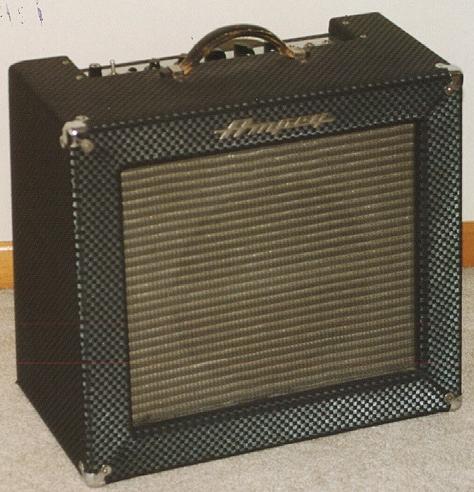
By 1961, only a handful of amplifier manufacturers had installed reverberation units in combo amps, most notably Ampeg, with their Reverb Rocket. Though none of these amplifiers had been rated at 100 watts up until now.
Leo then went on to create the Fender Reverb Unit, which was used by Dick Dale, the Beach Boys, and many other Surf band to get that exceptional reverberation sound. Dale also utilized an Echoplex.
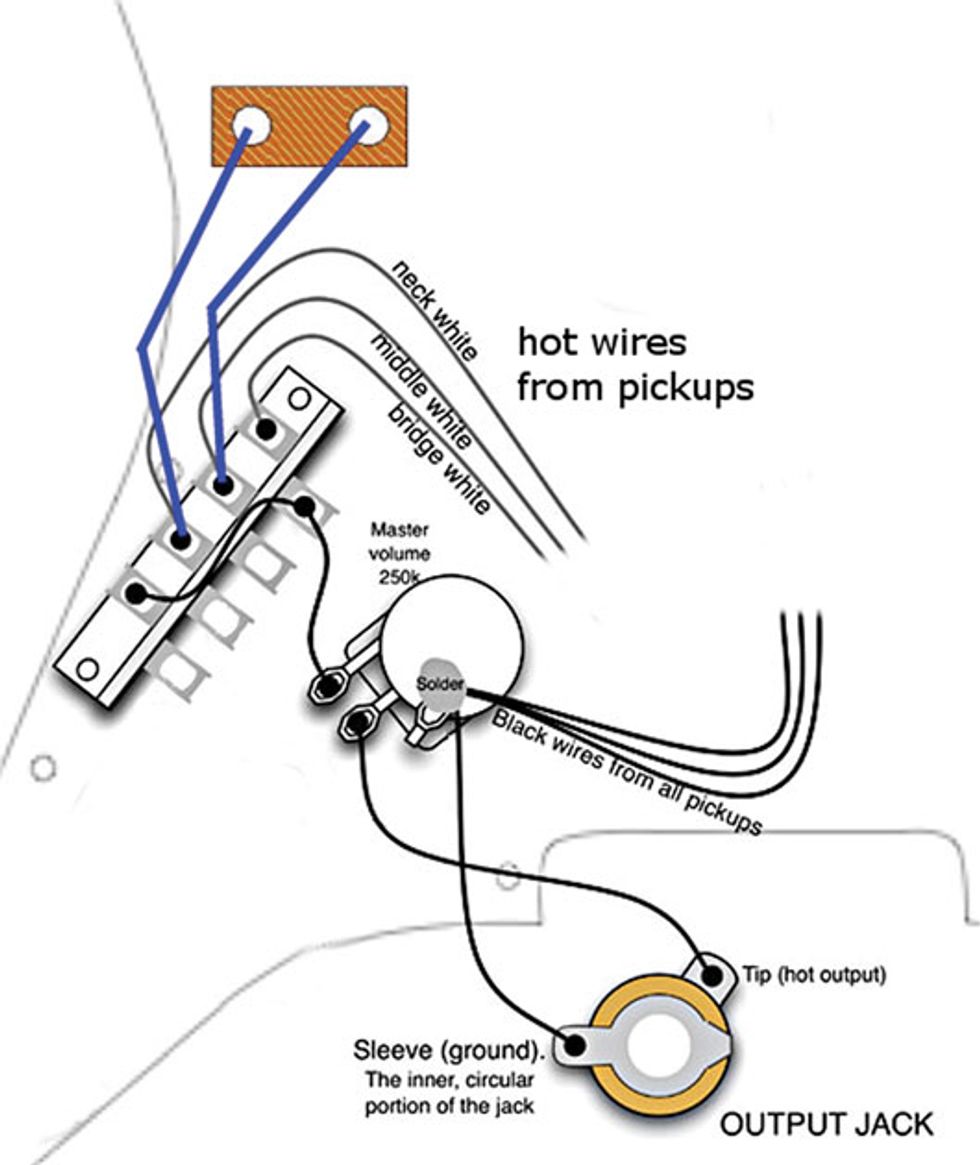
For instance, Dale’s Strat does not have any tone potentiometers. He removed both of them and replaced them with metal plugs. The guitar has only a 250k master volume pot. On Dale’s personal guitar, there is not even a volume knob, just has the end of the potentiometer sticking out.
Dales guitar has a 3-way pickup selector switch, just like on the original Stratocasters and he prefers it that way. Fender offered to update it with a five-way switch but Dick Dale declined. Instead he added a mini-toggle switch that turns the middle pickup off and on, so it can be used in combination with either of the other two pickups.
One would think that a Surf player would utilize the vibrato, but not Dick Dale. Though his guitar still has 5 springs on the back side holding the vibrato block (5 springs were standard on original Stratocasters) there is a wooden block wedged between the block and the guitars routed area to keep the block from moving.
Dick Dale’s Fender Stratocaster is a mid 1950’s model, which is odd as it has a rosewood slab fretboard. The body is finished in sparkle gold paint
The only other modifications include the addition of an America Flag sticker on the upper bout, a pick-holder/dispenser on the lower bout and a Kenpo karate sticker placed on the guitars body. This sticker is from the same organization that Elvis Presley was a part of and was founded by Senior Grand Master Ed Parker. Dick Dale has been a student of Karate for over 30 years.
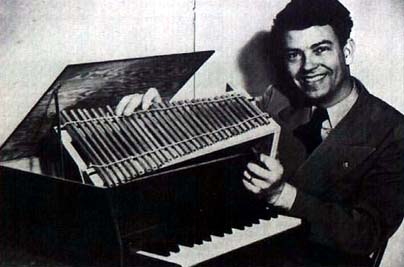
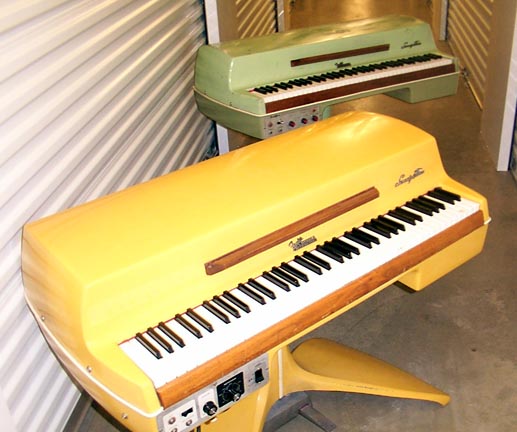
Around 1959 Leo Fender was interesting in adding a piano to his company’s inventory. He struck a deal with Harold Rhodes, who was a musician and inventor.
By now Leo Fender considered Dick Dale to be not just a guitarist, but the ultimate test machine. If he could give Dale a piece of equipment and let him use it in concerts, then Fender could see if it was worthy. Apparently, the Fender Rhodes Piano passed the test and though it never became a substitute for an acoustic piano, it became a studio and concert mainstay.
Another device that was tested by Dick Dale and his band was the Fender Contempo Organ. In the early and mid 1960’s, many bands were utilizing portable organs such as those manufactured by Farfisa, Vox, Maestro (Gibson), and a number of other companies.
A company called Pratt Read, was manufacturing parts for the Fender Rhodes piano and was asked by Fender if they could put together a combo organ.
The Fender Contempo was one of the sturdier of the portable organs of that era. This was another product that Fender gave to Dick Dale to test for road-worthiness.
Some time before 2010, Dick Dale ask Fender if they could build a signature acoustic guitar for him. He complained that most acoustic guitars are too deep and too wide, which causes cramps in his abdomen. In 2010 Fender came up with a full size acoustic-electric guitar that was only 3" deep and based on the Fender Malibu series guitar of the 1960's. This instrument had a solid mahogany top, back and sides. The neck was a reverse Stratocaster style with a rosewood fretboard that was set in to the heel and the guitar was painted cherry red. It had two pickguard for Mr. Dale's aggressive style playing.
Since Dick's son, Jimmy, often travels with him and is a part of his act playing guitar and drums, Fender also built a Jimmy Dale Kingman SCE model. This guitar is a full sized with an all mahogany body. The set-in maple Stratocaster-style neck without the reverse headstock. Both guitars are no longer offered.
A year later Dick and the band were featured in another movie called Muscle Beach. From the picture it appears that Dick Dale either had his Stratocaster painted gold sparkle and changed the pickguard from tortoise shell to white or perhaps he got a new Stratocaster.
Dick Dale has survived numerous health issues. He has recovered from rectal cancer and almost lost a leg to a terrible infection. He has endured radiation and chemotherapy and has come out on top.
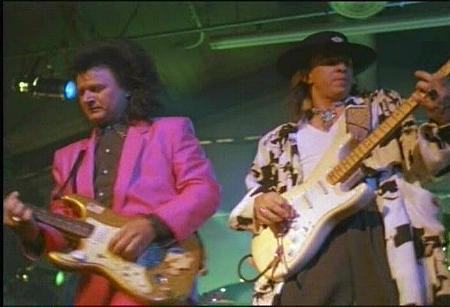
In 1987 he appeared in the movie Back to the Beach, once again playing Surf guitar. In 1993 he recorded the song Pipeline with Stevie Ray Vaughn and the following year Quentin Taratino used Dale’s version of the song Miserlou in the movie Pulp Fiction, which revived interest in Dick Dale’s career. At age 78 despite all his health issues Dick Dale is still playing concerts and putting on energetic live shows.
Like I said before, I really admire Dick Dale. Dick is a viable part of the history of the electric guitar and all the equipment that changed the face of rock music and he deserves recognition.
Dick Dale passed away this past Saturday, March 16th, at age 81. It is so sad that most people of his age are retired, but his medical condition was costing him up to $3,000 a month, and the only way to pay the bills was to continue touring. His contributions to the guitar, the amplifier, and music will not go unnoticed.
At around 13 years of age, the Guitar Bug bit me, and bit me hard. I started off practicing on a $20 pawn shop guitar, and decided not just to learn how to play the darn thing, but I wanted to know everything I could about guitars.
I lurked around music stores in my area, and bothered the salesmen. I called up music stores, and asked what they had in stock and how much their guitars cost. And I went to pawn shops.
At the time, most stores carried Fender, Gibson, Guild, Martin. A few sold Gretsch, and one store in town even carried Rickenbacker guitars. But none of the retail music stores carried those gorgeous sparkly, glittery, eye-catching guitars made from celluloid material. These were sold in pawn shops.
Welson certainly sounds like a British name, but the trade name actually belonged to an Italian accordion manufacturing firm founded by Signore Orlando Quagliardi back in the early 1920’s. Before the name Welson was used on guitars, it was used on accordions. Welson and Quagliardi accordions were manufactured by that company. Their accordions are no longer being manufactured, but used ones are available.
Quagliardi was one of a handful of Italian manufacturers based out of the town of Castelfidardo in Marches region of central eastern Italy, which is considered to be the international capital of accordion manufacturers. Quagliardi has the distinction of being one of the first accordion makers to enter the guitar market. They began building acoustic archtop guitars under the Welson brand in the mid 1950’s.
Around 1962, the guitar boom first started. There was going to be be a high demand for guitars, especially electric guitars, and the company was there to offer their products.
Welson, and other Italian builders, applied accordion manufacturing techniques to the electric guitars.
The 1962 through 1965, Welson solid body guitars came with four to six rocker switches similar to those found on an accordion. On an accordion the switches modified the reeds, and the color of the sound. On these Italian made electric guitars, the switches determined which pickups were on or off to color the sound. Many of these guitars came with four pickups.
On Welson guitars, the upper edge of the pickguard was bedecked with a metal Welson badge logo; a five point crown with the name Welson beneath it. These guitars had a bolt-on necks with a six-in-a-line headstock.
On early models the neck was painted black. Later models had bare necks. The neck and headstock were usually bound. There was no logo on the earlier headstocks.
Instead of leaving the end of the neck flat, as on Fender guitars, Welson luthiers carved out an elliptical pocket at the top of the body for the neck to fit into. It was then bolted in place. These guitars generally used open back machine heads with plastic buttons. Some of these were sold in the United States under the Beltone brand name.
Around 1964 the design changed to mostly sunburst finishes on their solid body guitars. The necks were no longer painted, and the machine heads were of a better quality. The badge logos were now only the five pointed crown, or sometimes were no longer added. At other times they were embedded into the metal section of the scratch guard.
During the latter part of the 1960's, the company also began to offer some hollow body instruments, both for guitar and bass guitars. These instruments featured rotary potentiometers for volume and tone, and Switchcraft-style single or double throw switches to control the pickup selection, instead of the rocker style on/off switches.
These instruments were known as the DS series, and included the DS-2. This guitar came with twin single coil pickups, a vibrato tailpiece, two volume, and two tone controls, and a three way pickup selector. The bolt-on neck was maple, with two mahogany stripes, along with a volute. The neck was topped with an ebony fretboard with box mother of pearl position markers. The bound headstock was a three-on-a-side style with the logo Welson inlaid at it’s top.
Later models had more features such as the DS-3, with three single coil pickups, and some further controls. One on the upper bout was a two way rotary knob that allowed for “All” or “Jazz Tones”. Beneath this were two more potentiomers, reminiscent of a Fender Jaguar. On the lower section, another rotary knob was labeled “Wild” or “Solo”. The rotary knob pickup selector appears to be a three way dial and was located on the lower cutaway.
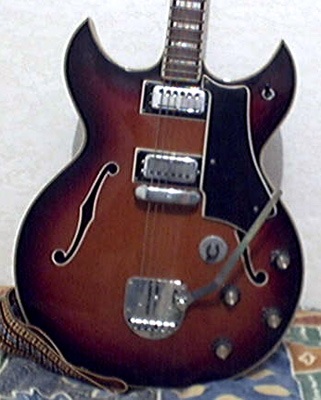
These Welson models also included the DC-12, 12 string, non-vibrato double cutaway model based on the ES-335. This guitar featured a bound neck with an ebony fretboard, an adjustable bridge saddle, and a trapeze tailpiece.
During these days, some American companies looking to cash in on the guitar boon took note. The Wurlitzer Piano and Organ Company contracted with Welson to build a couple of models to be sold under the Wurlitzer brand. These included the Wurlitzer model 7741 guitar, in the 335 style.
The Wurlitzer 7741 was a Welson model D2, re-badged with Wurlitzer’s logo. The guitar had two double coil pickups, a three position switch that went from Solo to Sharp to Wild, and a vibrato tailpiece.
The Wurlitzer model 7780 was a bass version of this instrument, with double coil pickups, and a large metal cover with an embossed “W” that went over the tail piece. Both of these Wurlitzer models come with bolted on necks.
A German audio company, Dynacord, sold re-branded Welson guitars from 1966 through 1967. They sold several models including the three pickup Dynacord DC3. This was another 335 style body, which had 3 single throw switches on its upper cutaway horn. Each pickup had a volume, and tone control. The guitar came with a vibrato tailpiece.
But the most unusual Welson model that Dynacord offered was called The Cora. This was a three pickup guitar, with not much of a body at all. In fact it was called an “open body” guitar. The center of the guitar was the body, and it had metal bars jutting from it, that formed a guitar shape. A most interesting instrument indeed, and ahead of its time.
The Vox Company, better known for its amplifiers, got into the guitar business around 1964. Very few of their guitars were manufactured in the U,K., and those were built by a furniture manufacturer.
The Vox solid body guitars were mostly built by EKO, another Italian guitar factory. Most of the other electric acoustic, and semi-acoustic guitars were built by another Italian manufacturer called Crucianelli.
Welson built a rather odd series of guitars that combined the older push button and roller potentiometer controls, but this time on a semi-hollow electric guitar. These were sold under the Welson brand, but they produced one to be sold by Vox, and another that was sold under the Kinton brand name.
The top of the line Welson thinline acoutic electric model was called the Golden Arrow. This was advertised as a stereo guitar, but came with a monaural output. It was loaded with features, and gold plated hardware.
Welson also made a few semi-acoustic electric guitars and a bass with Florentine cutaways. These are quite rare instruments. The were made during 1967-1968.
A slightly different version of this guitar was marketed under the Dynacord brand. A bass guitar in this same style was also sold by Dynacord, but manufactured by Welson.
Welson also made a few single cutaway Jazz style guitars. Notably these were the model M-62, and M-63.
A jazz style guitar was made for the Wurlitzer company. This was the sunburst deep bodied, twin pickup model 7730. The same guitar was available in a cherry-burst finish called the model 7731. Though it appears to have a set neck, the neck is actually a bolt-on style.
By the end of the 1960's, the agreement with Wurlitzer to build guitars had concluded. Importer, Maurice Lipsky of New York, acquired the rights to the Orpheum brand name. Orpheum was a defunct 19th century banjo company. Lipsky wanted to import cheap guitars to the United States under this brand. Lipsky already had agreements with several other companies, but he wanted violin shaped guitars and basses.
After 1972, the company quit making guitars and accordions, then concentrated their efforts on making organs, and compact keyboards. They went out of business in 1981.