At the time McGee was on tour and apparently suffered a heart attack on stage. After being hospitalized he went into a coma, and passed away four days later.
It had been two years since McGee had played in Japan with The Ventures. His participation in that tour was cut short due to his health issues.
During McGee's tenure with the band, he recorded three of their biggest hits in Japan, including “Ame No Midosuji”, “Kyoto No Koi” and “Kyoto Bojo.” The Ventures have a huge following in Japan.
Gerry McGee toured with The Ventures for three years. sometimes playing guitar, and sometimes playing bass. He rejoined the band in the 1984 until he was forced to step away two years ago due to health issues.
McGee recorded with a long list of artists that included Elvis Presley, The Everly Brothers, Eric Clapton, John Mayall, Kris Kristoferson, Delaney and Bonnie, Ricky Nelson, and The Monkees.
In the late 1980’s and throughout the 1990’s I worked the second shift. Upon leaving work at midnight and driving home I listened to a radio show called ‘The Truckin’ Bozo’ hosted by Dale Sommers. Between songs, truck drivers from all over the nation would call him, with news about the highways, and sometimes just to share their funny stories.
Bozo's show also played the Country Music hit songs of the day.
This show is where I was introduced to more contemporary Country acts. Garth Brooks was just coming on the scene in those days. His music hearkened back to those former days of Country Music. The lyrics were great, the music was great, and Garth's voice was pure Country.
’Friends In Low Places’ thumbed it’s nose at high society. ‘If Tomorrow Never Comes’, let us know to express I love you, to those you love, because we have no guarantee of tomorrow. ‘The Thunder Rolls’ was a modern take on the age old theme in Country music of a cheating spouse.
Brooks was a fresh face on the music scene, and his concerts were like a circus. He was energetic, and ran all over the stage, sometimes even flying over the audience.
Garth eschewed the traditional Martin guitar, instead using a Japanese model made by Takamine. Takamine had been in business for many years, and they had perfected a piezo pickup, so the acoustic guitar sound came through loud and clear, thanks to the instrument’s built-in preamplifier.
By this era, there was no need for a cable going to an amplifier since radio controlled units gave the performers more freedom.
Eventually the Takamine Company created a ‘Garth Brooks’ model. The sound hole on this guitar resembled the shape of the cutaway on the guitars body. Brooks gave one of these guitars that he had been playing, at each concert to a lucky fan.
Although other artists were using Takamine guitars before Garth Brooks hit the scene, Brooks is probably responsible for some of Takamine guitars popularity with Country artists.
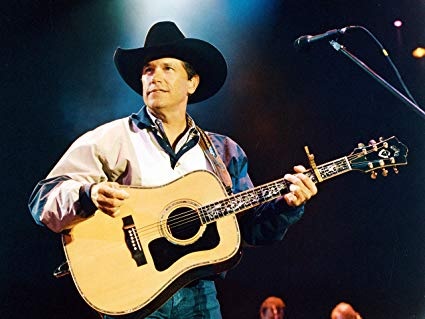
George Strait was another popular Country star. Though his shows were far less outrageous than Brooks act, Strait brought traditional Country Music into the 1980’s and ‘90’s, and even into the current decade. His music eschews ‘Modern Country’ and his songs and recordings hearken back to days when Country Music was not Rock that was packaged up as Country Music. Perhaps that accounted for his outstanding record sales and many Grammy awards.
Alan Jackson came on the Country Music scene during the 1990’s. Jackson is one of the best selling artists of all time, and is beloved by Country Music fans for his anthem ‘Don’t Rock The Jukebox’.
He is another artist that endorses Taylor guitars, and he plays a custom built Taylor guitar that is based on their model 610e.
Jackson's guitar has AAA rated maple back and sides, and a Sitka spruce top. It has an inlay of a Blue Marlin on the 12th fret. It has a built in Fishman Matrix under bridge pickup with a Baggs pre-amplifier.
Vince Gill started his career playing guitar, and singing with the rock group Pure Prairie League. Their original lead singer, Craig Fuller, had left the band. That is Gill's voice you hear on 'Let Me Love You Tonight'.
His favorite Martin is a 1942 D-28 Herringbone. He owns several other Martins including a 1971 D-41, and two 1928 000-45's, and two 1936 000-28's. He owns a 1953 white Fender Telecaster, and several 1950's black pickguard Telecasters.
He also owns 8 vintage Fender Stratocasters, and a 1959 sunburst Les Paul.
There are several woman Country singers, but few play guitar. Emmylou Harris got her start playing guitar alongside Gram Parsons. She had her roots in Folk Music, but transitioned nicely into Country. Once she was discovered by producer Brian Ahern, she was encouraged to put together her 'Hot Band' for tours.
The talent in that band was incredible, and as members got other opportunities, they were replaced.
Emmylou Harris has recorded so many great albums, songs, and has recorded with a cornucopia of well known artists, that include Rodney Crowell, Dolly Parton, and Linda Ronstadt.
Harris was best known for using her black Gibson J-200. This guitar was modified by luthier Danny Ferrington, with and updated 'mustache bridge', and inlaid an image of a rose on the guitars top, which became her trademark.
While other Country artists depend on Fender, or Peavey amplifiers, Brad Paisley uses amplifiers made by Dr. Z (Mike Zaite).
Marty Stuart is another Country artists, and multi-instrumentalist that has not swayed from his Country roots. His band, 'The Fabulous Superlatives', reminds me of Buck Owens band, 'The Buckaroos'.
Marty is another guitar collector. His main electric guitar once belonged to Gene Parsons, and contains the original Parson/White string bender.
The 1954 Telecaster actually has two bodies, that are back to back, to maintain the inner workings of the bender. The headstock has two Keith banjo tuners on the E-strings.
Though there are some other Country artists and guitarists that still play Country Music, but they seldom get any air play on 'Country Music' radio stations.
Modern Country artists, such as Brooks and Dunn, Kenny Chesney, Blake Shelton, Luke Bryan, and others in my opinion no longer fall into the Country Music mode of 'Three Chords, and the Truth'. While they are very talented, put on wonderful shows, and have a large fan base, their recordings are full of production tricks, such as digital auto-harmonization, pitch correction, over compression, and distorted guitars. I am not sure Hank done it that way.
For Country Music, one of the results of World War Two was the massive increase in listeners. Radio transcripts of all types of broadcasts were delivered to the European and Pacific fronts for the morale of those fighting the war.
My own father, who was stationed near the southern German border was exposed to ‘Hillbilly’ music from his troop members from Kentucky, and listening to broadcast transcriptions from WSM.
By the time the war ended, Nashville was fast becoming a Mecca for Country artists. Owen Bradley, who was a music arranger, and songwriter for Decca Records was already recording music with some great artists, such as Ernest Tubb, Burl Ives, Kitty Wells, and Red Foley.
To add a second studio, he purchased a semi-circular aluminum structure called a Quonset hut.
These were temporary buildings used during the war, and were being sold as war surplus. This structure abutted the original building and the endeavor became know as Quonset Hut Studios. Late in 1956, major Country artists came here to record their songs.
But it was Owen Bradly that is credited for creating what came to be known as ‘The Nashville Sound’ by adding lush string arrangements, and choral parts to Country Music songs.
Patsy Cline, Brenda Lee, Kitty Wells, Loretta Lynn, Faron Young, Eddie Arnold, Conway Twitty, and many others recorded music at Bradley’s studio.
Much of the music recorded there became hit songs that crossed over from Country to Popular music.
Bradley, figuring he was on to something, even tried to update some Jimmy Rodgers songs played by Moon Mullican, and songs by Bill Monroe to include the Nashville Sound.
Both his studio, and RCA employed some of Nashville’s greatest guitarists at the time as ‘session musicians’. In Nashville those session players were known as The A Team, long before the TV Show came out.
The A Team guitar section included Chet Atkins, Grady Martin, Hank Garland, Ray Edenton (also mandolin, ukulele, and banjo), Harold Bradley, Velma Williams Smith, Paul Yandell, Pete Wade, Jerry Kennedy, Norman Blake, Jimmy Capps, Spider Wilson, Fred Carter, Jr., Billy Sanford, Wayne Moss, Jimmy Colvard, and Chip Young.
He was especially known for adding the 'tic-tac' bass line to songs by using a Danelectro six string bass guitar. Harold Bradley went on to develop RCA's studio B.
Hank Garland, was a prolific guitarist who played on thousands of recordings. He was a star and a well known recording artist in his own right. Garland wrote and recorded the popular ‘Sugarfoot Rag’, and played guitar on literally thousands of sessions backing other artists.
Garland is probably best known for his Gibson Byrdland model guitar, that was co-designed with Country guitar player Billy Byrd. It was the first thinline model produced by Gibson, and by request it featured a 23 i/2" short scale and narrow neck, that was only 1 5/8" at the nut. Hank's original model #2 came with two P-90 pickups.
He then ordered the #3 model with a cherry finish, and a Charlie Christian pickup in the neck position. Because of the scale being almost 2" shorter than the standard L-5, the Byrdland's only had 20 frets.
Garland played a variety of guitars that were mostly manufactured by Gibson. These included the 1940's Epiphone Xpher with 'Sugarfoot' inscribed on the pickguard.
His career was tragically cut short in 1961 following a car accident.
Garland played through a Standel amp, and an Echosonic amplifier made by Ray Butts. You can hear Hank on Patsy Cline's recording, 'Walking, After Midnight'. That is Hank Garland's guitar you hear every Christmas on 'Jingle Bell Rock'.
Chet Atkins was already famous for his thumb picking style of guitar playing. As mentioned after he was signed to record at RCA, and was promoted by Steve Shoales to manage the studio. Chet can be heard on records by The Everly Brothers, Don Gibson, Jim Reeves, Porter Wagoner, Hank Snow, Kenny Price, and many other recordings.
Chet also used an unusual guitar that was put together by his friend Paul Yandell. This was called 'The Peaver'. It was a Peavey T-60 body, with a Fender Stratocaster neck. The guitar has two EMG single coil pickups that were wired to a phase switch. The pickups were placed strategically in the middle and bridge positions. This was done because on a traditional Stratocaster, the neck pickup is placed in a section that makes it virtually impossible to get a harmonic note. Atkins used this guitar only on a few songs.
Gibson Phasor
Gibson built him a similar guitar they called The Phasor. He owned one of the first Echosonic amplifiers. Later on he used Standel amps with an Echoplex, and much later relied on MusicMan amps with a digital echo unit. In the 1960's he worked with Gretsch to design some amplifiers.
There was a faulty tube in the mixing console, that caused the part he was playing to be distorted. The producer liked the effect, and recording engineer Glenn Snoddy, back traced what had happened and went on to design the Maestro Fuzztone.
He played a borrowed Martin on 'El Paso' and did the guitar fills in one take. Martin used a Gibson ES-345, and a Gibson ES-345 12 string on some recordings. Grady Martin played recordings and concerts backing artists from Ernest Tubb to John Prine.
Paul Yandell went on to be Chet Atkins accompanist in concerts and television appearances. He started out by backing The Louvin Brothers in concerts, the went on to play guitar for Kitty Wells, and back up Jerry Reed. He worked for Chet Atkins from 1975 until Chet passed away in 2001.
He favored the same Gretsch guitars that Chet was using. However when Gretsch went out of business, both he and Chet played Gibson's Country Gentleman versions. Paul was also instrumental in aiding Gretsch when they started building guitars again.
Jim Colvard had over 140 recordings that he was credited as being the guitarist. He was one of the first guitarists to play steel guitar lick on his six string guitar.
It was during these days that Country Music became more ‘Pop’ music. The music coming out of Nashville now gained the reputation of being ‘Countrypolitan’.
Not only did songs cross over to popular format radio, but some popular artists of the day came to Nashville to record. These included Elvis, Perry Como, The Everly Brothers, Bob Dylan, Roy Orbison, Joan Baez, Gordon Lightfoot, Neil Young, Linda Ronstadt, and Paul McCartney.
Willie Nelson wrote so many hit songs that were sung by other artists, such as Crazy for Patsy Cline, Pretty Papers for Roy Orbison, Hello Walls for Faron Young, to name but a few. He tried desperately to fit in as a Nashville entertainer. Nelson dressed in Cowboy clothing, and combed his hair the right way. But Nelson realized he was never going to be the new Ernest Tubb.
He packed up, shook the dust off, and headed to Austin, where he was embraced, and became an extremely popular entertainer. Nelson started off playing a Martin 000-28. He later struck up a deal with the up-and-coming Baldwin Piano Company, who just got into the guitar business.
He started using a Baldwin Vibraslim electric guitar. Later on the company gave him a Baldwin Classical electric guitar, model 801CP, that was actually made by The Harmony Company. It had a unique piezo pickup that was called a Prismatone. They also gave him a Baldwin C-1 amplifier. This amplifier was unique since Bud Ross, the creator of Kustom amps, sold his solid state design to Baldwin. At a show, Willie Nelson set his guitar flat on the floor. Some drunk guy, that was anxious to meet him walked up on stage and stepped on the guitar, crushing it's body.
Willie took the broken instrument to Shot Jackson's music store. Jackson determined the guitar was beyond repair. He had a Martin N-20 in his shop, and discovered the Prismatone pickup would fit in the Martin.
Willie has beat this guitar to hell and back, but continues to use it. He named it 'Trigger' after Roy Roger's horse. Though he could afford a much better amplifier, he has used that Baldwin C-1 amp throughout his career.
But the Nashville Sound just did not fit his style. Kristofferson is usually seen playing a Gibson SJ (Southern Jumbo) guitar. He also sometimes plays a Martin D-28.
Waylon Jennings wrote music, and recorded in Texas at Norm Pettys’ studio. The same place where Buddy Holly got his start. Jennings famously played bass in Holly’s traveling band, after the split with The Crickets. He gave up his seat on Holly’s ill-fated flight. Waylon eventually moved to Nashville, and much like Willie, and Kris, he just did not fit in with The Nashville Sound.
Like Holly, Waylon started out playing a 1956 Fender Stratocaster. But Waylon Jennings is best know for playing a Fender Telecaster that is wrapped in a leather covering. He had more than one Telecaster.
Down the street from RCA’s studio B, and Quonet Hut, Tompall Glaser purchased a two story stucco building, that author Shel Silverstein dubbed ‘Hillbilly Central’. Tompall had been in a band called 'The Glaser Brothers'. Artists that desired for Country Music to return to its roots, began to flock to record their music at this small studio where clocks and budgets did not matter. The goal to record great music.
Kristofferson, Mickey Newbury, Billy Joe Shaver, Jimmy Buffet, John Hartford, and others began recording at this studio. Because these musicians broke out of the Nashville Sound mold, and because some had even been released from contracts with RCA, and Decca, Glaser’s secretary, Hazel Smith dubbed them as The Outlaws.
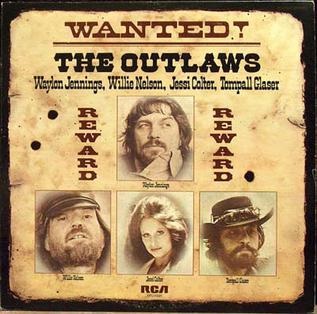
Perhaps the most notable recording from this era was the album, ‘Wanted! The Outlaws’ that featured a wanted poster as a front cover that featured pictures of Waylon Jennings, Willie Nelson, Jessi Colter, and Tompall Glaser performing some of their own songs, and many songs written by others.
They later added Johnny Cash and put together a band, calling themselves The Highwaymen after one of the songs from the original record.
Despite taking the Nashville music industry by shock, the masters were sent to RCA for distribution.
It became the first Country Music album in history to reach platinum certification for selling over a million units. And this once again changed Country Music.