Wednesday, March 31, 2021

All The Vocal Groups From Television, Cartoons, Radio, Movies, And Film - THE UNIQUE VOCAL MUSIC BLOG


This is not my church choir
but they look quite nice
I was always fascinated with music since my childhood. This was especially true with vocal music long before I learned to play guitar. I joined the children’s choir at my church. We had a great vocal music program in the school I attended. I later joined a church choir, and even took voice lessons. 

This is why as of today I am changing this blog’s theme to:

  THE UNIQUE VOCAL MUSIC BLOG 

I find that participation in a vocal music group can be fun, and a comfort to those that don’t want to stand out in the crowd. It is also wonderful to join in the blending of voices by harmonization. 

The TM Studios Jingle Singers 
Throughout my life I always wondered about those amazing folks that sang the vocals for movies, television themes, and even commercials. And what about those short little jingles that reminded us which radio or television station we were listening to.

I found out in the United States there were only a handful of professional choral groups that were hired for this purpose. 

Perhaps the most famous, and most heard were The Ron Hinklin Singers.

The Ron Hinklin Singers
The Ron Hicklin Singers were a group of Los Angeles studio singers contracted and organized by, who else but Ron Hicklin! In Los Angeles studio circles in the 1960s through 1980s,  

They were the vocal equivalent of and they often worked with  the Los Angeles session instrumentalists known as The Wrecking Crew, by performing backup vocals on thousands of songs, TV and movie themes, and as lead (while remaining anonymous) singers on thousands of radio and television commercials. 

The Core Group usually consisted of Ron Hicklin, lead tenor, Tom Bahler, tenor, John Bahler, tenor, Jackie Ward, alto, Sally Stevens, soprano, Gene Morford, bass. 


Thurl Ravenscroft
However, this core group was often augmented with other specialist vocalists such as the deep bass voice of Thurl Ravenscroft, who provided the voice of Kellogg's Tony the Tiger of Frosted Flakes cereal for 50 years, and the vocalist for "You're A Mean One, Mr. Grinch"!). Also Mitch Gordon, Jim Haas, Andra Willis, and Linda Dangcil. 

Butch Cassidy And The Sundance Kid 
This group performed themes for many major motion pictures in the 1960s, 1970s, and 1980s. These included the song South American Getaway, written by Burt Bacharach for Butch Cassidy and the Sundance Kid, Dear Old Dad, for the movie Death Game, 

They also sang a song called Savior Like a Shepherd Lead Us written by William Batchelder Bradbury for the movie Mosquito Coast and the music for Rosemary’s Baby. 

Flipper the TV Show
The Ron Hinklin Singers also sang the theme songs for such major TV shows as Love, American Style, with lead vocalist John Bahler, Batman, Flipper, That Girl, Happy Days, for which Hicklin himself sang lead, Laverne & Shirley, along with lead vocalist Cyndi Grecco, Wonder Woman, with John Bahler singing lead, and Angie, along with lead vocalist Maureen McGovern. 

They also sang many commercial vocals, including campaigns for Kawasaki ("Kawasaki, let the good times roll"), Datsun ("Drive a Datsun, then Decide") and the McDonald's commercial ("You Deserve a Break Today"). 

I am sure you have heard many, many radio and television jingle such as “1360 WSAI” or whatever station you listened to. That was the Ron Hinklin Singers doing those short jingle packages for the last four decades. 


The group also sang on recordings that were credited to such artists as The Brady Kids aka The Brady Bunch, Cher ("Dark Lady"), the band Climax featuring Sonny Geraci. They were featured on recording attributed to The Ray Conniff Singers, The Percy Faith Orchestra and Chorus, The Anita Kerr Singers Jackie Ward sang alto on the group's Dot Records recordings which were usually done in Nashville. 

They also provided backing vocals for Gary Lewis & the Playboys, Mark Lindsay ("Arizona"), The Henry Mancini Orchestra and Chorus, The Monkees ("I'm a Believer"). 

The Partridge Family

Except for Shirley Jones, and David Cassidy, the Ron Hinklin Singer were essentially the voice on The Partridge Family songs. 

They backed up Gary Puckett & The Union Gap. Paul Revere & the Raiders, Ringo Starr ("Oh My My"), even Gene Vincent and His Blue Caps on the 1959 Crazy Times album. 

Without the entire group, The Bahler Brothers can be heard performing tenor harmonies on: Hugo Montenegro's The Good, the Bad and the Ugly theme. Jimmy Webb’s "MacArthur Park", "Suicide Is Painless", Johnny Mandel's theme to the 1970 film M*A*S*H. Member Jackie Ward also had a hit on her own as Robin Ward with the 1963 hit "Wonderful Summer". 

Hoyt Curtin
Of course those of us that are my age grew up watching cartoon shows produced by Hanna-Barbera, such as Huckleberry Hound, Quick Draw McGraw, Yogi Bear, The Flintstones, The Jetsons, and many others. These theme songs were written by one man named Hoyt Curtin, who had been previously employed writing music for companies, and trade show. The vocal ensemble hired to perform was The Randy Van Horne Singers. 


Randy Van Horne Singers
Randy Van Horne's career began in the late 1940s as a Los Angeles studio musician. He formed his first musical group, the Encores, in the early 1950s with three other musicians. After The Encores broke up in the late 1950s he went on to create the Randy Van Horne Singers. The group was known for its easy style of music and remained predominantly a studio musical group. 

However, the Randy Van Horne Singers did make occasional television performances, such as on The Nat King Cole Show in 1957. 


The group became most famous for recording the theme songs for several high-profile Hanna-Barbera cartoons when they were hired by Hanna-Barbera's music composer, Hoyt Curtin, to complete the theme songs. 


Aside from this the group also continued to record for commercials and radio station spots and jingles. Many of the jingles were actually written by Randy Van Horne. 

The Randy Van Horne Singers
The Randy Van Horne Singers officially disbanded in the early 1970s but Van Horne reunited the group after 2000 with many of the original members. They are currently led by Alan Wilson since 2018. 


The Anita Kerr Singers or The Jordanaires sang background on just about every Nashville hit in the late 1950s and early 1960s. The group contributed backup vocals on Patsy Cline's first studio album. 


A few years later, Kerr and her singers performed five times a week with Jim Reeves on his national radio program at WSM. The quartet's roster at this time featured tenor Gil Wright, baritone Louis Nunley, alto Dottie Dillard, and Kerr herself as both soprano and arranger. Singers and arranger soon began hiring the group to contribute to between twelve and eighteen recording sessions weekly. 

The Anita Kerr singer  backed Faron Young, Chet Atkins, and Webb Pierce on SESAC radio transcription sessions,. They were invited to record their own songs for SESAC. Between 1959 and 1963, the group recorded sixty SESAC tracks. 

In 1960, under the pseudonym "The Little Dippers," they recorded a hit single, "Forever", for the University label. Crediting herself as "Anita & Th' So-And-So's," 

Kerr multi-tracked her own voice to record the song Joey Baby, in 1961.  The Anita Kerr Singers continued to perform as backup singers in Nashville and can be heard on songs by Hank Snow, Brenda Lee, Perry Como, Pat Boone, Rosemary Clooney, Bobby Vinton, Roy Orbison, Willie Nelson, Floyd Cramer, Al Hirt, Ann-Margret, and many other artists. 

Under her RCA contract, Kerr also arranged and produced a series of albums for The Living Voices on the RCA Camden budget label. These Living Voices recordings included the Anita Kerr Quartet, with the addition of 4 other vocalists to form an octet. 

In 1964, together with Chet Atkins, Bobby Bare and Jim Reeves, the Anita Kerr Singers toured Europe. In the 1960s, Kerr composed and recorded numerous jingles for use by various American radio stations, including: Gene Autry's KMPC AM-710 in Los Angeles, California; WMCA AM-770 in New York City; WLS AM-890 in Chicago and at WGH AM-1310 in Newport News, Virginia.

After divorcing, Anita Kerr disbanded the Nashville version of her Anita Kerr Singers and relocated to Los Angeles. 

So there you go! And I hope you have by now realized that today is April the First.  

On April 2nd I will return to more guitar stories as The Unique Guitar Blog.

Click on the links under the pictures for sources and further information.


Sunday, March 21, 2021

Henry Goldrich, Owner Of Manny's Music, Passes Away at 88


Manny's Music
When I was 16 years old our high school band took a trip to New York City. We were scheduled to visit famous landmarks in the city, but my friends and I had only one landmark in mind to visit:  Manny’s Music. 

We got in a little trouble, but it was worth it to visit the most well known music store in the city. In our minds it was better than a trip to Disneyland. I still have an old fuzztone that I bought from the store during that visit. One thing that stood out on that day was the prices for guitars were less than what the Cincinnati music stores were asking. It was a most memorable day

Manny Goldrich opened the store in 1935 on 48th street. The location was close to Broadway theaters, recording studios, 52nd street jazz clubs, music publishing firms, and even the Brill Building. Goldrich thought this would be an excellent location to sell music and musical instruments. And he was right. 

Manny passed away in 1968, but he had groomed his son Henry Goldrich to take over the business.  Henry had grown up at the store. After a stint in the Army during the Korean War, Henry returned to work at Manny's, then took over the business. 


Henry became know as the “Gear Guru to Rock Stars”. He passed away a few weeks ago on February 16th, at age 88. When asked what instrument he played, he said, “I play the cash register.” Henry Goldrich may not have played guitar or bass, but he certainly played an important role in rock by connecting famous musicians with cutting-edge equipment. 


Henry Goldrich 
“To these guys, Henry was the superstar,” his son Judd said. “He was the first guy to get gear they had never seen before.” Manny’s Music attracted many, many famous musicians who purchased guitars, amplifiers, keyboards, and other related equipment. 


Mr. Goldrich was in the good graces of all of the top manufacturers and distributors of guitars and music equipment, and always stocked his shop with the latest cutting edge gear. 

And though many artists would be provided with gear straight from manufacturers, artists preferred to go to Manny’s. 

His customer included Jimi Hendrix and Eric Clapton. When Vox introduced the Wah-Wah pedal it was Mr. Goldrich who recommended that they purchase one. The same held true for Fuzztones, and other devices. 

Henry’s son, Ian Goldrich said that Hendrix would by scores of guitars of guitars and gear, and have Manny’s techs set them up. 


John Sebastian at Manny's
John Sebastian, founder of the Lovin’ Spoonful, recalled in an interview how Mr. Goldrich, in the mid-1960s, helped him select the Gibson J-45 that he used on early Spoonful recordings like “Do You Believe in Magic?” 


Goldrich sold James Taylor  Martin guitar early in Mr. Taylor’s career. 

Sting purchased the Fender Stratocaster from Goldrich to compose “Message in a Bottle” and many other hits for the Police. 

David Gilmour's Stratocaster
In 1970, Mr. Goldrich sold the Pink Floyd guitarist David Gilmour the 1969 black Stratocaster that he played on many of the band’s seminal recordings. That guitar sold at auction in 2019 for a record $3,975,000.
 

Pete Townshend of the Who would order expensive electric guitars by the dozens from Mr. Goldrich, who was not happy when he heard about Mr. Townshend’s penchant for destroying his guitars onstage for theatrical effect. “It was good business,” Ian Goldrich said, “but my father was annoyed that Pete was breaking all the guitars he was selling him.”.


Richie Havens, Oscar Brandt,
and Henry Goldrich
50th Anniversary of Manny's
Though the rock stars that were his customer often wore wild clothing, Goodrich always dressed conventionally in a sport coat and kept a blunt demeanor that put his customers at ease. His son said, “He had a gruff personality; he treated them all the same. He’d tell Bob Dylan, ‘Sit in the back and I’ll be with you in a minute.’” 

In 1985, on the busiest day of the year, Black Friday, the store was packed when Mick Jagger and David Bowie walked in to shop. This halted sales from excited customers. An unhappy Goldrich asked them what they were doing there today of all days. 

He sold Mick and David what they wanted and quickly sent them on their way. 

Guns N’ Roses wanted to shoot part of a music video at the store. Goldrich allowed it, but said he was not shutting down the store. 

Harry Chapin - Taxi
Henry Goldrich adviced Harry Chapin that his song, “Taxi” was nice but too long and it would never be a hit. 

Paul Simon bought his first guitar at Manny’s, Goldrich told him Simon and Garfunkle was a lousy name for their act. But he also gave some great advice to new and upcoming musicians and groups, to not squander their new found wealth because their fame may not last forever. 


Henry Goldrich became close friends with many musicians, Mr. Goldrich once described selling the violinist Itzhak Perlman an electric violin. When Mr. Perlman tried bargaining, Mr. Goldrich parried by asking if he ever reduced his performance fee. “He said, ‘It’s different, I’m a talent,’” Mr. Goldrich recalled. “I said, ‘I’m a talent in my own way, too.’” 


Then there was the store’s Wall of Fame, which includes thousands of autographed publicity photos of famous customers that constituted a Who’s Who of popular music. These were placed along the walls of the store. Many of them were inscribed to Mr. Goldrich.  


He had to stop his employees from stacking merchandise in front of them. 

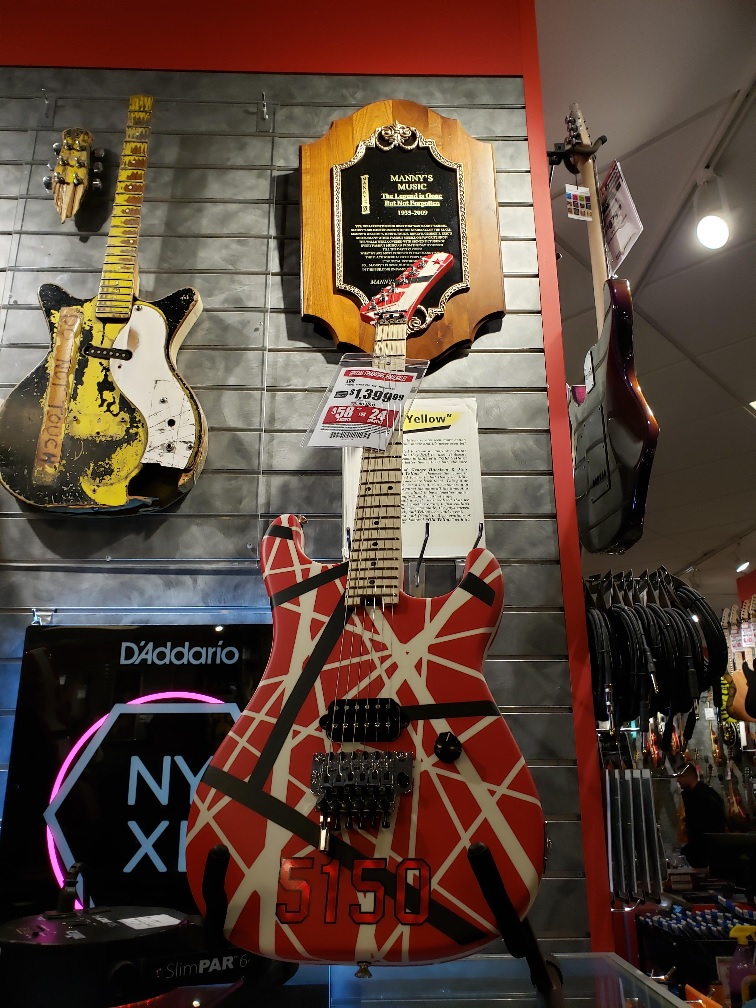
Old Yellow
Henry routinely purchased used instruments for resale, and on this day someone brought in a full set of instruments repainted with new, bright colors. Among them was an unremarkable Danelectro guitar that had been painted bright yellow.  His son Ian recalls “It wasn’t a factory color, in fact now that the guitar has aged, you can see it probably came from the factory as black. It had one lipstick pickup in it, all stock parts, just the color was different." The other repainted instruments were eventually sold, but “the yellow guitar” hung around the store. 

Goldrich was well-known for his strict policy of forbidding customers to try out new guitars unless they were serious about buying them. Henry’s “show us your money” approach was fair enough; no shopkeeper wants his wares damaged pre-sale. 

Old Yellow On Display
But where did that leave customers looking to test out new amplifiers or effects pedals, who actually needed a guitar to play. Henry realized Old Yellow was a good-playing guitar, and paid nothing for it  and wasn't going to sell it. So when somebody wanted to try out an effects pedal or an amplifier he wouldn’t let you pull down a new Strat out of the showcase; he said ‘Here, this is the tryout guitar.’ It didn’t matter if you were some kid from Cincinnati or Joe Walsh from The Eagles: if you were in the market for a new amp or effects unit or amp, you played Old Yellow. 

It is currently in a display at Sam Ash Music in NYC.

The guitar passed through countless famous (and not-so-famous) hands over the ensuing decades. Ian Goldrich stated “Everybody who played it said it played really well,”  “My father tells the story of George Harrison, Paul McCartney, Bob Dylan and John Sebastian sitting in the back of the store so it’s got to be in the mid-70s or something like that, and they’re all passing this guitar around when George offered my father $200 to buy it. And my father turned him down!” 

Eventually, however, “Old Yellow” met an abrupt end of sorts. “It fell off a guitar stand and the headstock broke off,” Ian says. “That was the end of that.” Despite being damaged beyond repair, the guitar remained in a glass display through the ‘80s and ‘90s as a totem of years past. Currently Old Yellow resides at Sam Ash Music on 34th street in New York City.

Manny's closed in 2009

In 1999, Mr. Goldrich sold Manny’s to Sam Ash Music, a rival store, which largely retained the staff until Manny’s closed in 2009, as Music Row began to disappear.  


Guitarist and collector extraordinaire, Joe Bonamassa, was able to save the huge sign that hung in front of Manny's. It is on display at the Songbird Museum until Joe decides to move it. 


Mr. Goldrich died on Feb. 16 at his home in Boca Raton, Fla. He was 88. His son Ian, who confirmed the death, said his father had been in frail but stable health.

Click on the links below the pictures to view sources. Click on the links in the text for further information.
©UniqueGuitar Publication 2021 (text only)


Saturday, February 13, 2021

Hilton Valentine - Guitarist For The Animals - Dead On January 29th


It's an Am kid, not Bm,
you little showoff!

So everyone get out a guitar. Tune it up to standard tuning. If you are ready let us begin. The song is in 6/8 time and the guitar part is played in an arpeggio style. So count along with me on each chord. Are Ready? Let's begin...1,2,3,4,5,6... 

Am 1,2,3,4,5,6  Cmaj 1,2,3,4,5,6  Dmaj 1,2,3,4,5,6 Fmaj 1,2,3,4,5,6 
Am 1,2,3,4,5,6  Cmaj 1,2,3,4,5,6  Emaj 1,2,3,4,5,6  Emaj 1,2,3,4,5,6
Am 1,2,3,4,5,6  Cmaj 1,2,3,4,5,6  Dmaj 1,2,3,4,5,6  Fmaj 1,2,3,4,5,6 
Am 1,2,3,4,5,6  Emaj 1,2,3,4,5,6  Am 1.2.3.4,5,6 Cmaj 1,2,4,5,6  Dmaj 1,2,3,4,5,6  Fmaj 1,2,3,4,5,6 
Am 1,2,3,4,5,6  Emaj 1,2,3,4,5,6  Am 1,2,3,4,5,6 Emaj 1,2,3,4,5,6

Now just repeat, or as we say in the Music Biz "DC" (da capo), which means, return to the beginning, and keep playing until the song is finished.

If you have played along with me so far, then you probably recognize this song that we are playing.

Hilton Stewart Paterson Valentine passed away on January 29th of this year at age 77. Many of you may not know of him. Even those of us trying to wrap our fingers onto guitar fret boards back in the mid 1960's  may not have known the name of this man, but we were certainly aware of his epic guitar part on the song House Of The Rising Sun, and in 1964/65 when we were developing calluses on our fingers in an attempt to learn his version that song. 


Hilton Valentine took up the guitar in 1956 and learned enough chords to join a Skiffle Band. These type of groups were all the rage in Britain at the time.

Railroad Bill Skiffle Band
Skiffle Music was being played on the radio and in pubs, and the allure was that players didn’t need a lot of money to purchase an instrument to be in a band. The term Skiffle is English slang for “making a mess of business”. The style of music probably originated in the United State in the form of Jug Bands, but during the 1950's Skiffle experienced a revival in the U.K.. 

John Lennon, Skiffle Band
 The Quarrymen
 
Notable Skiffle players included John Lennon, Ronnie Wood, Van Morrison, Mick Jager, Jimmy Page and so many others. All a group need was an acoustic guitar player, a washboard player, and a homemade“tea chest” bass ( some used an overturned galvanized washtub and a broom handle to tie a string), and the ability to sing some wild songs.

Starting at age 13, Hilton Valentine was completely self taught on the guitar, and he parlayed his talent into several local Skiffle groups. 

By 1959, when Rock Music was coming into vogue, Valentine purchased a Futurama III solid body electric guitar and a Selmer amplifier and set his sights on joining a local rock band.


In 1960 he traded the Futurama for a much nicer Burns aka Ormston Burns Vibra Artist, and joined a group called The Wildcats. Within a year Valentine was developing a reputation for being quite a wild guitar player. 


The Alan Price Combo
Around 1963 Chas Chandler of The Alan Price Combo aka The Alan Price Set  went to hear Hilton Valentine play, and invited him to join his group. Within a few months the band's name was changed to The Animals. Vocalist Eric Burdon was already a member. 


The Animals went on to record many popular songs of the mid 1960’s including We Got To Get Out Of This Place, Please Don’t Let Me Be Misunderstood, It’s My Life, I’m Crying, and of course, The House Of The Rising Sun. 


The group was featured on many pop music television shows of the day in the U.K., in the United States and in Europe. 

The Animals "It's My Life"
The Animals were mainly know for Eric Burdon’s gruff vocals, Alan Price’s haunting organ solos, and their choice of rhythm and blues style songs. However Hilton Valentine’s guitar playing, Chas Chandlers bass, and John Steel drums were integral to the group’s sound. Unfortunately due to poor management 

The Animals split up in 1966. They reunited in 1968 and did a short tour in 1975. 

Dylan's version of
The House Of The Rising Sun
 

Perhaps their most well known song was The House Of The Rising Sun. The group had been playing their version of this song in local clubs. They learned it from hearing Bob Dylan’s recording. Dylan learned the song from folksinger Dave Van Ronk.

The song, traced back to 1905, and was originally about a woman that worked in a “bawdy house” as a prostitute. 

Over the years the gender occasionally changed based on who was singing it. It was "the ruin of many a poor girl, or many a poor boy."


Hilton Valentine is credited for using guitar arpeggios on the chord progression which had not been done before. To a 13 year old boy struggling to play guitar, if we accomplished playing Valentine’s version it was like striking gold. You simply dragged your pick across each note instead of just strumming the chord.


When Valentine recorded this song he was using his 1962 Gretsch Tennessean model guitar and his Selmer amplifier. Price played the howling organ riff on his Vox Continental model organ. 


It was recorded in 1964 in just one take during the 15 minute recording session. With all the verses the song clocked in at 4 minutes and 29 seconds, which was twice as long as most popular songs played on the radio. But producer, Mickey Most pushed it through since he sensed it was going to be a hit. And it was! The Animal’s version of House Of The Rising Sun charted three times, in 1965, and again in 1972 and 1982.

After The Animals disbanded, in hopes of reviving his career, Valentine took someone's advice and  moved to California.  There he recorded a solo album entitled All In Your Head, which unfortunately was not very successful. 


Valentine then returned to the UK. Over the years joined several Animals reunions. Hilton Valentine even formed a short-lived group called The Animals II in 1993 which included original drummer John Steel.


Rock and Roll HOF Induction
In 1994, along with Eric Burdon, Chas Chandler, Alan Price, John Steel, and Valentine, The Animals were inducted into the Rock and Roll Hall of Fame. Then in 2001 with the other Animals, Hilton was inducted into Hollywood's Rock Walk of Fame.


Hilton Valentine released a new album in 2004 called It's Folk 'n' Skiffle, Mate! From that release until October 2009 he played throughout New England, New York and South Carolina, with his Skiffledog solo project. 


From February 2007 to November 2008 Valentine toured with Eric Burdon in a group called Eric Burdon and The New Animals. 


In early 2009 Valentine released two basement demo recordings on his MySpace page. (Anyone remember MySpace? I wonder if it still exists?) 


By 2011, Valentine released a new album titled Skiffledog on Coburg Street and they a Christmas album with Big Boy Pete Miller ex-Peter Jay and the Jaywalkers titled Merry Skifflemas!.  Throughout his career, Hilton Valentine used a variety of guitar. 


In 1965 due to the success of The Animals, Rose Morris Music, which was a large London shop that distributed Rickenbacker guitars in the UK gave him two guitars. One was a Rose Morris Rickenbacker 1997 model, and the other was a Rickenbacker 12 string Rose Morris Model 1993. 


During the filming of a television show in New York City a fan presented  him with a Fender Telecaster and a case. 


To promote their guitars, Vox Music Instrument gave Valentine a V223 Mark XII Teardrop guitar. 


1963 Gibson SG Custom
Another guitar he was seen playing was a 1963 Gibson SG/Les Paul Custom. At one time this was Gibson's top of the line solid body guitar. It had a white finish on the body and neck. The fretboard was ebony with block abalone markers. The headstock had a split diamond inlay. 

The hardware was all gold-plated including the three pickup covers, and tuning machine. The original model came with a Gibson Vibrola.  I remember when it first was introduced. I drooled over it. 


In later years Valentine relied on a a '72 Telecaster Thinline model with a rosewood fretboard.  


For six string acoustic work Valentine owned a Guild D-120.

In his remaining years, Valentine made his home in Connecticut. He died there on 29 January 2021, at the age of 77. He was married to wife Germaine, who revealed the news of his death on 30 January 2021, at the age of 77.

Click on the text under the pictures for sources. Click on the links in the text for further information.
©UniqueGuitar Publication 2021 (text only)