
Here is a little history lesson about Guild Guitars,
the manufacturer of the Guild
S-200 Thunderbird, which sort of resembles the
little claymation guy, Gumby.


When Anastasios died in 1915,
and his son,
Epaminondas, nicknamed Epi, took
over. After two years, the company was known as The House Of Stathopoulous. In addition to the instruments that had been their mainstay, the company began manufacturing banjos under the Recording brandname.
It was in 1928 when the company produced their first guitars under the brandname Epiphone.

Epi passed away in 1943 and his two brothers, Orphie and Frixo, were left running the business. The partnership lasted only five years when Frixo sold his share of the company to his brother. Orphie continued to run the company.
He moved it out of New York to Philadelphia when he workers threatened to strike. Finally in 1957 when he had enough and sold out to Gibson Guitar's owner Chicago Musical
Instruments.
The craftsmen that worked for Epiphone were left without work when
Gibson/CMI moved production to their headquarters in Kalamazoo Michigan

Former Epiphone
executive Alfred
Dronge and a
music retailer George
Mann banded
together in 1952 to found Guild Guitars in Manhattan , New York
Dronge and Mann were able to hire some of the craftsmen that had been working for Epiphone and lured a few away from Gretsch.
In the mid 1960's Guild were not only producing fine acoustic guitars, but also were building outstanding electric guitars and basses.
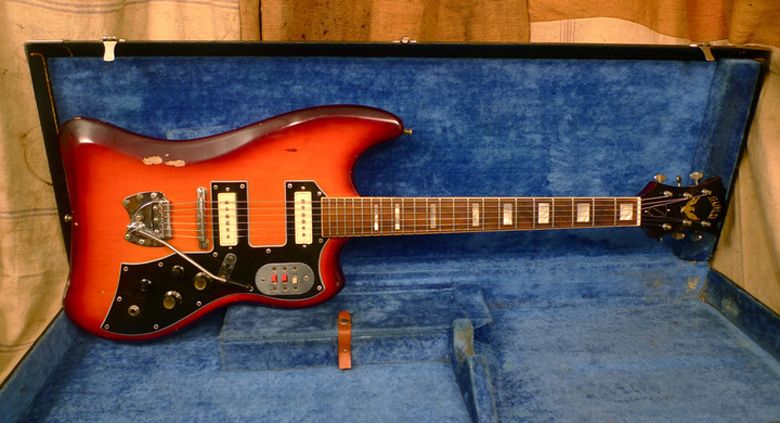
But the one that stands out in my mind is the Guild S-200 Thunderbird aka The
Gumby Guitar as
it sort of resembles the little clay guy when you stand it up.

This Guitar was equipped
with two pickups, 2 tone circuits for each pickup on/off switches
and phase switch. The body shape with the three slider switches looked somewhat
like a Fender Jaguar.
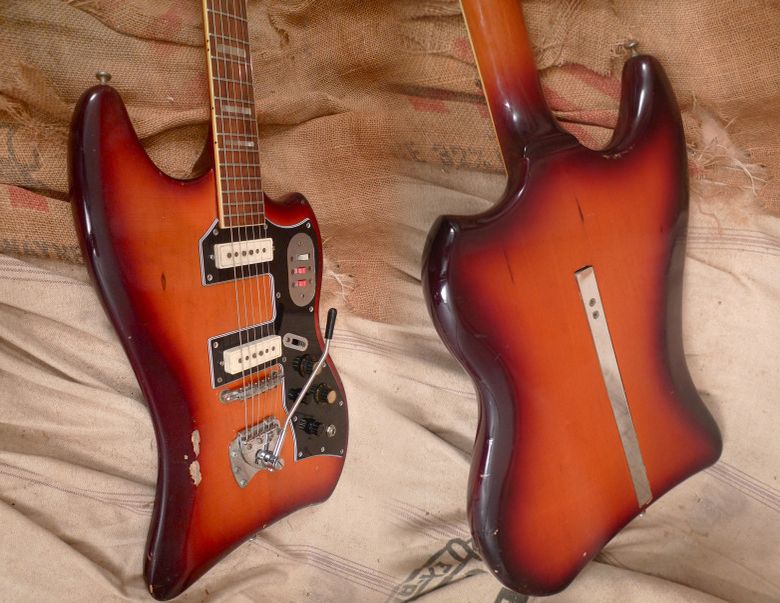
The lead pickup knobs go
to up to nine. The Guild S-200 came equipped with a Hagstrom
tremolo unit. Later production models switched from the
Humbucking pickups to DeArmond
single coil pickups. As far as I can discern the guitar was
produced from around 1963 to 1968.

I call your attention to
the asymmetrical headstock shape, the carved and contoured body and the inlay
on the bound neck. The neck on the Guild S-200 was a set neck. In essence it
was a quality instrument.
All of us who are old
enough to remember Shindig, Hullabaloo, Where The Action Is, Ready Steady Go
and other TV rock shows of that era may recall Zal Yanovsky, lead player of the
Lovin' Spoonful rocking
out on his Guild S-200 Thunderbird.


5 comments:
Rehabbing a DeArmond/Guild Sevenstar. Bought for 207usd. Have NO IDEA why they sell so low. Quarter-sewn neck, DeArmond pups (which one's, I have no idea, but would like to know; black, S/duncan looking), Firebird-sy feel. Adding Hag trem, red switches on the lower bout for coil-tapping; red slider for in-out phase. Should make his Daddy proud; the venerable S200 Thunderbird...
Yes, I have a machinist/welder who will fab a 7-string claw for the Tremar. He wants to know if there would be a market for them. I said, "I don't know".
Do you want to reset your iPhone? Click: factory reset iphone
The rest of the story of the Dearmond Sevenstar rebuild into the only 7-string Thunderbird I've seen. DiMarzio Crunch Lab and Liquifire combo replaced the pups (wanted SD SHRPS but were not available for 7-string) Just drilled through the string cleat on the Hag Tremar for the B-string, foregoing any rehab, Had to use Fender Jag plate for the sliders. Big deal. Scalloped the lower bout for upper neck fretting. Sperzel locking tunas for stay-in-tune glory, and good looks. went on wire diag for three way toggle, but with the sliders only get series, parallel, kill switch. However, with pup toggle in center pos, everything lights up. I am lioving pleasurably with the sounds I get the way it is. When they released the brand new guild line of TB's was thrilled but not getting a series, SC, parallel awitching from the manufacturer was disappointing when I saw the guitar capabilities. No one asked me!! 😥
I found this article very informative. I'm impressed by the amount of work you put into this article.
Top 10 engineering colleges in Dehradun
Post a Comment