 |
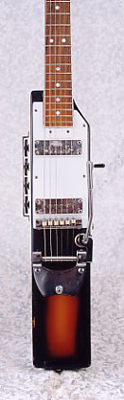
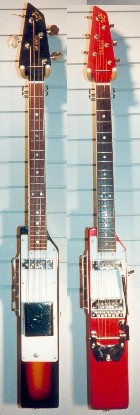
| Vox V-251 Guitarorgan |
The guitar craze of the 1960’s not only made everyone want to play electric guitar, but brought guitar technology to the forefront. Musicians wanted to play guitar, but they wanted the guitar to sound like a different instrument and they wanted more sustain.
For years blues guitarists used crappy guitars and amplifiers and got a distorted, gritty sound that some American and UK performers thought was cool.

The modern Rockers of the day wanted that down and dirty sound but would not be caught dead with a Silvertone guitar and a cheap old Danelectro amplifier.
Electric guitar technology came to the rescue and it's first invention was called a
fuzztone. Next came the
LBP-1(Linear Power Booster) transistorized preamps, wah-wahs and a host of other bells and whistles.
The granddaddy of fuzztones - The Maestro by Norlin Gibson

Taking the technology a step further there were some folks that wanted the guitar to sound like an organ. The first to develop this concept was a company located in Waco Texas known as
Musiconics International (MCI) came up with
the Guitorgan, which was invented by a fellow named
Bob Murrell.

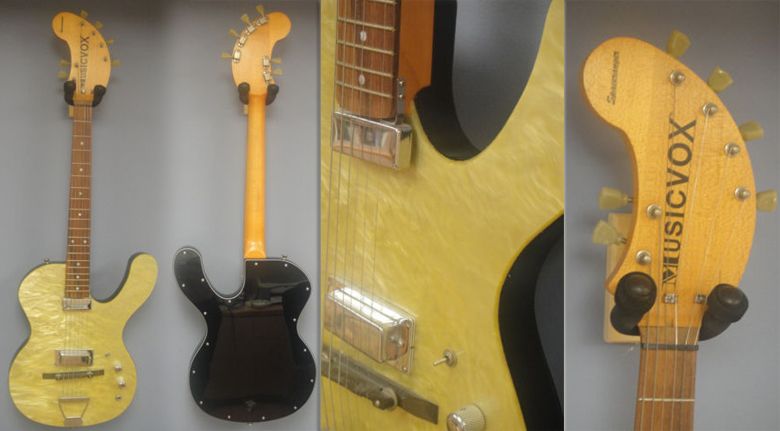
Musiconics International did not actually make the guitar. They used a semi-hollow body guitar made by the Japanese firm Univox. What MCI did was to route the back side of the guitar and put organ circuitry inside the instrument. The guitar was named the Guitorgan.
The challenge of making the instrument work was to divide each fret into six segments and attach wires through the neck which connected to each segment of the fret. So the average 22 fret instrument must have housed 132 wires and connections. Each fret was now a contact switch.
The guitar sound would be produced through the single coil pickups as usual; however depressing the string on the fret also initiated contact to the organ section since pressing the fret was like pressing an on/off button switches which caused the ground connection to produce output similar to pressing the keyboard on a conventional organ to produce the sound.

The organ sounds used transistorized oscillators. As the years progressed Murrell was constantly upgrading his invention. The last version from the 1980’s included an analog synthesizer and a MIDI connector. One could have just the organ sound, just the guitar sound or a mixture of both sounds. Musiconics built about 3,000 units.
There were two issues with the guitorgan and subsequent products. With a regular guitar there is a note on each string between the nut and first fret. However there was no wires going to the nut. So instead of the first organ note on the first string being F, it was F# since the first actual fret was wired. Guitarists compensated for this by tuning down a half-step.
The other issue was only the highest fret segment played on a particular string would sound. And though the organ section in a Guitorgan is a 6-note polyphonic circuit, which allows full guitar chords to be played the organ notes can only be played alone or simultaneously with the guitar. The idea was to use the expression pedal in such a fashion to bring the organ in or out but have the guitar be the primary sound giving the illusion of a duo, but actually just being one musician.
In 1976 and Italian company known as
Sisme which produced
Godwin Organs came up with a product they called
The Organ.
As we may discussed with the Wandre guitar, Italian made guitars seem to possess an accordion-like quality, with sparkly designs, use of celluloid coverings and lots of buttons. The Godwin (guitar) Organ was no exception. It certainly looked impressive since the controls covered the entire bottom side of the instrument.

Users claim it produces a sound similar to a Hammond organ, especially if fed into a Leslie rotary speaker. Like the Hammonds drawbars, which emphasize different overtones produced by the tonewheels that produce the percussive like sound, the (guitar) Organ utilizes rotary knobs for this purpose. The instrument also has had slow/fast vibrato with an on/off switch so that even without the Leslie, you can get a pretty good impression.
The Godwin Guitar-Organ has 19 switches and 13 knobs. They also produced a lower cost model with 16 switches and 4 knobs.
The Vox Company, which was made popular due to the Beatles association with Vox amplifiers produced their own version, known as the Guitar Organ (without the hyphen). The electronic circuit was based on their Vox Continential organ Voice Boards. The body of the Vox was based on their Phantom style guitar. Most Vox guitars were manufactured in Italy.
Like the other instruments
the Vox Guitar Organ could be played as a guitar or as an organ or blended between the two instruments. It was also possible to get organ rhythm behind the guitar melody. This was due to the feature that played automatic chords in rhythm with your song.
 |
| Vox V-251 Guitarorgan |
The instrument also featured two inputs to amplifiers. There were also features to provide sustain and percussion. The Vox Guitar Organ had a power supply interface to provide power to the organ section.
Alas the age of synthesizer came into the picture along with the hex-pickup and the need for the guitar organ ended.