This resulted in Fender introducing their first line of transistor amplifiers in 1965. These models were not reliable and did not have the sound their tube counterparts had. Subsequently they had a very short fate and were pulled off of the market.
Of course other manufacturers jumped on the transistor design. It was cheaper and the need for those pesky tubes was eliminated.

For some of these manufacturers another idea occurred. Why not make an electric guitar with a built in battery powered amplifier. Transistors provided a way to house much smaller components in an amplifier chassis.
In 1956 the Eveready Corporation invented the small rectangular nine volt battery, eliminating housing 6 AA or AAA batteries which took up more room and were more expensive.
Some of the first guitars with built in amplifiers came from the Asian nations, specifically Japan and others were manufactured in Europe.
Teisco TGR-1
 The Teisco Company of Japan got it’s name from the acronym for the Tokyo Electric Instrument and Sound Company.
Teisco produced their own products under the Del Ray name, which sounded Spanish.
Spain equated with guitars back in the 1940’s and 50’s that were not Hawaiian style guitars.
 Teisco produced an odd shaped guitar designated as model TGR-1. The lower section of this guitar housed a low wattage amplifier that could be turned off an on with a slider switch. The amp section ran off of 2 nine volt batteries. The back of the speaker coil was slightly larger than the guitar, so a round metal cover was put on the back of the body. The front of the guitar’s scratchplate was metal and house twin pickups, volume and tone knobs, the slider switch and slats cut out above the speaker section.
There were three European models. Two were manufactured by Davoli. One was under the Wandre name which we have discussed previously with the post about Pioli Wandre.
The first and the oddest is the Davoli Bikini guitar.
During the time of its arrival the bikini was all the rage for beach wear and everyone was talking about the skimpy little outfits that left little to the imagination.
 |
| Davoli Bikini Guitar - Built by Wandre Guitars |

The amplifier section was housed in a large round plastic enclosure designed with a plastic grill, similar to the guard plate of an electric fan.
The amplifier was a German made Kraandal CT642.
The guitar section was oddly shaped and covered with a celluloid material, which seemed to be the case with many Italian made guitars. It had twin pickups attached to a chrome plate with pushbutton switches and an on/off slider switch.
 Pioli Wandre had hooked up with Davoli and used Davoli pickups in most of his models. He created a guitar with a built in speaker that was named the Meazzi Hollywood. This guitar looked more like what one would image a guitar to resemble. However true to Wandre’s artistic design, it was very misshapen.
 This instruments neck was made of wood instead of the aluminum used on most of his guitars and the body was made out of plastic. It had one Davoli pickup with a plastic cover, a volume potentiometer and an on/off throw switch. This guitar also purportedly used the same Kraadal CT642 amplifier.
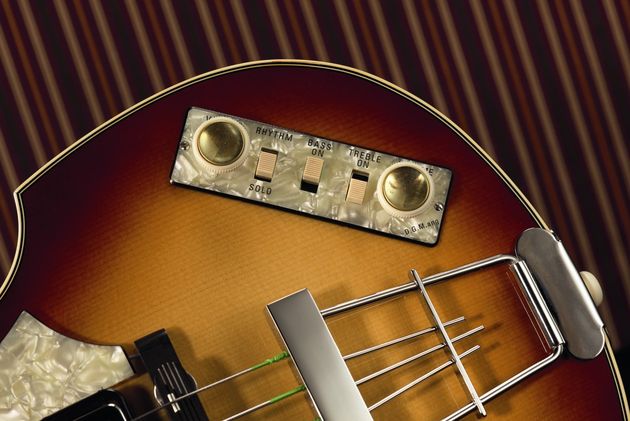
 The upper section of the guitar’s lower bout housed the amplifier. The top of the guitar had a fairly complicated design above the speakers grill. The bottom section housed the same control panel found on their Violin bass and other Hofner instruments.
The back access panel was made from part of the wood that had been carefully sawed off of the guitars back. This gave it a much classier look than just slapping a piece of plastic on the guitars back. The amplifier was designed by Hofner.

They took their name from Mr. Kuhrmayer's middle initial. Kay produced a guitar called the Kay Busker. Although I cannot seem to find much information about this guitar, I do recall it being shaped somewhat like a Les Paul and contained a speaker in the lower bout.

Kay also produced a Busker that had a Telecaster-like appearance.
For the uninitiated Busking is a word that means playing as a street musician.
More recently there are about four models of guitars with built in amplifiers that can be deemed guitars as opposed to toy guitars.
 |
| Fernandez Nomad and Nomad Deluxe |
The Nomad’s body comes in a number of colors including red, white and blue.
 |
| Fernandez Nomad |

The Nomad Deluxe has all the same features and shape of the regular Nomad, plus a DigiTech multi-effects processor with drum machine.
The processor gives you 25 programmable effects (10 at once), 40 factory presets and 40user created presets, including amp, cab, pickup, and mic models.
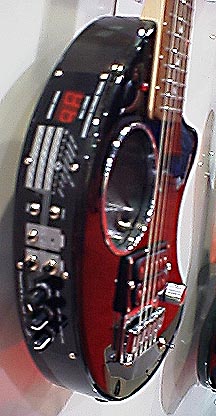
This guitar comes with an input for an expression pedal input and contains a built chromatic tuner. Besides the built-in speaker this guitar has a headphone output jack.
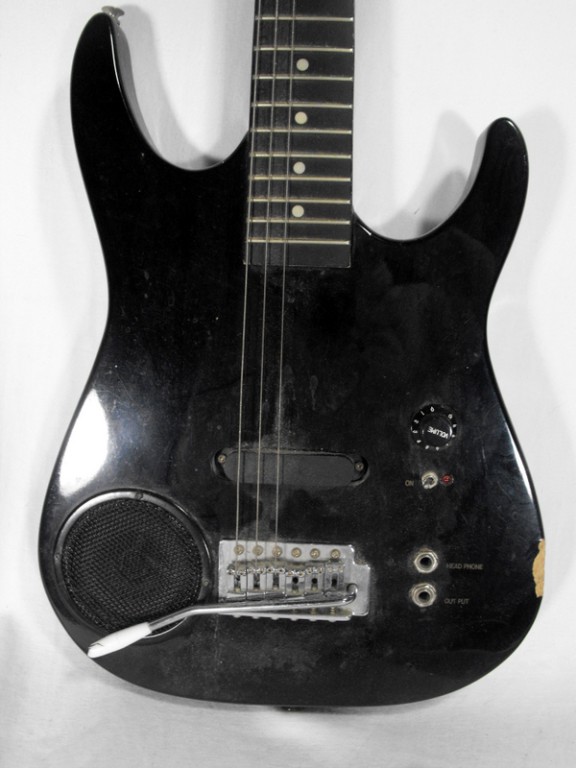
The Synsonics Terminator features a built-in amp and speaker. I am not certain if this guitar/amp is still available. It wasn’t quite as well constructed as some of the previously mentioned models.
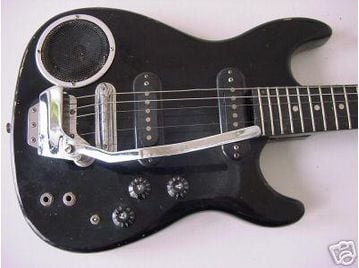
It came with a single coil pickup Asian made pickup and a tremolo bar. Some models had two single coil pickups.
These guitars were manufactured in Korea during 1989 through 1990.
A similar guitar may be sold today under the trade name First Act.
Finally Pignose Industries, the maker of those little battery powered amplifiers, has been offering a guitar with built-in speaker for sale since the late 1990’s.
 The model PGG 100 houses a built in amplifier that produces 1 watt and runs on a nine volt battery.
The speaker is housed under the strings in the same place the soundhole would be on an acoustic guitar.
The guitar has a unique double cutaway design with a small body. The neck has a 24 ¼” length and a 3+3 headstock. The bridge is an adjustable Fender style unit.