Back in 1964 when Christmas was rolling around, we thought about Christmas presents. I wanted an electric guitar. My sister wanted a Patty Play Pal doll. My brothers wanted some toy trucks. The catalogs started arriving at our house in early November. We loved looking at those pictures in the catalogs and reading the descriptions. We each spent hours checking them out for our desired Christmas presents that we hoped Santa would bring.
We referred to these as the Wish Books. They magically showed up in the mail. We received three or four of these from different stores. I would turn right to the guitar section and carefully read each description with fascination. Those were those "olden days" long before Amazon, Musicians Friend, or the myriad other web sites which came years later. Back then we had no clue about an internet, and a web was something spun by spiders.
During this time I would beg my parents for a guitar or amplifier. My siblings would do the same for their heart's desire. As this page is dedicated to guitars, that will be my focus. But perhaps we may look into other things too.
Wow that Harmony flat top was made of seasoned wood! So it had to be great! (I had no clue at the time what seasoned wood was. I guess seasoned wood sounded more flowerily than "made from dried out old wood we left in a barn for six months.)
Later on, I was able to send away to different companies for their guitar catalogs. I wish I had kept them. Those catalogs are valuable now.
Since I was not into Chatty Cathy or Betsy Wetsy, or even Tonka trucks, let’s go back to those days and review some of those guitars, and amplifiers available years ago. And check out the prices too!
Straight out of the Sears catalog were all of these "Silvertone" instruments. The two hollow bodies on the left, and the two solidbody guitars on the lower right were made by the Harmony Guitar Company. The two teal solidbody guitars on the upper right were made by
the Kay Guitar Company. Silvertone was the brand name that Sears had put on their radios, and televisions.
The company also applied that name to their musical instruments. Sears owned the Harmony Company, but also contracted with several different manufacturers to produce guitars, and amplifiers, and then badged them with that brand name.
All of these guitars pictured on the left were made by Kay, with the exception of the second one on the top row, which is a Danelectro guitar.
The amplifiers on the page were made by National.
It is a fact that the Danelectro Company sold most of their guitars and amplifiers through mail order retail companies such as Sears. Montgomery Ward, Spiegel, and JC Penny.
This Silvertone, model 57 1444L bass guitar caught the attention of my best friend, and he purchased it for $99.00 in 1965.
I recently saw this same bass at a local music store with the price tag of $800.00.
About six month later my friend had saved up enough money to purchase the matching Danelectro-made
Silvertone model 1483 bass amp. This amp pumped 23 watts into a single 12" Jensen speaker. Though it was hardly powerful enough for a bass amp, it made a great guitar amp.
One of the most popular Sears Silvertone amplifiers was what most of us referred to as
the "Twin Twelver", although it's actual designation was Model 1484. It was made by the Danelectro Company of Neptune, New Jersey.
Silvertone amplifiers were much less expensive than a comparable Fender amplifier. The Danelectro speaker cabinets were even made with a compartment in the bottom to store the amplifier unit or head for transportation.
While Fender and Gibson made their amplifier cabinets out of solid pine wood, Danelectro used much cheaper particle board for construction.
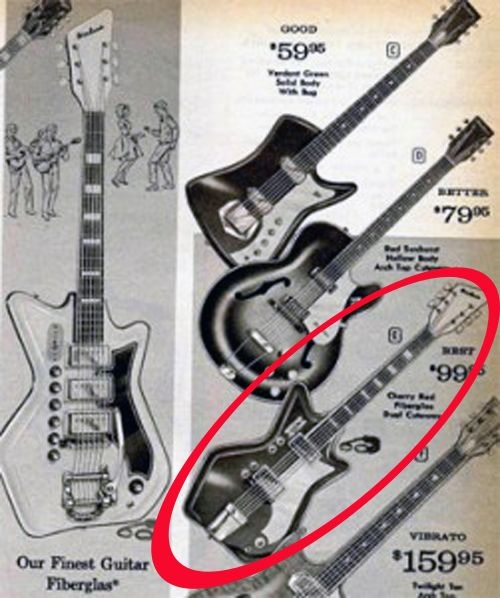
The Montgomery Ward Company used the brand name Airline for its electronic and music products. They used a number of "jobbers" or companies to procure their guitars and amplifiers, such as National, Valco, Supro, Harmony, Kay, All of these guitars were sold by Wards under the Airline brand name.
Perhaps the most interesting guitar out of their catalog was the
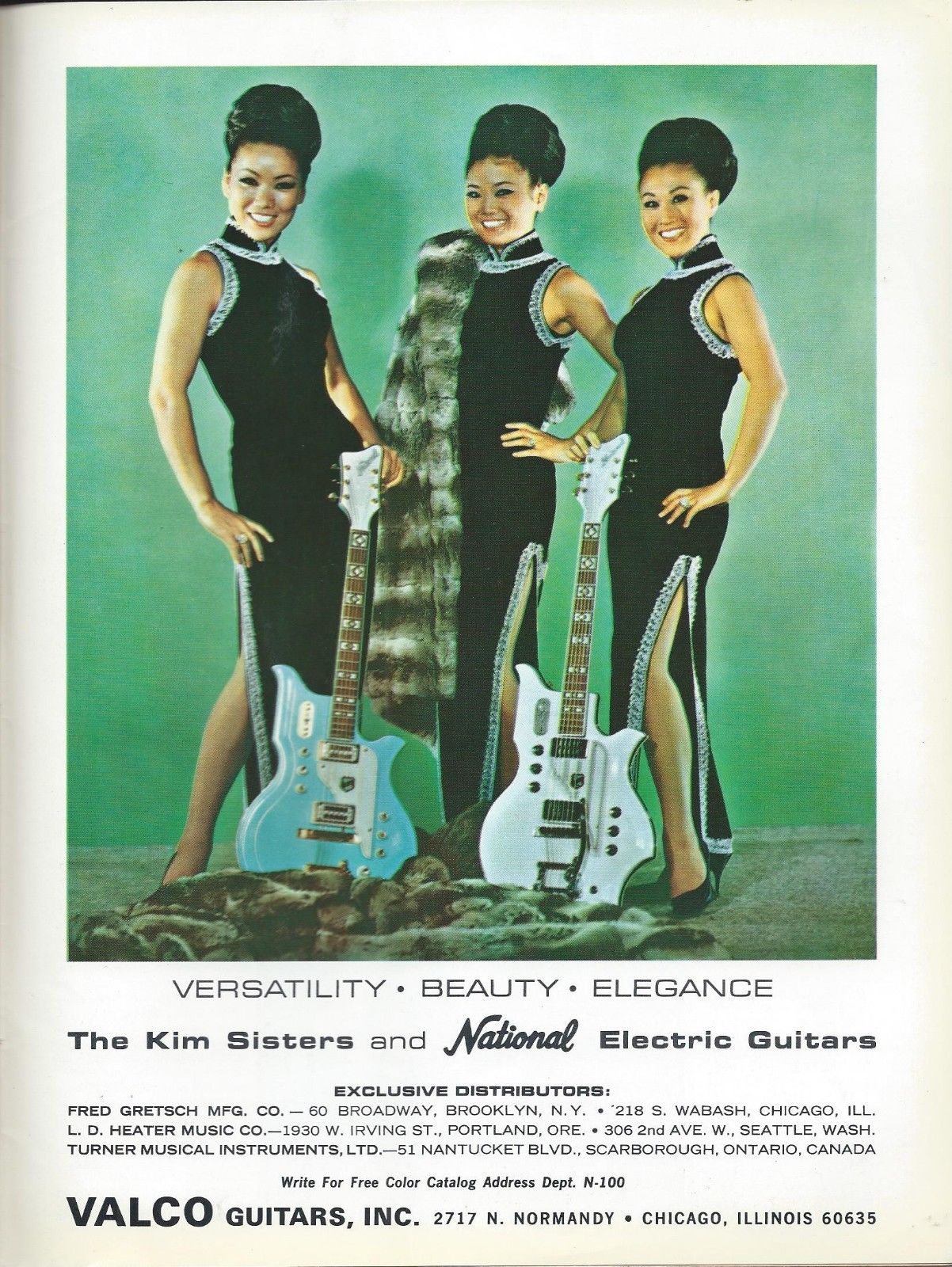
Valco made fiberglass models, which they referred to as
"Res-o-glass" for its supposed resonance. There is an interesting history of National, Valco, and Supro. This was a company started by the Dopyera brothers of Dobro fame.
Jack White played t
he JB Hutto model that was first manufactured in 1959.
Another one of the more unusual guitars that Montgomery Wards offered under the Airline brand was the
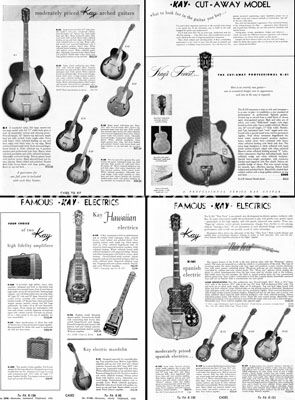
Kay Thin Twin.
The Kay Thin Twin was the model played by guitarist Jimmy Reed. You can see it in this 1954 company catalog. Most of the other guitars and amps on this page were made by National.
A company that has probably been long forgotten was Western Auto. They were very popular in the 1950's and 1960's, and sold guitars and amplifiers under the Truetone brand. The guitars and amplifiers were made by the Kay Company of Chicago.
One of my favorite Kay-made guitars sold by Western Auto was
the three pickup Jazz King aka the Speed Demon. It came with distinctive Kay single coil pickups. Each pickup had its own volume and tone control. Some models came with the Truetone decal, while others came with the Western Auto "W" logo.
One of the more popular guitars in the 1960's was
the Kay Vanguard, you can view it in the lower left corner.
This guitar came with one or two pickups, and a fixed bridge with an aluminum bridge cover. The price for the one pickup model was only $44.95, which was a big factor in the instruments popularity. These were sold by Western Auto, Sears, and under the Old Kraftsman brand for Spiegel, another catalog company that was based in Chicago.
Another popular model made by Kay was called
The Value Leader. It was sold through several different catalog companies under different brand names, as well as under the Kay brand.
This hollow body Les Paul shaped guitar came with a fixed wooden bridge, a rectangular aluminum pickguard, a trapeze bridge, and one, two, or three pickups. The single pickup model sold for $69.95, the two pickup model sold for $87.95, while the three pickup version was $99.95. The pickups were low output to decrease feed back.
Although Fender guitars were only sold through authorized dealers, you could obtain a
Fender catalog from a dealer or directly from the company. For a guitar obsessed kid, these were like finding gold. We could look at these guitars for hours and dream.
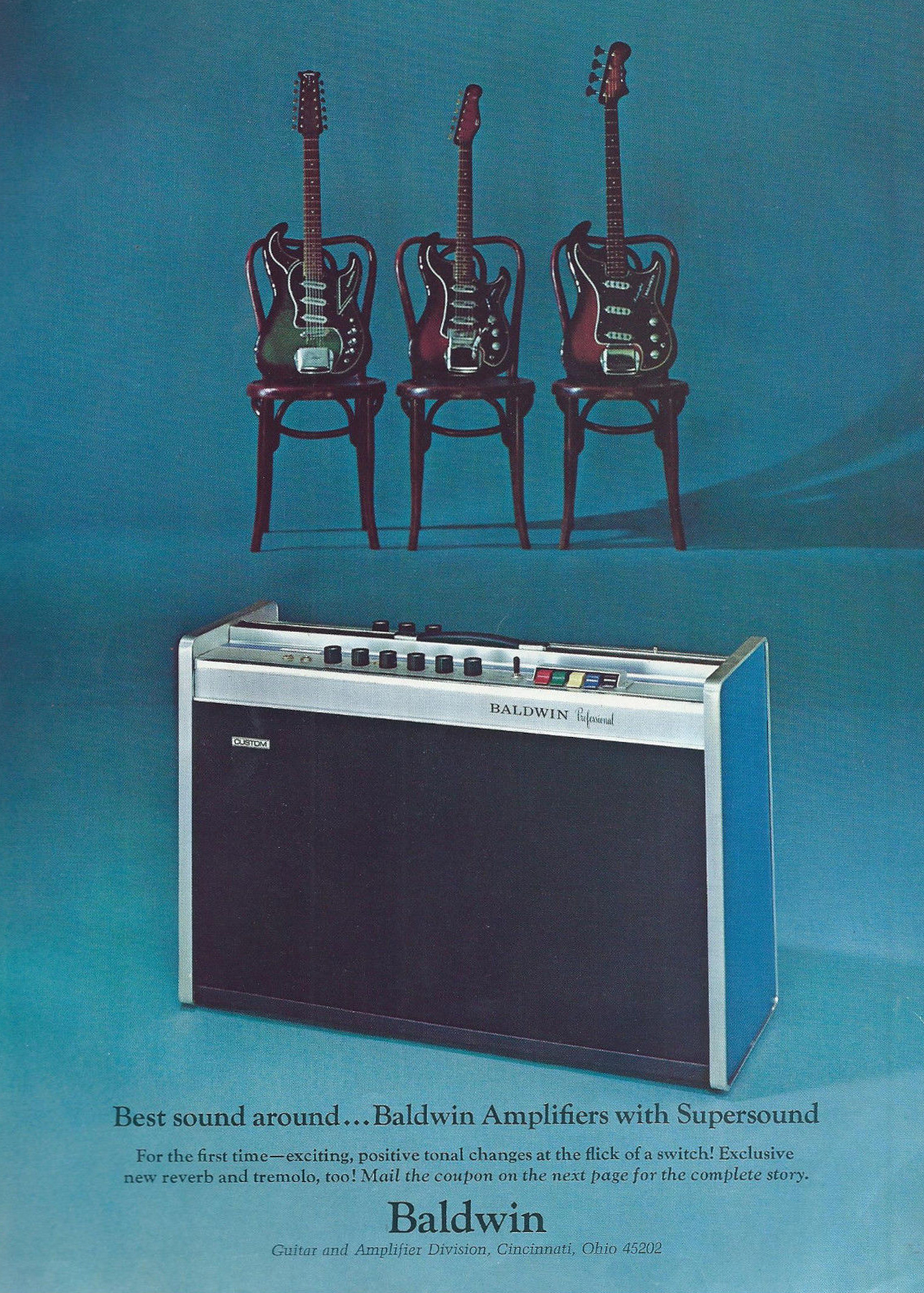
The new kid on the scene in 1966 was Baldwin guitars and amplifiers. The Baldwin Piano Company of Cincinnati had recently acquired Burns of London guitars, and the rights to
Kustom amplifiers. Some of the original Baldwin guitars were still labeled as "Burns", so Baldwin put their logo on top of the Burns logo. The Baldwin amplifiers were based on Bud Ross's Kustom amplifier circuitry.
The Joseph Speigel Company was a Chicago based business specializing in direct mail order sales. They sold guitars that were made by Kay Guitars of Chicago under the Old Kraftman brand.
One of the most interesting companies that origisnally sold guitars and instruments made by other companies, but within a few years manufactured their own guitars in the mid 1960's was
The Carvin Company of California. I recall sending for this catalog. It may have cost me 50 cents. It contained very interesting guitars and amplifiers, and it came with a separate price list written on a typewriter.
The Carvin Company was a family business, and remains so today but now it is under the Keisel brand name.
Years later I learned that the bodies of those early Carvin guitars were made by the California based company, but the
necks, pickups, and electronics were made by Hofner of Germany. although some of the pickups were wound in house. Later on Carvin manufactured their own brand of pickups
In addition to the wish books there were a few television commercials in the mid-1960's from
a toy company called Emenee. This New York based toy manufacture created several guitars that were made out of plastic. They were hoping to cash in on the British Invasion.
They also produced the "polychord electric-piano organ" aka The Audition Organ, and
the "Big Bash Drum" snare drum. Well a kid could start their own band with all those seemingly marvelous instruments.
The Emenee Tiger guitar was a hollow body archtop instrument made entirely of plastic. It had a cutaway, an archtop bridge and came with a detachable contact microphone which was probably made by the DeArmond Company.
The Swinging Cat guitar has been described in internet posts as perhaps the worst toy ever made. It was a solid body style all plastic guitar with a faux pickup section molded on top of the body. It came with a contact microphone that was permanently attached to the amplifier. The child could place the microphone contraption under the strings.
Both instruments featured low watt battery powered amps housed in a plastic cabinet.
Oh, but getting back to my sister's Christmas wishes, she did receive a Patty Play Pal and an Easy Bake Oven. The doll was almost three feet tall.
My brother's both got Tonka Trucks, that were dye cast, and made our of metal. Christmas was a great time at my childhood home back then. Those are now only sweet memories.
As for myself, I did get an electric guitar. It was a used one. A 1957 Fender Stratocaster that Dad found that was not expensive. I wish I had kept it. The current value of that instrument is $20,000 to $40,000. Oh well!
I hope that you all can sit back and check out these old catalogs. Many are online. I've posted a couple below. Dog-ear the pages for your selections,, circle them, and then make a wish. To help out, here is
a link to all the Sears catalogs since 1930 in a pdf format.. Enjoy!
I wish everyone a very Merry Christmas, Happy Holidays, and a Wonderful New Year!
©UniqueGuitar Publications (text only) 2025
Click on the links under the pictures for sources.
Click on the links in the text for further information.
Please click on the advertisements to help support this page. Thank you!






1 comment:
This brought back that feeling of looking through old catalogs and circling the things you hoped to find under the tree. I especially enjoyed the guitar sections and the old descriptions, because you can really see how different shopping was before the internet. Those vintage Harmony and Silvertone guitars are fascinating to look at now, especially knowing how collectible some of them have become. There’s something really special about the excitement of waiting for a catalog and dreaming about your next guitar. https://spinmamas.com/
Post a Comment