Wednesday, February 17, 2010

The Bellzouki aka The Danelectro 12 String Guitar

In the mid 1960's there was a popular TV show geared to teens called The Patty Duke Show. Often one of the popular rock artists of the day would make an appearance on the show.


One of member of a long forgotten group had a guitarist that played a very unusual looking 12 string guitar. I had no clue what type of guitar this was until years later when I discovered it was made by The Danelecto Company of Neptune, New Jersey and was called The Bellzouki.


This guitar was based on an idea from Vinnie Bell. Bell was an in demand studio player in the 1960's. He had wonderful career and played with a myriad of artists and on literally hundreds of hit songs of all styles. In fact he still makes a living as a guitar player and you can hear his guitar in The Family Guy theme. One of the more recognizable songs he did was the watery guitar work on the theme to Midnight Cowboy. Check out his website for some great stories. Be sure to click on Memories and Above and Beyond the work of a session guitarist.

Though Bell is Italian, he was periodically asked to double on the Greek Bouzouki for a record. 

A bouzouki is generally thought of as an eight string musical instrument that is shaped somewhat like a bowl back mandolin with an extended neck. It has four courses of strings tuned in unison and is played with a plectrum aka pick. The bouzouki is widely used in Greek and Turkish music. The eight string version is called a Tetrachord and is tuned in fifths just like a mandolin. The six string version has 3 courses of strings tuned in unison. This is call the Trichord Bouzouki.


Around 1960, several groups from Ireland that played traditional music of that country started using a version of the tetrachord bouzouki. However the body was flat and smaller than the Greek/Turkish models and the back was also flat. The tuning was modifed. 

As most studio players were apt to do, Bell would tune the Bouzouki like a guitar. As the age of the electric 12 string guitar ushered in, Bell got the idea to create a twelve string electric guitar, and make the body look similar to the shape of a Bouzouki and electrify the instrument by adding a pickups. 

He already had a deal with the Danelectro company which created an all wood electric guitar that he would endorse. He pitched this idea to Danelectro, drew up some plans and named it after himself. Thus the Bell-Bouzouki was born and known as the Bellzouki.

Danelectro model 7010 Bellzouki
The Danelectro Bellzouki Model 7010 was introduced around 1961. The body was tear drop shaped with two faux tortoise shell pickguards. The guitar came with one volume and one tone control, plus a 3 way toggle for tone selection. The neck, like all Danelectros, is a bolt on style and is made of maple capped with a rosewood fretboard. The nut is aluminum and the neck is reinforced with a steel truss rod. 

Though the body appears to be solid, like all Danos it is a poplar frame covered with Masonite. The sunburst finish adds the illusion of wood. To play the model 7010 you needed a shoulder strap due to its Bouzouki-like shape. 

 Bellzouki Model 7010 (the original) - Model 7020 - Model 7021
The scale for each of the Bellzouki models was 24 ½ inches and the neck was slightly wider than the neck on six string Danelectro guitars. All the models had one or two Lipstick pickups which have their own unique sound and these guitars were no exception to that quality. 

The earliest models came with 2 unison G strings to give it more of a Bazouki sound. Later these were adapted so only the first and second strings were tuned in unison, while the bottom four courses were tuned in octaves. 

Danelectro came out with two revised models, the 7020 and the 7021. 


The model 7020 may have been due to a suggestion of a fan of Mr. Bell to improve his design. The model 7020 had a similar shape to the original tear drop, but 4 notches surround the body to make it possible to play the guitar while sitting. The toggle switch was moved from the top of the instrument to the lower side. This model came with twin lipstick pickups and five potentiometers for volume, tone and master. 

The model 7021 was much like the 7020 in accouterments but its body shape was exactly like the Danelectro Electric Sitars body. 

1965 Danelectro Catalog
The Danelectro sitar that came with 18 strings and was another one of Vinnie Bell inventions. (There was another version of the Danelectro sitar with an oval shape and only six strings.) Most 1960’s groups favored more expensive model 12 string guitars, but the Danelectro 12 had been around much longer, it was an excellent player and a great bargain.
©UniqueGuitar Publications (text only)

Tuesday, February 16, 2010

The Hagstrom Electric Twelve - F-12S


Hagstrom F-12s

Swedish entrepreneur Albin Hagström registered his accordion import company in 1925 and was well on his way to becoming a success. Twenty years later Hagström was indeed successful and became one of the largest music store chain in all of Scandinavia. They even set up a shop in New York city. Hagström was not only were importing accordions, but manufacturing them as well.

Six years after the end of WWII the Hagström Company noted the demand for guitars. It was already importing Gibson guitars. After consideration the Hagström Company decided it would be feasible to manufacture guitars. Hagström proved to be very successful in this endeavor. Albin Hagstrom passed away at age 46 and did not live to see just how successful his company would become.


In the late 1950's Rock and Roll migrated to Scandinavian countries. This created a big demand for electric guitars. Hagström met this demand in 1958 by producing almost 700 guitars, in a way only European ingenuity could produce.


Their first guitar design was loosely based on the Gibson Les Paul; however the cutaway was a Venetian style instead of the Paul's Florentine style.

Instead of finishing the body with stain, paint or lacquer, they used the same material that was used on manufacturing accordions, which was celluloid. The sheets of celluloid had either a pearl or glitter pattern in various colors. On the first guitars even the neck was covered in celluloid. The fingerboard was different as well. It was made of Plexiglas. This may seem quite unusual, however the Martin guitar company is currently selling some models with a fingerboard made of man made material.


Hagström neck design included a patented H-bar instead of the usual round truss rod.

In the 1960’s Hershman Musical Instrument Company became the first sole agent in the United States to import and distribute Hagström guitars.

Hershman also imported another Swedish made acoustic guitar under the Levin name and later marketed acoustic and electric guitars under the Goya brand.

With the British Wave of music hitting the United States in the 1960’s, every teen wanted an electric guitar. So 1963 became the boom year for many guitar companies including Hagström. Some of the instruments came in under the Kent brand, although most were marketed under the Hagström brand.


In 1964 Hagström took on a new American partner for distribution known as Merson (later renamed Unicord.)At the time Unicord wanted a guitar with a thin neck and wide frets and Hagström was ready to oblige. In the 1960's thin necks = speed. I would prefer low action over a thin neck.


In 1966, with a list price of $229.50 including soft case, the Hagström Electric 12 string was introduced under the model name F-12S. The European version was model H-12. The guitars body was very similar to the six string H-II model.


The twelve string came with two single coil Hagström pickups, the inverted input jack plate, which was much like a Stratocaster jack. On the top bout mounted underneath the scratchplate was an on/off slider switch. The lower bout bore two slider switches to control the on/off feature of each pickup.

There was a tone switch that changed from a large capacitor to a smaller one. It was labeled Low/High. There was also a mute switch to give the guitar a muted sound for rhythm playing, which took the volume down a notch. The guitar came with only one knob/potentiometer as the volume contol.

The maple neck had 22 frets on a rosewood fingerboard. The neck is topped off with a headstock that has six tuners per side with a Hagström logo decal. The guitar was available in black, red, white or sunburst.


The neck was wider than a typical Hagström electric, however it was thinner in the sense of shaved neck. The strings were well space and it played great. It sold for around $170 cheaper than a Fender XII, plus it came with a case. And though the case was soft, it was plush lined.


My only complaint about the Hagström 12 was it was top heavy due to the added weight of the headstock and tuners.

I would have loved to have one of these back in the day. They were nice instruments and excellent bargains.


The Fender XII


Folk Music purists almost rioted when Bob Dylan played electric guitar at the Newport Folk Festival. Pete Seeger even says he was so angry he wanted to cut the cord to the sound systems amplifier.

The people that attend the event overlooked an important event in rock music history. This was the birth of Folk Rock.

The Byrds, Barry McQuire, the Mamas and the Papas and others took on the mantle. For a few years Folk Rock was the the thing.

The sound for many of the artists was an electric twelve string guitar with it’s jangly, chimey, almost harpsicord-like sound.


The Beatles were the first to use the Rickenbacker twelve string. They influenced Roger McQuinn to purchase a Rick 360/12.


McQuinn played banjo and he transferred his finger-picking style straight over to the twelve string guitar.

Everyone I know loves the way the Rickenbacker looks and sounds, but there are also those that have some complaints.

It is difficult to change strings on this guitar. Even McQuinn states it is a bear to restring, because the strings hold the tailpiece in place on the guitar. I have also heard complaints regarding tuning the Rickenbacker and keeping it in tune.

The older model Rick twelve strings came with six adjustable bridge saddles with two strings per saddle.

It would make sense this could make intonation difficult to achieve.

I’ve also heard guitarists complain because of the close spacing of the strings. This is because Rickenbacker uses the same neck for it’s six string and twelve string guitars. Then there are some that love this feature.

Due to the sudden interest in electric twelve string guitars, most all of the manufacturers came out with there version for sale.


Gibson and Epiphone each had a 12string model. Danelectro intoduced a Vinnie Bell creation that was named the Bellzouki. Hagstrom guitars also came out with a twelve string model.


Fender's concept for a 12 string model was simply known as the Fender Electric XII.

The body design was similar to the Jaguar, Jazzmaster shape but the lower bout had a slightly deeper carve.

The neck was a bolt-on Fender style neck. The guitars headstock was quite unique. It had a downward pitched carve on the neck’s distal end which made it resemble a hockey stick.


The Fender neck was wider than their six string models, which eliminated that cramped feeling guitarists complaint about on other models. It was an electric guitar purposefully designed to be a 12 string guitar.

The guitar also had tunable bridge saddles for each string, so compensation adjustment was a breeze. The strings went through the body and were held in place by string grommets, similar to the Telecaster design. This increased sustain.

The guitar was strung like most 12 string guitars with the lower string being an octave higher than the next string. Rickenbacker uses a reverse process with the lowest string first and the octave second.

Another unique feature was the pickup design. The placement is comparable to split pickup placement on a Fender Precision Bass guitar, which staggered the pickups. Essentially the twelve string had four staggered pickups in two sections. The player could get four different and distinctive sounds allowing for neck, neck and bridge in series, neck and bridge in parallel and bridge only options.

Fender XII Bridge/Saddles
Where most other 12 string electric guitars were built to accommodated two strings per saddle, Fender designed a special saddle for each string with a string-through-body design for extra sustain. The 1965 model came with a fairly wide neck, with dot inlays. The original model came with a three colour nitrocellulose sunburst finish and later models came with colour options as well as pickguard options.

The earliest models had a natural wood headstock. Models from late 1965 through 1968 underwent some changes. The head stock was painted the same colour as the guitar, the neck was bound and the dot markers were changed to block markers.

The Electric XII was designed by Leo Fender and introduced in late 1965. Most were produced in 1966. The guitar stayed in the Fender catalog through 1969 when it was discontinued.

Fender wound up with overstock on the necks and bodies.

The always thrifty Mr. Fender turned the extra stock into a unique six string guitar that was originally called The Fender Custom. The name was replaced and the guitar was then called The Fender Maverick.

Because of the guitars adjustable bridge saddle compensation, the Fender Electric XII was a favorite with studio players of the day (1965-70). Recording companies were interested in turning out songs as quickly as possible, so most bands recorded only the vocals and left the playing up to the studio guys and gals.


The band’s guitarist may be holding a Rickenbacker on the album’s cover, but chances are the sound you are hearing quite possibly came from a Fender Electric XII.
©UniqueGuitar Publications (text only)


Saturday, February 13, 2010

The Maestro Fuzztone - The Granddaddy of All Guitar Pedals


I recall hearing (I Can’t Get No, Satisfaction) on the radio for the first time when I was around 14 years old. I was already playing guitar.


I could not figure how The Rolling Stones achieved that trombone-like lead guitar line. My guitar sounded way to clean to achieve such a tone.

Later I heard The Yardbirds playing I’m A Man and Beck’s Boogie, with a sustained and dirty sound.


The Kinks came out with a couple of songs that sounded similar to each other.

One of their hit record was called You Really Got Me and the other song was All of the Day and All of the Night. Both songs used a distorted, fuzzy guitar sound to get that power riff.


No matter what I did to my 1965 Fender Deluxe Reverb, I could not figure how Keith Richards, Jeff Beck and Ray Davies got that sound.

I was told by a friend they were all using the latest invention for guitars and it was called The Fuzztone.


I did not have a clue what a fuzztone was, how it worked or even what it looked like. I even went so far as to get 6 of Mom’s bobby pins and attach them to the strings to get a fuzzy sound. (Don't laugh Philip Glass was doing this with his piano concertos.)


The sound I produced sounded exactly like a guitar with 6 bobby pins on the strings.


At the local dance a band was playing and the guitar player had a small brown box plugged into his guitar. The cord was coming out of this box. I asked him what sort of device he was and he told me it was a Jordan Bosstone.

I sure wanted one of those. I never got a Jordan Bosstone. But I did obtain a Fuzztone.

During a class trip to New York City I had some free time, so along with some friends, we headed to the music shop district. Our destination was Manny’s Music.

Manny's was guitar Mecca. THE guitar store!

All the instruments seemed to be less expensive than what Cincinnati music stores prices were for the same products. Manny’s had all the latest guitars, basses, combo organs and drum sets. It was better than Disneyland.

We walked back to the Hotel Edison where we were staying and I spotted Rudy’s Music. I had to stop there.

Rudy’s had an off brand Fuzztone of unknown origin for only $20.


It was not a Bosstone and it did not plug directly into a guitar. It was a floor unit with a volume and tone knob on either side and a push-push switch on it’s face. I plunked down my $20 and took it home.

My unit, simply called a Fuzztone, ran on 1 AA battery. An input and an output cord was built into the unit. These were the cheap, gray cords that were prone to shorting out. So I was continually cutting the plugs off the end and re-attaching new plugs.

About a year later, I purchased a Maestro Fuzztone.

The Maestro is the granddaddy of all fuzztones. There were other methods of achieving a distorted guitar sound before the Maestro unit.


But the Maestro Unit was the first commercially produced distortion device. This is what Keith Richards used on Satisfaction, along with a lot of studio reverb.

The Maestro Fuzztone was produced by Gibson/Norlin. It had a tone and fuzz potentiometer on the units top as well as a push on-push off footswitch. The unit had a grey output cord that went to the input of your amplifier, however it also had a female input plug.

This way you could use your own cord to the guitar. This was great, since I only had to repair one cord. The cheesy gray cord from the Maestro kept shorting out.

The instructions that came with the Maestro congratulated me on purchasing this fine guitar synthesizer which would enable me to achieve trombone and trumpet like sustained sounds from my guitar.

Maybe P.T. Barnum was running the advertising department at the time since I never did achieve the promised horn sounds. However the unit did distort my guitar’s signal by clipping it and changing it from a sine wave to a square wave. In that respect it was a synthesizer.

The Maestro Fuzztone was a Fuzztone, but to me the sound was closer to distortion than fuzz.


The Jordan Bosstone produced a sound that I will describe as being similar to an electric circular saw.


Vox had a floor unit called The Tone Bender. It’s sound can be described as an electric razor sound. If I had a need for a fuzztone the Vox sounds better.


In looking at a brief history of guitars and related products, fuzz guitar sound had been used early than the mid 1960’s.

In fact in 1961 (a year you can write right-side up or upside down and get the same result) a Nashville studio guitar player named Martin Grady recorded a solo for a Marty Robbin’s recording. The songs playback yielded a fuzzy guitar sound due to a loose tube in the recording console preamplifier. Robbin’s liked the sound and it was left in the mix.

The Ventures also picked up on this song's unique guitar sound and asked steel player and inventor Red Rhodes to come up with a device to get that sound. This was possibly the very first fuzzbox.


Ray Davies and Jeff Beck both took small amplifiers and cut the speaker with a razor blade. They then fed the signal to a large amplifier. This is basically what a fuzztone does, but the signal is smaller than what comes out of a 4 or 5 watt amplifier.


Maestro’s Fuzztone was the first commercially available unit. This lead to a myriad of other Fuzz boxes manufactured by many other companies.

In fact the invention of the fuzztone started a whole industry of pedals that modified a guitars sound. Before the fuzztone, we had reverb, tremolo or vibrato and echo if you could afford to buy an expensive Echoplex tape unit.

The first available fuzzboxes used germanium transistors. Starting in the 1970's the manufactures of floor pedals used cheaper and more durable silicon transistors, which could withstand heat and cold temperatures.


Germanium transistors are preferred by some purists that say these transistors provide a purer and superior tone. However germanium do not work well with other pedals. In the days before pedal boards, when a guitarist used only a fuzztone and tube amplifier distortion, this was not an issue. Because germanium transistors drop the guitars’ signal from high to low impedence the signal is deminished. Most pedals today do not drop the signal to low impedence.

I had two Maestro pedals back in the day. Unfortunately both were stolen.

I never did own a Bosstone, but came across a plug in fuzztone called a Frizzy-Fuzz. The circuitry in this unit is amazingly simple. There are no wires. The transistors, capacitors and resistors are all soldered together by their wires.

The housing on the Frizzy-Fuzz is aluminum which is superior to the Jordan Unit.

I've been told many Jordan units broke because during those days coiled cords were popular and if you strayed to far from your amplifier the Jordan Bosstone would be pulled out of your guitar by the spring action of the guitar cord.


You can hardly hear it, but look close Keith has his Maestro Fuzz

Friday, February 12, 2010

Tiple

1925 Regal Tiple

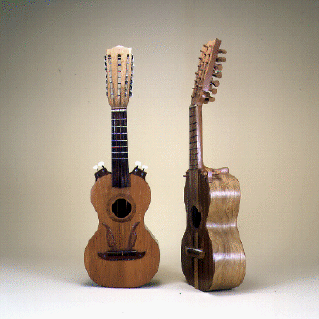
Though technically not a guitar, the Tiple is a guitar-like instrument that ranges in size from about as large as a soprano ukulele to slightly larger than the size of a tenor uke.

Kanile Tiple


You might see a Tiple on eBay for sale or pictured in a vintage guitar book. Tiples were very popular in the 1920’s through the 1930’s during an era when the ukulele was all the rage. Tiples are still utilized somewhat in Hawaiian music.

For the most part the Tiple has been replaced by the eight string Taropatch, a stringed instrument is larger than the ukulele and is tuned to an open G chord. The Taropatch has four courses of strings tuned in unison or in octaves.


Starting in 1920, Martin made some Tiples during the time period that ukuleles were popular. Production started in the 1920’s and continued for 50 years. The last Martin Tiple was in the 2000 Martin catalogue.

You can also find older Tiples made by the original Washburn company and other domestic manufacturers.


Martin’s styles included the T-15, T-17, T-18 and T-28. The size was always the same, but like Martin guitars the embellishments became fancier. The early Tiples had gut strings. As guitar evolved into steel string models, so did the Tiple. Tiple, which is pronounced “Tea – plee” is the Spanish word for soprano. The type of Tiple that is common to the United States is related to the Ukulele family.

It is replete with 10 strings that are made up of four courses. The North American and Hawaiian Tiple are tuned with the same tuning as a Soprano Uke. The first string has two strings of the same size. .

The second and third course has three strings each. Of those three strings, the center string is thicker and tuned an octave below the two outer strings, which are the same diameter. The fourth course of two strings are tuned an octave apart.

Brazilian Viola Capira
Tiples are indigenous to many South American countries. Depending on which country you are in you will find them to have a variety of tunings and sizes ranging anywhere from 12 to 15 inches in length. The can have from 3 to ten strings.

Tiples date back to the 18th century and possibly have evolved from the Spanish gutarrillo or vihuela. 

guitarron


There are several other Tiple-like instruments used in Hispanic music such as the Cuatro, the Bordonua and the requinto. Though the Tiples popularity has dwindled through the year, they are definitely unusual and unique stringed instruments.