Friday, December 18, 2009

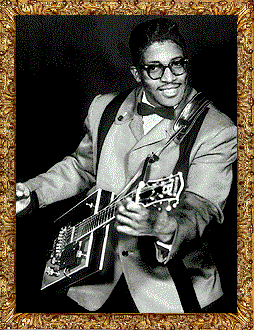
Hey Bo Diddley - The Gretsch Bo Diddley Guitars

The first time I saw Bo Diddley was on a mid 1960’s black and white TV show called Shindig.

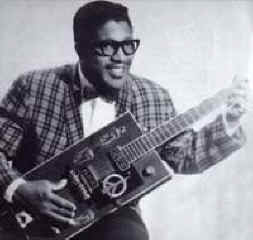
Bo was playing this weird looking guitar and singing his trademark song, “Hey Bo Diddley.” He had a very attractive woman who was also playing a similar guitar.

He was well known for the "Bo Diddley beat.” It is reminiscent of the old musical tag, “shave and a haircut…two bits" being played over and over again.

In an interview done before his death, he confessed that despite his admirers and historians attributing the rhythm to old African-American Hambone jive, he actually copped it from a Gene Autry song called, “I’ve Got Spurs That Jingle,Jangle, Jingle.”


Much of Bo’s rhythm could be due to his use of a loud Fender Dual Showman amplifier with the tremolo cranked up.  His guitar was often tuned to open E (E, B, E, G#, B, E, low to high), and capoed to change key. In the early years these guitars were run through one of the first effects boxes – the DeArmond Model 60 Tremolo Control.

It is rumored that Diddley rebuilt guitar amplifiers, constructed a tremolo unit out of a clock spring and automobile parts to achieve his guitar sound. He also enhanced the rhythm by adding maracas and additional drums.


As a boy a young Elias Bates fashioned a crude instrument called a diddley bow out of an old cigar box.

A diddley bow is based on a single string instrument of African origin that consists of a wooden board or a wooden dowl, such as a broom handle, a piece of wire and a couple of screws to stretch it over. The cigar box gave the instrument some resonance. It is usually played using a slide, which can be fashioned from the neck of a wine or beer bottle. A jack knife could also make a nice slide.


Not only did Elias Bates take his musical name from the diddley bow, he also used his cigar box instrument as inspiration for his personal guitar.


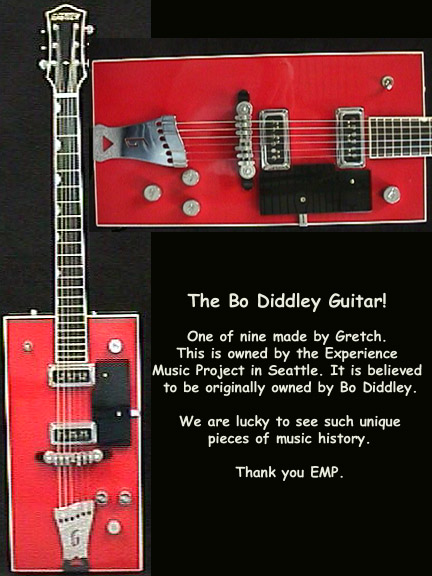
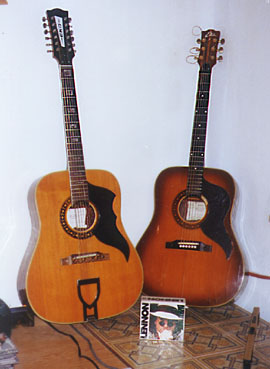
As his fame as a musician grew, Gretsch guitars was all too happy to oblige him with a custom instrument that he dubbed The Twang Machine. It was made in 1958.

Gretsch made him at least two more guitars which were based on the Cadillac fins. For all you young’uns out there, there was a time, back when most all cars were made in America. In the late 1950's America was entering the race to space and to help it along cars had to have fins.


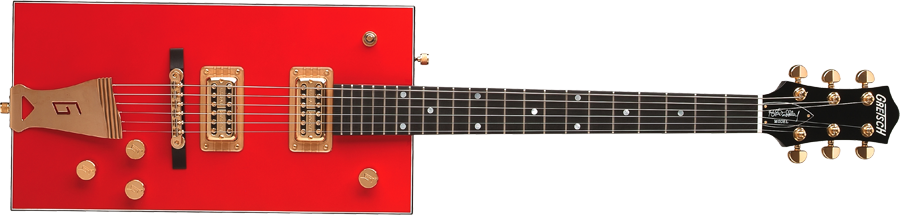
Gretsch now produces a reproduction of Bo’s famous instrument square guitar.


Just like the original, the instrument is 17-3/4" x 9-1/4" x 2" and made of alder and 5-ply maple for it’s semi hollow body. It is finished with a bright red paint job and lacquer. The guitar is decked out with two FilterTron pickups, a tune-o-matic bridge and a Gretsch G tailpiece with gold hardware.


They also produce a Bo Diddley Guitar under their Electromatic Brand. This one is not quite as fancy. It has a stop tail piece, a bolt on neck and chome hardware.


Wednesday, December 16, 2009

Ladies Only - Daisy Rock Girl Guitars

Guitars for girls, is this just a marketing ploy or a great idea?

Trish Ciravolo thinks so and is putting her name on the line with Daisy Rock guitars. She founded the company based on an idea her two year old daughter.


Trish had been a longtime guitarist and player in several L.A. scene all-girl bands. But in 2000 she was a stay at home Mom. Her daughter drew a picture of a daisy. Trish put a guitar neck on the picture and voila, an idea blossomed.


It probably helped that Trish’s husband was Michael Ciravolo, president of Schecter Guitars, which not only makes guitars under its own brand, but makes upgrade parts for guitars. He encouraged Trish on her concept and as of 2005 Daisy Rock has revenue of $2.4 million.

These guitars are designed for women and young girls. The bodies are lighter and contoured to make them more fitting for the female form. The neck scale is shorter than the usual 25.5” neck found on most Fender instrument, which means the space between frets is lessened, to help accommodate smaller hands.

The companies guitars weigh less compared to some other guitars.

And the finishes are designed to appeal to the ladies, come in shades of pinks, blues, purple, red and green. Some of the guitars are sparkly and come in heart, butterfly, star and flower shapes.

Your average male guitarist is not going to plunk down $3,000 to buy a guitar called Rock Candy Pink, which happens to be Daisy Rock’s top of the line instrument and is made in the U.S.A. Most of Daisy Rock’s guitars are moderatly priced since they are manufactured in Far Eastern countries.


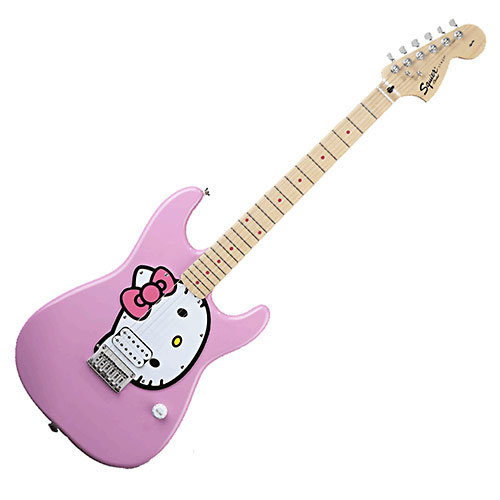
And though comments from Fender sales and marketing director, Andy Rossi seem to indicate Fenders opinion that the marketing angle limits distribution, Fender does not hesitate to market the Hello Kitty series of guitars and basses.

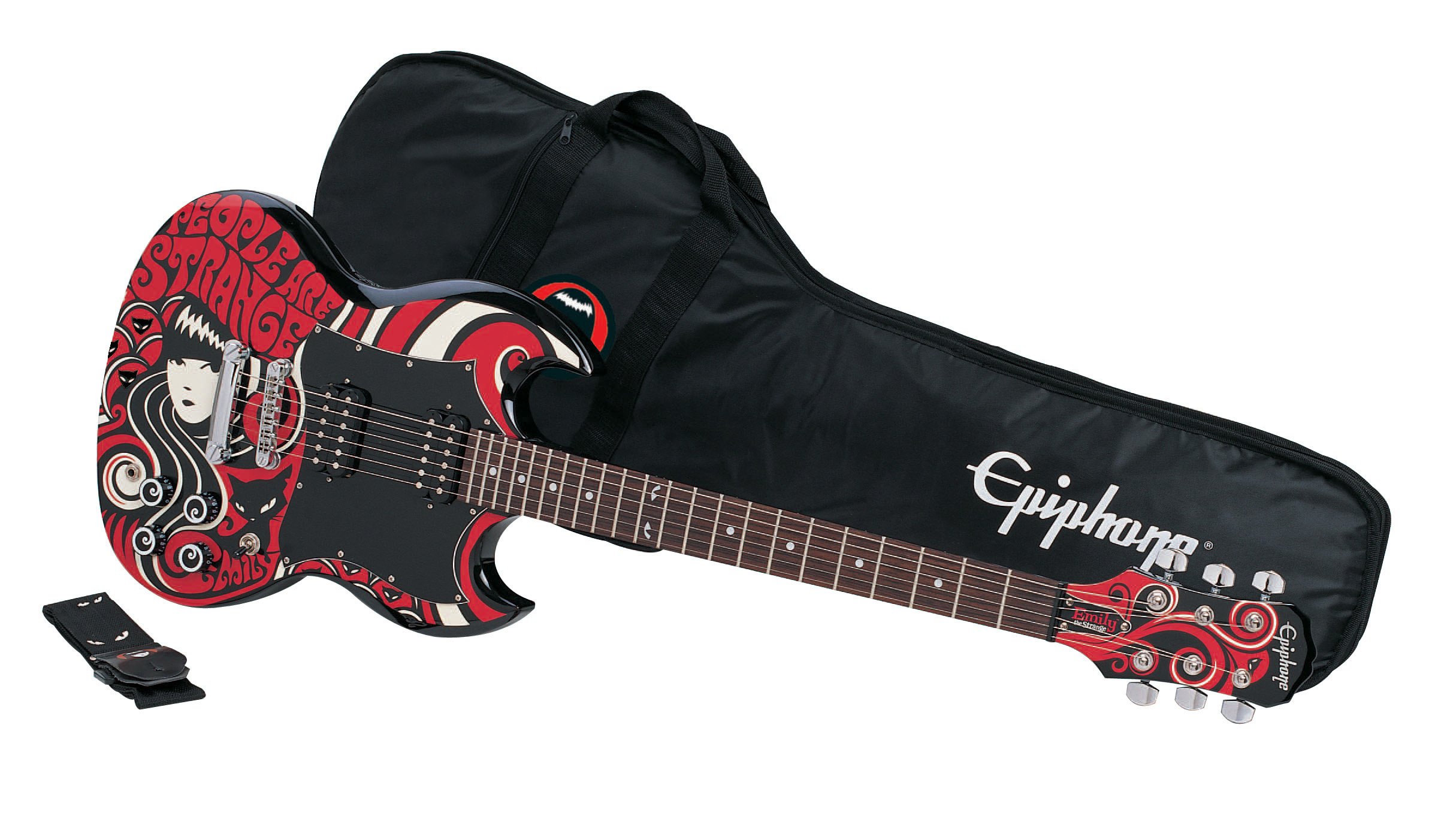
A few years ago Gibson had a guitar and bass that was aimed at the female teen Goth audience. It featured some unusual graphics depicting an internet character known as Emily the Strange.


Agile guitars which is an importer of Far Eastern made electric guitars, basses, some acoustic instrument and guitar related products makes some of their guitars with pink finishes.


I might add there are some very manly men that I have met that are not averse to playing a pink guitar. Specifically I point to Robin Lacy that used to play a pink Fender Telecaster before he became a Cajun man and took up the ‘cordion.


My buddy from the Fender Guitar Forum, Pinetree, plays a wonderful pink Stratocaster with pickups custom wound by Abigail Ybarra of Fender. I might say that Pinetree is about 6’5” and 300 lbs and rides Harleys, so don't be dissing him about his pink guitar.

Michael Wilshire is a pastor in Roanoke Virginia. Recently he told me he used a Daisy Rock 12 string on a recent recording he made. He didn't mention if it was pink. It was definitely a more economical guitar than a Rickenbacker and I couldn't tell the difference.

It is my opinion that guitars designed for girls is definitely an excellent idea.

CNN Daisy - Rock Check it out!


Saturday, December 12, 2009

Carbon Based Life Forms

Kaman Corporation, founded by aviation pioneer Charles Kaman, conducts business in the aerospace and industrial distribution markets. Kaman was an avid guitarist and owner of a 1946 Martin.

Kaman (pronouced like Command without the D) was not happy that the Martin dreadnaughts neck needed a reset and the body was cracking. He decided to build a better guitar.

Josh White Model
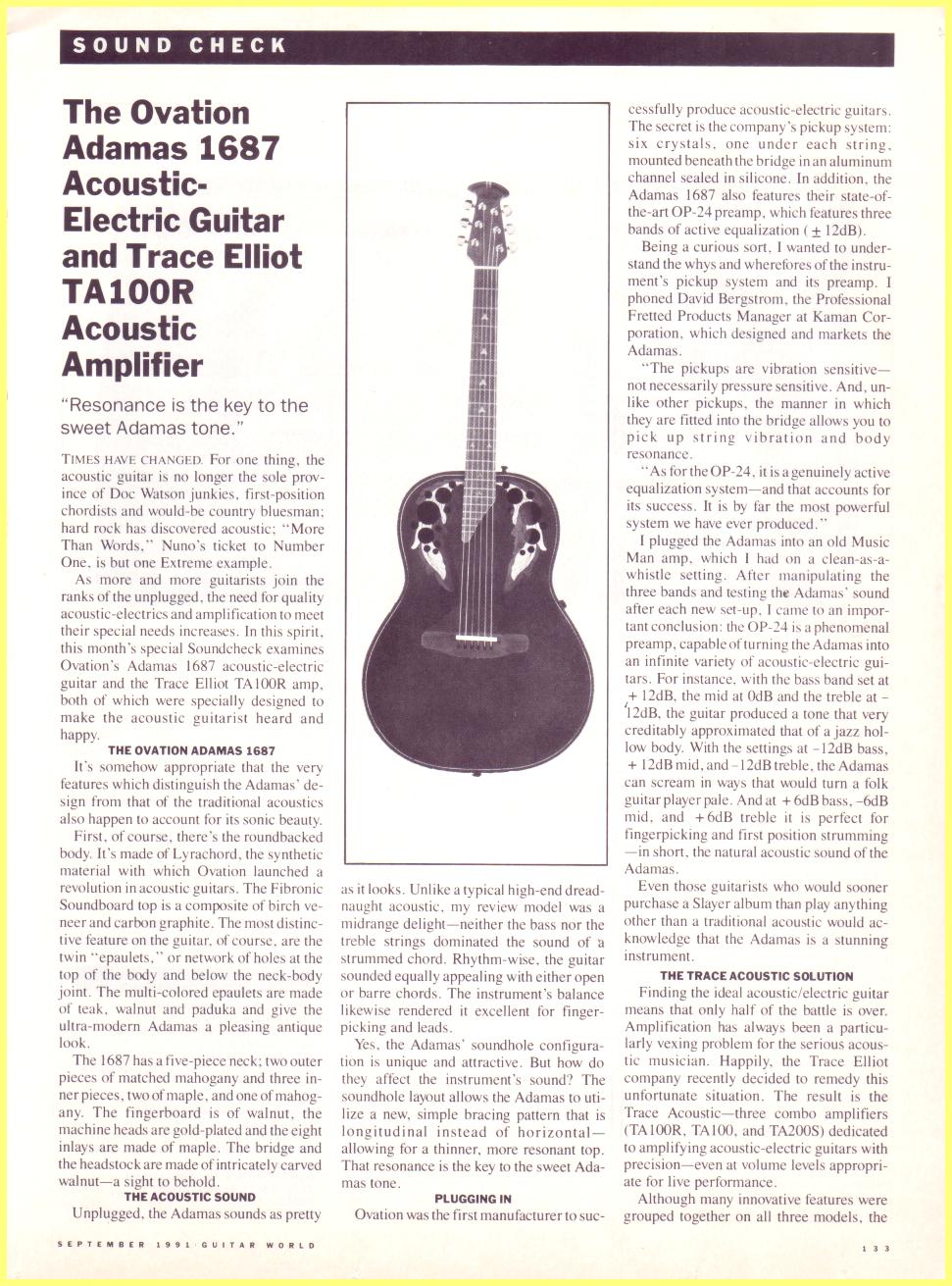
Using the same technology his company specializes in to create aerospace and satellite parts. Kaman came up with the idea of creating a guitar out of these materials. His first utilized a spruce top, a maple neck with a center strip of walnut and a unique fiberglass bowl-shaped back made of a composite material the company used in creating helicopters. The composite was trademarked as Lyrachord. Of course we are talking about the Ovation guitar.


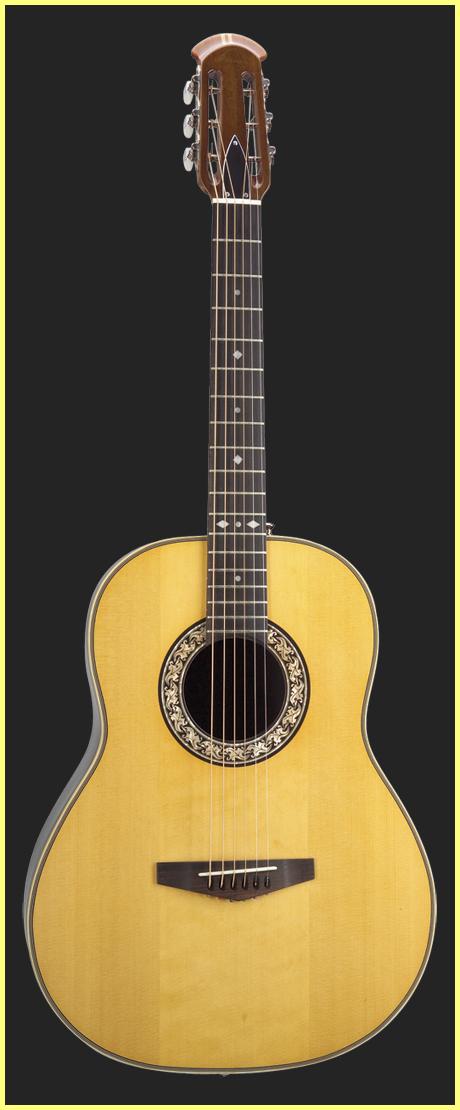
In 1976 Kaman took this a step further with the creation of the Adamas guitar.


The Adamas had the same round Lyrachord bowl back. What was quite unique to the Adamas was the instruments top. It utilized long strand carbon-graphite fiber. This material allowed the top to be much thinner than spruce, but as the company claims "with the same vibrating qualities of spruce. Due to the decreased mass, the vibration was intensified therefore able to vibrate louder and longer. "

The Adamas website also states; "The top is actually a composite structure, with two .005" carbon-graphite outer layers and a .035" birch veneer sandwiched in the center, bonded together at 250° F. While the fibers of the carbon run in a longitudinal direction parallel with the neck of the guitar, the birch veneer grain is set to a 60° angle to the carbon."

There is an extremely light finish applied as to not inhibit vibration.


Due to the strength of the guitars top, there is no need for X bracing that is found in most steel string guitars. Adamas employs a modified assymmetrical fan bracing system, much like what is found on classical or flamenco guitars.

To prevent torque issues associated with the pressure of string pull, the soundhole was relocated from its usual center of the instrument to the upper and lower bouts in the form of 22 individual soundholes (15 soundholes on cutaway models.)


Traditional guitars use a series of wooden blocks to bind the top and back of the instrument to the sides. This is called kerfling. Because of the construction method of Adamas, kerfling was eliminated and replaced with a flexible ring on the inner top and bowl of the instrument. Of course due to the parabolic design of the bowl back, which acts as a orchestra shell, there is no need for kerfling since the bowl is molded.


RainSong is an acoustic guitar manufacturer currently based in Woodinville, Washington, and originally started in Kihei, Maui, Hawaii. The company makes high-end carbon fiber (graphite) bodied acoustics and acoustic electrics, with past models including nylon string guitars, 12-string guitars, and a jazz archtop.

The RainSong Guitar Company was formed in the 1990s by Dr. John Decker. Decker was living in Hawaii and concerned about string instruments warping due to the humid climate. He came up with a guitar that was made of all graphite composite.

The early models designed in cooperation with luthier Lorenzo Pimentel.

By contructing the entire instruments top out of a consistantly uniform molded graphite, there is no need for bracing. This eliminates weight and deadened spots. The tone can be quite loud but balanced.


WS1000
The advantage of RainSong guitars are the impervious to changes in temperature and humidity since the neck is immune to warpage and the top and back will not crack of change character. Additionally the guitar is extremely light.

The neck is unique in that it is cast from a single graphite matrix instead of cut from a piece of wood. Due to this process, RainSong guitar necks have a consistant shape. The action can be set low without buzzing. The casting process also provides for consistant positioning of fretslots.

Though the necks have trussrods, they are used for customization of neck relief since the necks will not twist, bow or warp.

RainSong guitars come in only one color, black. The company states this is because they do not want to cover up the graphite. There are several layers of UV protected clear finish applied, buffed and sanded to a thin layer.

There are some other guitars that were made of carbon graphite or partially manufactured of this material, such as the original Steinberger bass and guitar made by designer Ned Steinberger that was made of graphite reinforced epoxy. Modulus basses have a graphite composite neck for added strength.

A company called Moses produces graphite retrofit necks for most style guitars including Steinberg.

Chrysalis Guitars manufacturers an inflatible travel guitar that is designed to be taken apart and placed in a small brief case.


Wednesday, December 9, 2009

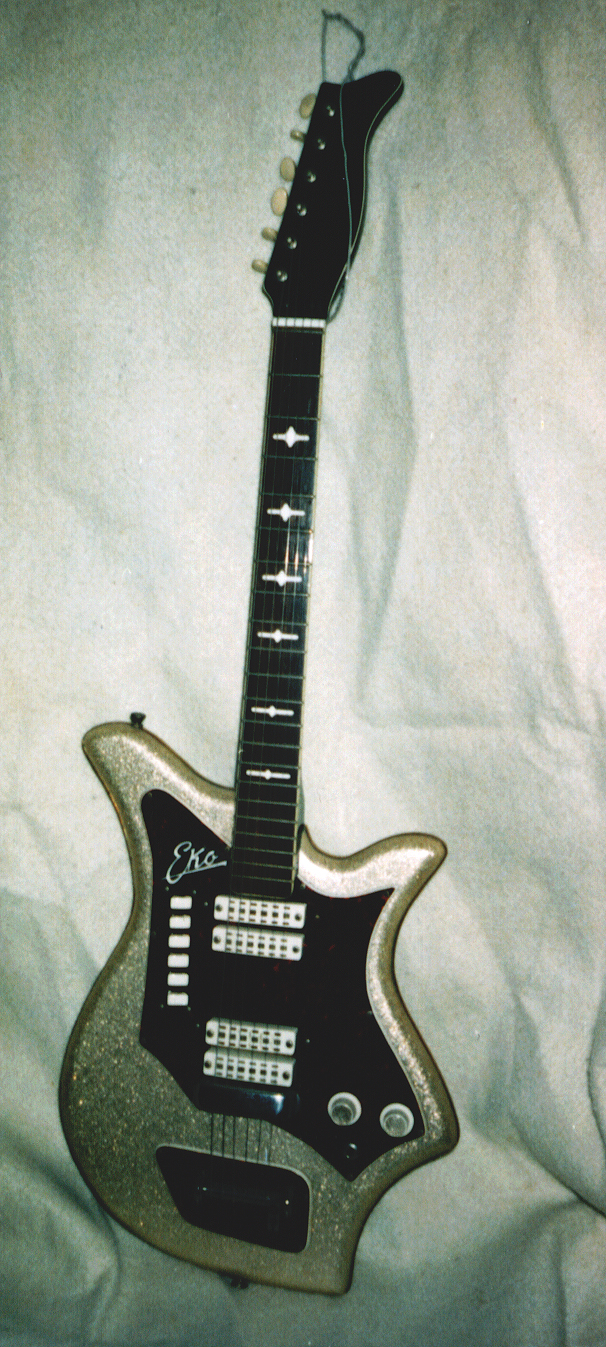
Eko Guitars

The Eko Company was founded in Italy by Oliviero Pigini in 1959 and was the largest musical instrument company in Europe during the years of 1964 through the 1970’s. Eko was also a significant exporter of guitars basses, organs and accordions to the United States thanks to the company’s ties with the Lo Duca Brothers of Wisconsin and the Vox Corporation.


The Lo Duca Brothers, Tom and Guy started their business in the early 1940’s selling accordions, providing accordion lessons, accordion repair, and sheet music and instruction books. They began importing Italian made accordions during this same period.


If you are old enough to remember there was a period that occurred in the late 1940’s through the 1950’s where the accordion gained some popularity and salesmen went door to door signing up children for lessons and encouraging the purchase of a child-sized beginner instrument.

The accordion was especially popular in mid-western and north-western cities with ethnic populations such as Swedes, Norwegian, German, Dutch, Slovakian, Polish and others that enjoyed Polka music. Many Italian instruments had faux pearl and sparkly celluloid finishes. The also were equipped with rocker switches that controlled the different reeds to provide diverse sounds.

The British Invasion hit around the United States in 1964 and everyone wanted to learn to play guitar. Most of the domestically manufactured instruments were expensive, so to fill the glut some manufacturers and entrepreneurs turned to importing Asian and European manufactured instruments.

The Lo Duca Brothers began importing guitars from Eko.


In 1959 Oliviero Pigini was already in the accordion manufacturing business.

Swedish accordion manufacturer/competitor Hagström was reconverting its factory to build guitars. Mr. Pigini decides this is the way to go. Neither he nor his workers had any experience in guitar building, so Pigini sets out to gather information on the process. He speaks with Italian builders, the Paladino Brothers for advice and sets up a sales contract with them. He also contacts German guitar builder Wenzel Rossmeissl who is building excellent electric jazz style guitars and selling them under the brand name Roger, which is his son’s name.

The company starts by building flat top and arch top acoustic instruments.
Models 100 and 200 are in direct competition to the Framus Sorella and countless other German arch tops.

The Eko 300 is offered as an alternative to the Höfner Club or Framus Hollywood, Europe’s best selling electrics of the late 50’s. Wenzel Rossmeissl, who is by then reducing his own production and increasingly concentrates on Eko ’s distribution in Germany, was certainly influential in that choice.


The solid bodied 400 (often called ‘Ekomaster’) is a master stroke. As far as electrical construction and finishing techniques are concerned it takes an obvious inspiration from the already established Hagström Deluxe and Standard series, but instead of aping a LesPaulish Höfner Club the shape leans towards Fender’s top-of-the-line, the recently introduced Jazzmaster.


The whole production is build with glued-in necks. Pickups (optional on the 100 and 200 series) have a sparkle or perloid plastic topping, soon to be substituted with visible polepieces.


There is still some trial-and-error in the designs but the guidelines are clearly defined: Eko’s philosophy is to offer a complete range of guitars, made with standardized solutions and industrial procedures that warrant consistent quality. The company targets the most buoyant market segment, i.e. affordable instruments that can also be used at a semi-pro level if the dreams of thousands of beginners come true. Eko sells the tools for the dream

During the early guitar days, Piginis are based on German designed guitars. The first solid body guitar to come out of his factory was known as the Ekomaster.

The electrical design was much like that of a Hagström, but the shape was reminiscent of a Fender Jazzmaster. The accordion influence is very prevalent in the design as some of the new models have a sparkle or perloid plastic topping. The pickups on the earlier instrument feature this encasement as well. Later instruments were designed with visible polepieces. The guitars featured set in necks.

Eko Acoustics
The acoustic instruments and guitars with visible wood utilize thick laminated wood with heavy glossy finishes. The plastic coated instruments are covered with a virtually indestructible material that is resistant to cracking if the guitar is dropped. The switches on many of the instruments were either rocker or pushbutton style.


They created a bass guitar that was similar in appearance to the famous Höfner 5001 violin style bass. The price was far less than the Höfner and during those days the Eko bass was a somewhat popular alternative.

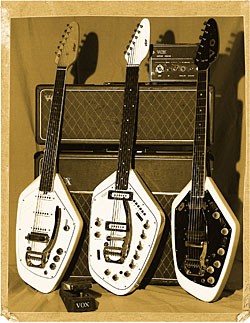
In the mid 1960’s, due to the influence of the Beatles use of Vox amplifiers, their manufacturer Rose Morris set out to create guitars. These were first produced in the U.K. however as demand grew, this time due to the Rolling Stones use of Vox instruments,


Rose Morris contracted with Eko to produce instruments under the Vox logo. The Vox instruments featured unusual shapes, but most had more conventional potentiometer knobs and toggle switches. They all featured single coil pickups that were similar to Fender pickups.


Although we are dedicated to guitars, it needs to be mentioned that Eko produced its own line of combo organs during this same period.


Rose Morris also contracted them to produce the famous Vox Continental organ. This was the most popular organ for 1960’s bands and featured a bright red or orange top, reversed key colors and an unusual stand.


Eko also created its own line of guitar and bass amplifiers.
©UniqueGuitar Publications (text only)



Sunday, December 6, 2009

The Framus Star Bass


The Allied Forces took control of the Sudetenland in WWII. This had and adverse effect on the town of Schoenbach, which was bordering north northern and western Czech/Hungary Bohemia.

The town was enclave of German speaking violin and musical instrument makers. Musical instrument building had always been a thriving business in this city. In 1945 Fred Wilfer learned of the Allied plans to take over the region. He saw this as a good thing.

With the arrival of Western musicians Wilfer hit on the idea of manufacturing Western musical instruments.

He contacted government authorities in Bavaria and they obliged his plans for creating conditions necessary to construct a facility for this purpose. Wilfer was classified by the Czechoslovakian authorities as an anti-fascist. Thus the US military government in 1946 gave him permission to open his manufacturing plant.

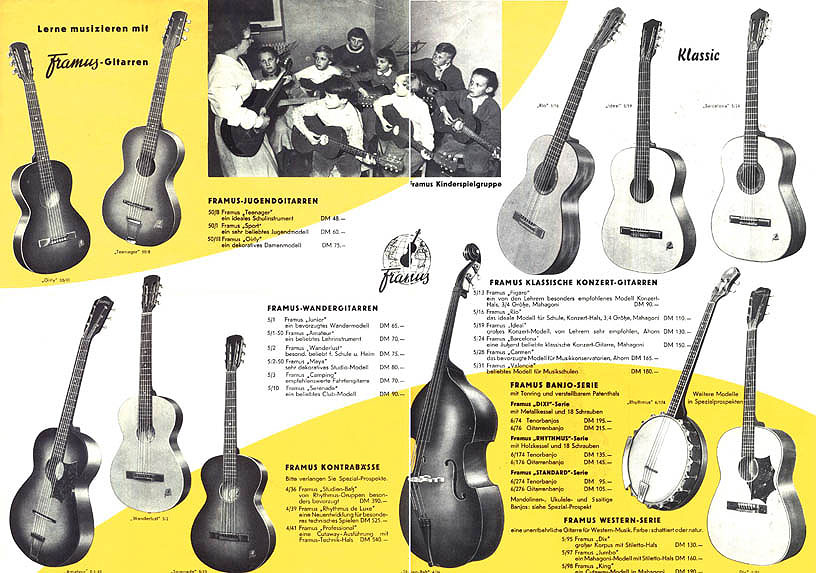
It was called the Franconian Musical Instruments Manufacturer Fred Wilfer. In German the acronym is FRAMUS. Wilfer hired craftsmen who had been displaced from Schoenbach.

Violins were less popular and being replaced by the guitar. The violin makers turned their task to building guitars, which had become popular due to the American occupation of Germany.


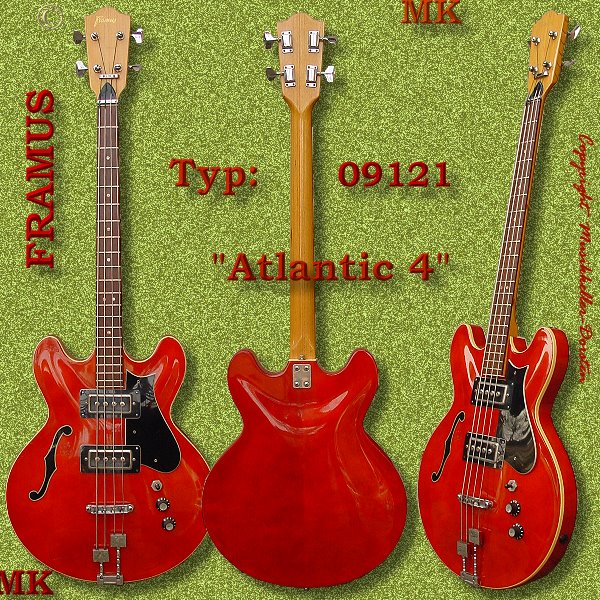
The company’s catalogue included a wide array of instruments, however the most unique was their line of bass guitars was the Framus Star Bass.

Fender had set the standard for bass guitars with the Precision Bass. The neck was wider than a guitar neck to accommodate the thicker bass strings. It was 1-5/8” at the nut and 2-1/2” at the 20th fret.

The Star Bass is one of the Framus bass guitars that Bill Wyman of The Rolling Stones played in the early to mid 1960’s. The neck was reported to be a mere 1.25” at the nut and 1.75” at the 12th fret. The neck length of a Fender Precision bass is 34”. The Framus is short in scale and is only 30.5”. The weight of the Framus Star bass was about 5 lbs which could be attributable to its hollow body.
 
Most professional bass guitars that were manufactured in the United States had large tuners with large keys. The tuning keys on the Star Bass and other Framus bass guitars were similar to those used on standard electric guitars. The neck had 20 frets which was one shy of the Precision bass which had 21. The body on the Star Bass had a single Florentine cutaway on the lower bout. The top and back were mahogany and the sides were maple. It was bound with a white plastic strip.

The ultra-thin neck was rosewood with mother of pearl markers. The body was 2” deep and approximately 9” at the upper bout and 12.875” at the center of the lower bout.


The bass was favored by Bill Wyman of the Rolling Stones. He held it almost vertically as he played the bass. Because of his popularity it was also called The Stone bass.


Framus made other bass guitars too. Its line included the Akkerman Bass which resembled the Star bass. The Atlantik, the BL, the Caravelle and Sorento were solid body models.


The Star was updated to several models including the Hollywood Star Bass, the De Luxe Star Bass and the Golden De Luxe Star Bass. Later on the company produced the BL-12 and the Nashville Standard and Standard De Luxe.

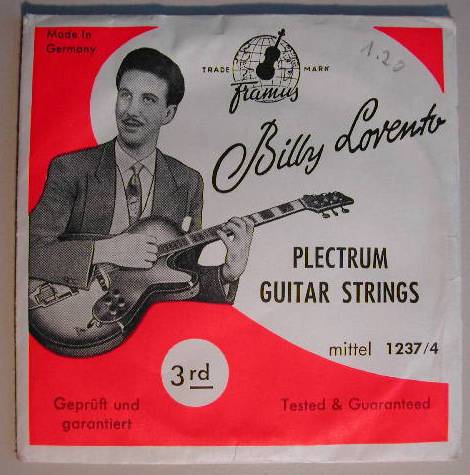
Some of the players that favored Framus instruments included a very young Bill Lawrence (guitar pickup manufacturer), who used the stage name Billy Lorento back in 1953.


Peter Kraus model
Peter Kraus was a Framus endorser and played a 4 string guitar during the Folk era.

Dutch guitarist Jan Akkerman also endorsed Framus. Charlie Mingus and Jim Hall were also players of Framus guitars at one time.

1970 Framus Sorrento


In the early 1970’s the Framus bass guitars took on a more traditional American flare. This is also the era which closed Framus. Due to the market being flooded with less expensive Asian guitars, Framus declared bankruptcy in 1975 and closed its doors.


Wyman's Framus


1982 the Framus legacy continued under the direction of Fred Wilfer’s son, Hans Peter Wilfer. He called the company Warwick and they manufactured a line of marvelous professional bass guitars. In 1995 Wilfer the younger revived the Framus name with its present series of high end electric guitars and amplifiers.


2012 Framus Star Bass
The Star Bass is currently produced by the new Framus Corporation. However it is a more conventional hollowbody bass guitar and the neck is more of a traditional size. 

The 1960's Star Bass was an easy-to-play instrument that had the feel of an electric guitar and certainly had the thinnest bass neck I’ve ever encountered.

Saturday, December 5, 2009

More On Sebastian

In doing a follow up search last night, I stumbled across Mr. Apollonio selling a similar instrument to the one he made for Noel Paul Stookey in 1968.


I copied the advertisement and a picture of his guitar.

Bell Citern
Mr. Apollonio states the shape is slightly different than the original Sebastian and he goes into great detail in his description. The following are his words.

"This odd looking guitar was custom made for Noel Paul Stookey in 1968 after a chance meeting in Camden, Maine. It was only my 15th guitar and at the time was rather crude and basic, due to my inexperience. It did not hold up to string stresses, although it had a very stellar career with one of the most popular performers in America at the time."

Its delicate and haunting sound, though not as deep and powerful as a full size regular shape guitar, inspired Paul to write The Wedding Song on it, for his lifetime friend Peter Yarrow. Over the decades the song has been the crowning music of nuptials for countless thousands of people who still write about it.

After 41 years and many hundreds of instruments, I decided it was time to rebuild and update; to make it even better than new, with all the features that keep my 12's user friendly and more playable than most any other.

The neck has a short scale for extremely easy playing, with a user friendly exterior adjustment for optimum action in any climate and a bridge calibrated for exact intonation of each string. The tailpiece removes forward tension on the bridge allowing for lighter (though stronger) bracing, to boost sound.

Glen Heggie with "Moby"
Materials are: AAA western red cedar top with a compass point inlay around the sound hole. Native walnut body (original) and a new neck of dark walnut aged 60+ years. An ebony fretboard and bridge with pearl position dots and brass side markers.

The headstock has a pale abolone "A" for Apollo logo inlaid at the top. The tuning is set up for 2 frets low with medium strings or concert pitch with light guage.

The body length is 19"; width is 13 3/4; depth is 4". The instruments scale is 24 7/8th."

The neck is heelless. This 12 string comes with a padded gig bag.

Below is Barbara Schultz playing a Apollonios 10 string citern.